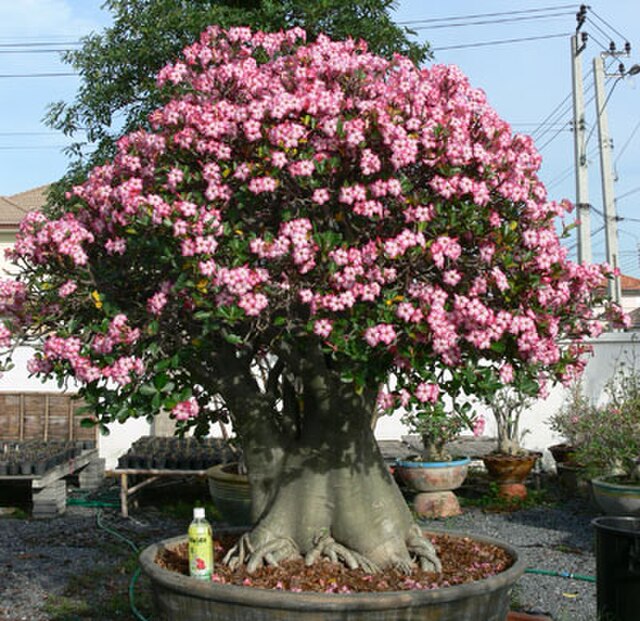
Source: Wikimedia Commons
Adenium Arabicum
IntermediateAdenium arabicum
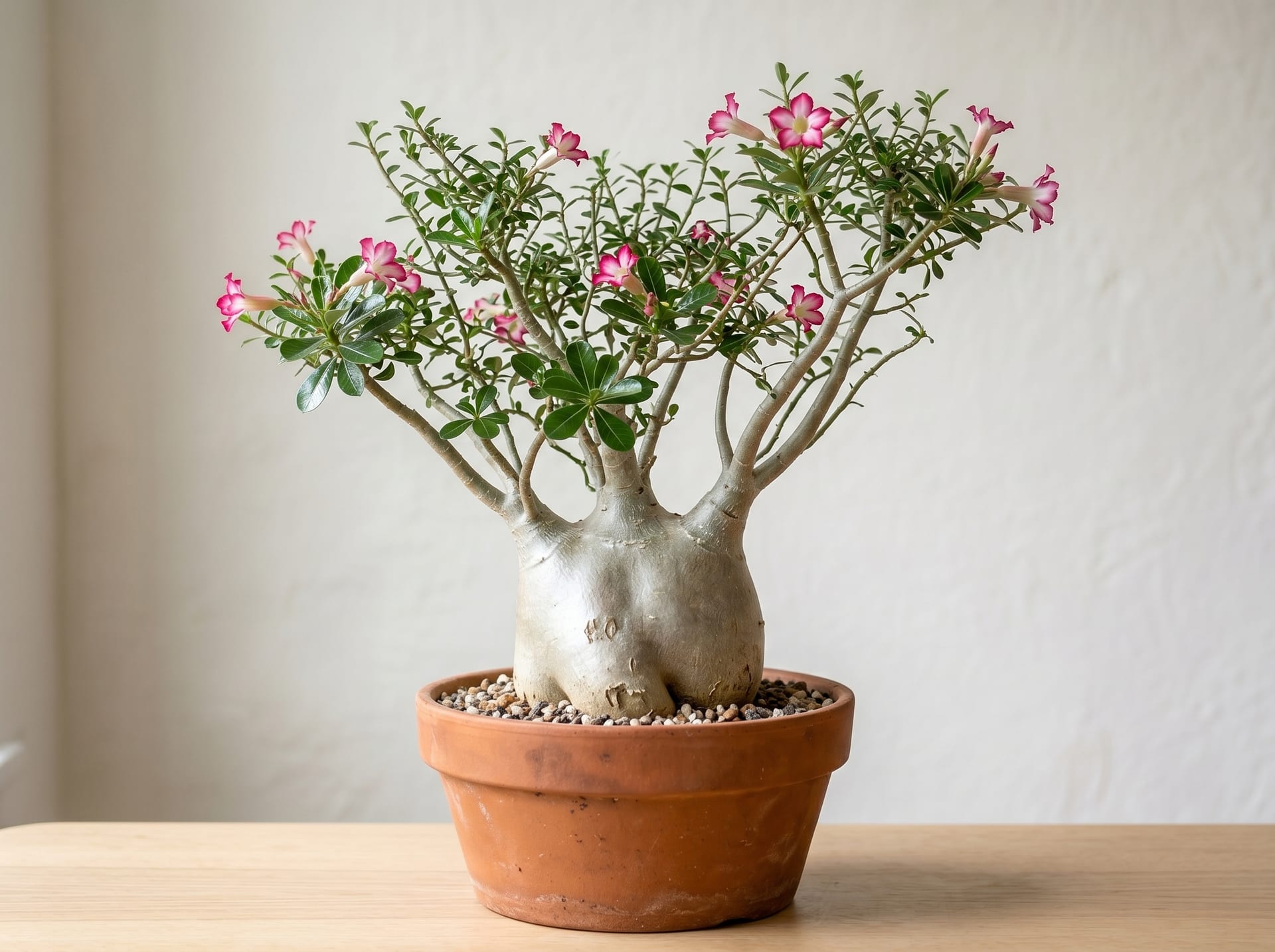
An Adenium with wide spreading caudex, more caudex-focused than obesum, popular with collectors.
About
Adenium arabicum is native to the arid regions of Yemen and Saudi Arabia, closely related to A. obesum but distinguished by its broader, more dramatically swollen caudex that spreads outward rather than growing tall. The trunk has a rough, grayish-brown texture and develops a highly sculptural form with age. Leaves are thick, glossy, and dark green, generally larger than those of A. obesum. Flowers are beautiful shades of pink to red. Growth tends to be slightly slower than A. obesum, but the caudex becomes more impressively massive over time. Full sun is essential—sunlight exposure directly influences caudex development. It is particularly prized for bonsai-style cultivation and the practice of exposing the roots above soil level for dramatic effect.
Source: Wikipedia (CC BY-SA 4.0)
Lifespan of the Adenium Arabicum
The Adenium Arabicum lives 10-30 years.
Size of the Adenium Arabicum
The Adenium Arabicum grows to 20-60cm.
Temperature & humidity for the Adenium Arabicum
Well-draining soil, generous watering during the growing season, and complete winter drought with temperatures above 10°C are required.
Basic Info
Origin
Yemen and Saudi Arabia
Lifespan
10-30 years
Size
20-60cm
Temperature
10〜35℃
Growing Tips
Light & Placement
It prefers full sun, and the caudex fills out in proportion to the light it receives. Give it a sunny outdoor spot.
Watering
From spring to autumn, water thoroughly once the soil dries. Withhold water in winter and let it live on moisture stored in the caudex.
Temperature & Overwintering
Overwinter indoors in a bright spot kept above 10°C. Dry soil plus warmth keeps the caudex sound through dormancy.
Soil & Repotting
Use a well-draining mix. For an exposed-root style, lift the caudex a little higher at each repotting.
Pruning & Shaping
It suits bonsai-style training. Cut back overlong branches in the growing season and shape it to show off the wide, spreading caudex.
Adenium Arabicum FAQ
QWhat is the growing difficulty level for Adenium Arabicum?
Intermediate. A variety suitable for intermediate growers. Requires some cultivation experience and knowledge of environment management. Pay careful attention to temperature and humidity control.
QWhat is the lifespan of Adenium Arabicum?
The average lifespan of Adenium Arabicum is 10-30 years. With proper cultivation environment and nutrient management, you can keep it healthy for a long time.
QHow large does Adenium Arabicum get?
The mature size of Adenium Arabicum is 20-60cm. This may vary slightly depending on cultivation environment and individual differences.
QWhat is the typical price for Adenium Arabicum?
The price of Adenium Arabicum varies significantly by variety, characteristics, size, and lineage. Please check GrowerDirect's price guide for the latest market information.
Last updated: July 5, 2026
References & Sources
Edited & verified by: GrowerDirect Editorial Team
The classifications, regulations, and growing data on this page are created and verified based on the primary information database below.
Taxonomy & Authority
Accepted name: Adenium arabicum (Forssk.) Roem. & Schult.
Synonyms: Adenium arabicum Balf.f., Adenium somalense var. caudatipetalum Chiov., Adenium obesum subsp. socotranum (Vierh.) Lavranos, Adenium micranthum Stapf, Adenium tricholepis Chiov., Adenium honghel Lindl., Adenium arboreum Ehrenb., Cameraria obesa (Forssk.) Spreng., Nerium obesum Forssk., Adenium speciosum Fenzl, Adenium coetaneum Stapf, Adenium somalense var. crispum Chiov., Adenium somalense Balf.f., Adenium socotranum Vierh., Adenium obesum subsp. somalense (Balf.f.) G.D.Rowley
Authority databases: GBIF · POWO
Nomenclature follows global taxonomic authority databases.
Regulations & Conservation Status
Not listed in either CITES Appendix I or II. Also not subject to Japan's designated invasive species or specified animals regulations (being a plant).
Sources: CITES Appendix I species list / CITES Appendix II species list / Ministry of the Environment List of Specified Invasive Alien Species
Regulations may change. Always verify the latest information with the relevant authorities.
Related Species
Find listings for this species
Related Articles
Monadenium Caudex Plant Care Guide | Water Management, Dormancy, and Cautions about Latex Sap
A comprehensive guide to growing Monadenium. Learn everything about caring for this East African caudex succulent: placement and light management, switching watering schedules between growth and dormancy periods, creating well-draining soil mixes, safety precautions with Euphorbiaceae latex sap, and propagation through cuttings and division.
Adenium Grafting Guide — Rootstock Selection to Successful Union
Grafting Adenium: rootstock and scion selection, timing, step-by-step technique, improving success rates, and troubleshooting.
How to Grow Adenium and Tips for Blooming
Learn the basics of Adenium (Desert Rose) care and tips for sunlight, fertilizer, and pruning to encourage blooms.
Adenium (Desert Rose) Overwintering Management | Winter Temperature, Water, and Dormancy Strategy
Adenium is a caudex plant native to the tropics, and winter management is the greatest challenge. This article provides detailed, practical overwintering strategies covering essential temperature management, securing light, and water adjustment, from autumn preparation through winter watering and spring recovery. It also covers troubleshooting for common problems such as leaf drop, root rot, and poor sprouting.
🩺 Common diseases
Can't find the plant you're looking for?
Post your wishes for free and growers with matching plants will contact you with introductions.