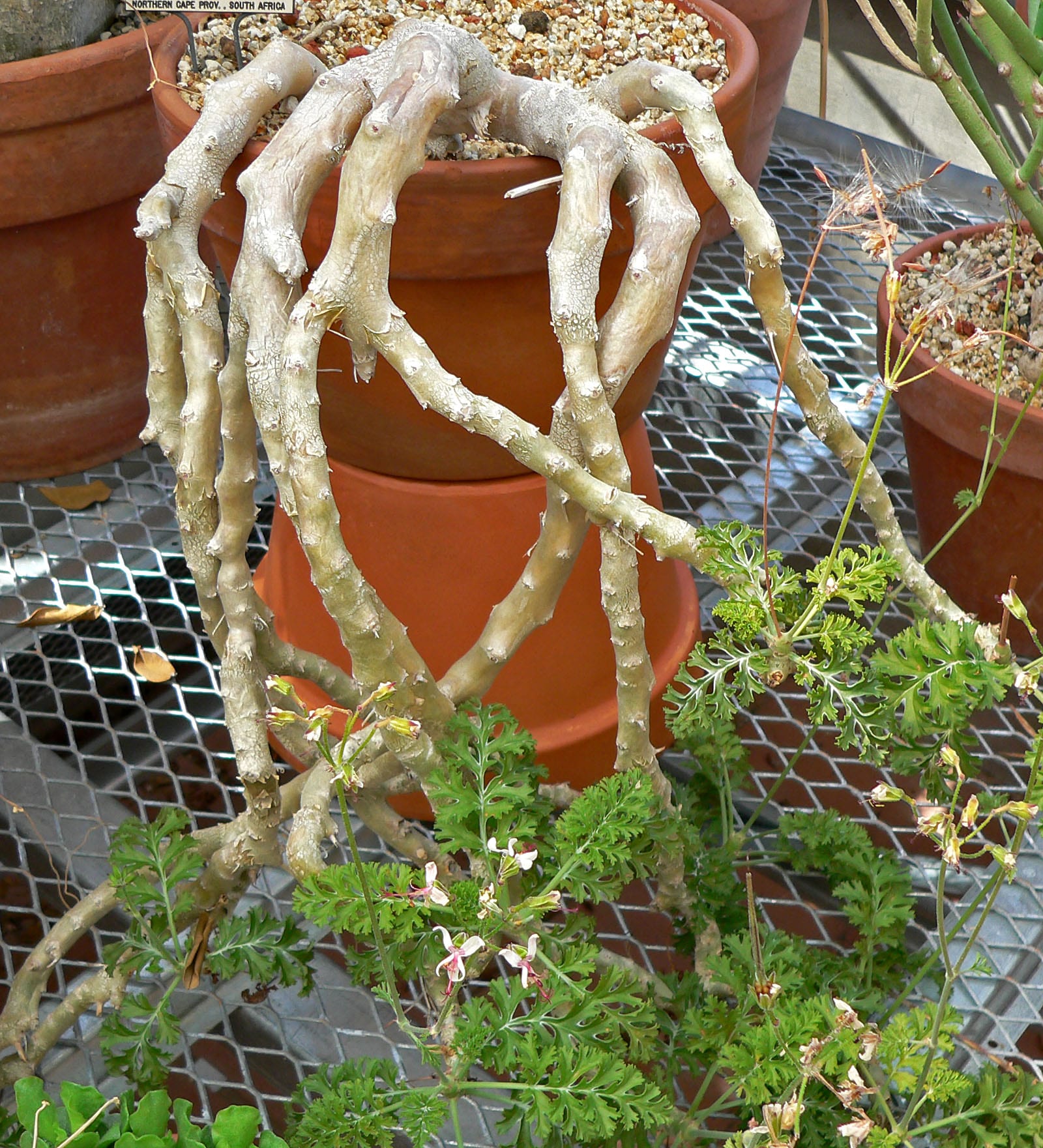
Source: Wikimedia Commons
Pelargonium carnosum
AdvancedPelargonium carnosum
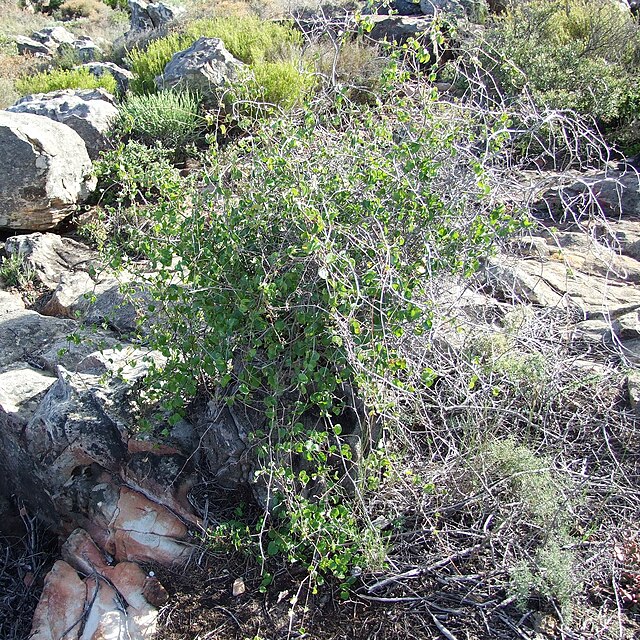
Known in Japan as Kareno-aoi. A winter-growing southern African Pelargonium with thick, knobbly grey-green succulent stems and soft, finely pinnately divided leaves. It drops its leaves and rests in summer.
About
Pelargonium carnosum is a succulent shrub of the Geraniaceae, known in Japan as Kareno-aoi. It occurs in Namibia and in the Northern, Western and Eastern Cape provinces of South Africa, and is assessed as Least Concern on the South African Red List. A thick underground hypocotyl (tuber) gives rise to knobbly, grey-green succulent stems about 4-5 cm thick that branch; plants are usually about 60 cm tall and can reach 1.2 m. Leaves are finely pinnately divided along a long midrib, soft, downy and somewhat fleshy, and the midrib often persists after the leaf falls. Long-stalked inflorescences carry many small flowers with white, greenish-yellow or pinkish petals, the upper two marked with purple. It is a very variable species that may include more than one species. It grows with winter rain and is dormant in summer; in cultivation, too much water and fertiliser make it lose its naturally compact shape. In Japan seedlings and individual plants are handled by specialist caudex and bonsai nurseries.
Size of the Pelargonium carnosum
The Pelargonium carnosum grows to About 60 cm tall (up to 1.2 m).
Basic Info
Origin
Namibia and South Africa (Northern, Western and Eastern Cape)
Lifespan
Long-lived perennial (little published data)
Size
About 60 cm tall (up to 1.2 m)
Temperature
10〜35℃
Watering & Fertilizer
Once per growing season, a diluted low-nitrogen succulent fertiliser
Growing Tips
Dormancy Care
A winter grower that drops its leaves and rests in summer. Water in spring (February to April) and autumn (August to November), and keep it dry in midsummer and midwinter.
Light & Placement
In the wild it grows among rocks and in the shade of other plants, so in summer give it light shade or morning sun in a cool, well-ventilated spot.
Watering
Water only when temperatures are at least 14°C. Overwatering spoils its shape and the lush growth becomes prone to fungal disease.
Temperature & Overwintering
Protect from frost and keep it dry at a minimum of 8°C.
Soil & Repotting
Use a mix with almost no organic matter. It dislikes frequent repotting and can stay in the same pot for years.
Fertilizer
Feed only once in the growing season with a low-nitrogen succulent fertiliser at reduced strength.
Pelargonium carnosum FAQ
QWhat is the growing difficulty level for Pelargonium carnosum?
Advanced. A variety suitable for advanced growers. Requires advanced cultivation techniques and specialized equipment, with careful environmental adjustments needed.
QHow large does Pelargonium carnosum get?
The mature size of Pelargonium carnosum is About 60 cm tall (up to 1.2 m). This may vary slightly depending on cultivation environment and individual differences.
QHow should I water and fertilize Pelargonium carnosum?
Pelargonium carnosum: watering & fertilizer — Once per growing season, a diluted low-nitrogen succulent fertiliser. Aim for appropriate frequency and amount.
QWhat is the typical price for Pelargonium carnosum?
The price of Pelargonium carnosum varies significantly by variety, characteristics, size, and lineage. Please check GrowerDirect's price guide for the latest market information.
Last updated: September 23, 2026
References & Sources
Edited & verified by: GrowerDirect Editorial Team
The classifications, regulations, and growing data on this page are created and verified based on the primary information database below.
Taxonomy & Authority
Regulations & Conservation Status
Not listed in CITES (checked on Species+). No special procedure is needed for transfers within Japan.
Sources: Species+ (CITES): Pelargonium carnosum
Regulations may change. Always verify the latest information with the relevant authorities.
Related Species
Find listings for this species
Related Articles
Pelargonium (Caudex) Care Guide | Inverted Growing Cycle, Summer Drought Management & Propagation Methods
Comprehensive guide to cultivating caudex Pelargonium. Covers adapting to the inverted growth cycle of summer dormancy and fall-winter-spring growth, displaying techniques to enhance the ornamental value of the swollen caudex, drought management in summer, fertilization schedules, and practical propagation methods via seed and cuttings.
How to Grow Uncarina | Differences Between the Madagascar Endemic Species Grandidieri and Roeoesliana
An explanation of the appeal and cultivation methods of the Madagascar endemic caudex plant Uncarina genus. We introduce the differences between Uncarina grandidieri and roeoesliana, seedling cultivation, and repotting timing.
Complete Guide to Choosing Caudex Plants as Gifts | Recommended Varieties by Occasion and How to Include Care Notes
A guide to choosing caudex plants as gifts organized by occasion. We introduce how to select varieties based on the recipient's cultivation experience and how to include care notes for long-term enjoyment.
Diagnosing and Treating Poor Root Development in Caudex Plants | Causes and Solutions for Roots That Won't Emerge or Won't Grow
A detailed guide to root emergence problems in caudex plants. From diagnosis methods to solutions, practical techniques for promoting healthy root development are introduced.
🩺 Common diseases
Can't find the plant you're looking for?
Post your wishes for free and growers with matching plants will contact you with introductions.