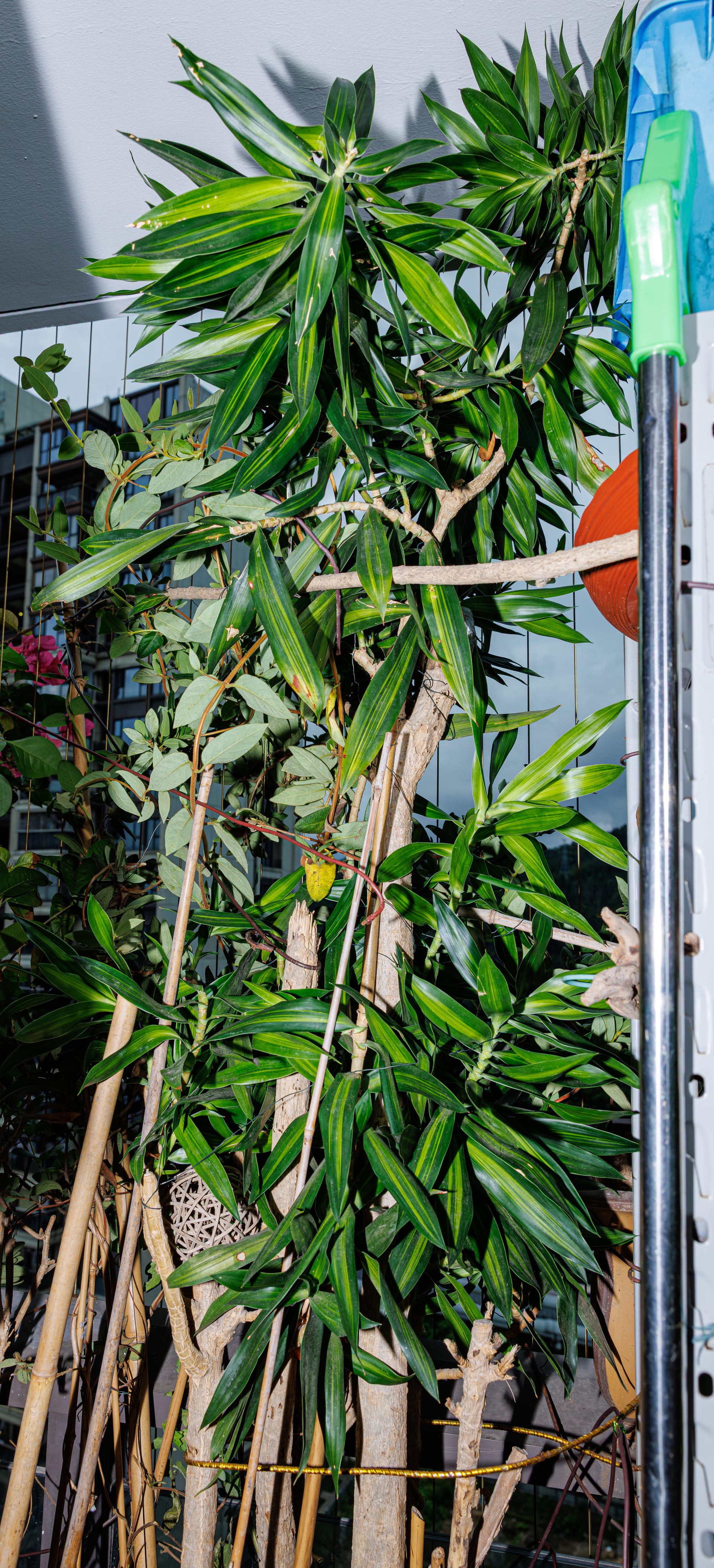
Source: Wikimedia Commons
Song of India
BeginnerDracaena reflexa 'Song of India'
A variegated form of Dracaena reflexa with narrow leaves edged in yellow to lime green, crowded in spirals at the stem tips. The stems grow in irregular curves. The variegation fades in low light.
About
'Song of India' is a variegated cultivar of Dracaena reflexa, a species from the western Indian Ocean region, including Madagascar, Mauritius and northeastern Mozambique. The species is an evergreen shrub or small tree reaching 4-5 m in the wild, with lance-shaped leaves 5-20 cm long crowded in spirals at the tips of the stems. Wild plants have uniformly dark green leaves, whereas this cultivar has yellow to lime-green margins and is grown as a houseplant around the world. 'Song of India' is also used as a common name for the species, and other cultivars such as 'Song of Jamaica' exist, so check the colour and pattern of the variegation. Potted plants usually stay around 1-2 m, shedding lower leaves to reveal twisting stems. Japan's variety register once listed two similarly named 'Song of ...' cultivars (Nos. 10185 and 17383), but they are different cultivars and their protection has expired. It is a different species from D. fragrans and is widely available in Japanese garden centres and online.
Source: Wikipedia (CC BY-SA 4.0)
Size of the Song of India
The Song of India grows to About 0.9-1.8 m in pots; the species reaches 4-5 m in the wild.
Basic Info
Origin
Western Indian Ocean islands (Madagascar, Mauritius, etc.) and Mozambique (species)
Lifespan
Evergreen shrub (long-lived)
Size
About 0.9-1.8 m in pots; the species reaches 4-5 m in the wild
Temperature
15〜30℃
Humidity
50〜70%
Watering & Fertilizer
Slow-release or liquid fertiliser in the growing season
Growing Tips
Light & Placement
Bright indirect light; avoid direct sun except early morning. In too much shade the stems grow spindly and the variegation fades.
Watering
Keep the mix evenly moist but not wet. Leaf tips and margins brown if it is either too wet or too dry.
Temperature & Overwintering
Sensitive to cold and drafts and prefers a steady temperature year-round; try not to let the room drop below 18°C.
Soil & Repotting
Plant in a free-draining, peaty mix. Stake taller plants as they grow.
Propagation
Propagate by stem cuttings.
Pests & Cautions
It likes humidity, so raise it in dry seasons. Dracaenas contain saponins; if eaten by dogs or cats they can cause vomiting, drooling and loss of appetite. Keep out of reach of pets. It is not a registered variety under Japan's Plant Variety Protection Act.
Song of India FAQ
QWhat is the growing difficulty level for Song of India?
Beginner. A variety suitable for beginners. No special equipment or experience is required—you can grow it without problems by setting up a basic cultivation environment.
QHow large does Song of India get?
The mature size of Song of India is About 0.9-1.8 m in pots; the species reaches 4-5 m in the wild. This may vary slightly depending on cultivation environment and individual differences.
QHow should I water and fertilize Song of India?
Song of India: watering & fertilizer — Slow-release or liquid fertiliser in the growing season. Aim for appropriate frequency and amount.
QWhat is the typical price for Song of India?
The price of Song of India varies significantly by variety, characteristics, size, and lineage. Please check GrowerDirect's price guide for the latest market information.
Last updated: September 23, 2026
References & Sources
Edited & verified by: GrowerDirect Editorial Team
The classifications, regulations, and growing data on this page are created and verified based on the primary information database below.
Taxonomy & Authority
Regulations & Conservation Status
Not listed in the CITES Appendices. Not a designated invasive alien species in Japan, nor a nationally rare species under the Act on Conservation of Endangered Species.There is no application or registration for 'Song of India' in Japan's plant variety database. Two similarly named 'Song of ...' cultivars (Nos. 10185 and 17383) are different varieties whose protection has expired.
Sources: Species+ (CITES listing check) / Ministry of the Environment: List of Invasive Alien Species / MAFF Plant Variety Registration Database
Regulations may change. Always verify the latest information with the relevant authorities.
Related Species
Find listings for this species
Related Articles
Complete Dracaena Care Guide | Variety-Specific Management from Massangeana to Marginata
Comprehensive guide to caring for popular Dracaena varieties including Massangeana (the lucky tree), Marginata, and Warneckii. Covers variety-specific cultivation methods, watering, lighting, pruning, and upright training techniques, as well as causes and solutions for leaf tip browning issues.
Why New Leaves on Foliage Plants Are Smaller — Practical Solutions for Light, Humidity, and Nutrition
We analyze the causes behind stunted growth and smaller new leaves on foliage plants. From light environment and humidity management to fertilization strategy and root health, we explain each factor based on empirical data and introduce methods to restore new leaf size.
Spider Mite and Scale Insect Control: Practical Pest Prevention
Learn to identify spider mites and scale insects on houseplants and recognize damage signs, master practical spider mite control methods, discover effective scale insect elimination techniques, create pest-resistant environments with seasonal management, understand pesticide safety precautions, and discover early detection and prevention strategies.
Root Rot Prevention and Root Zone Regeneration Management in Foliage Plants | Soil Selection, Watering, and Early Diagnosis & Recovery Techniques
Root rot is the greatest threat to foliage plants. This article covers practical knowledge from the mechanisms of root rot development to prevention, early-stage diagnosis and treatment methods, and ensuring long-term plant health through soil and watering management.
🩺 Common diseases
Can't find the plant you're looking for?
Post your wishes for free and growers with matching plants will contact you with introductions.