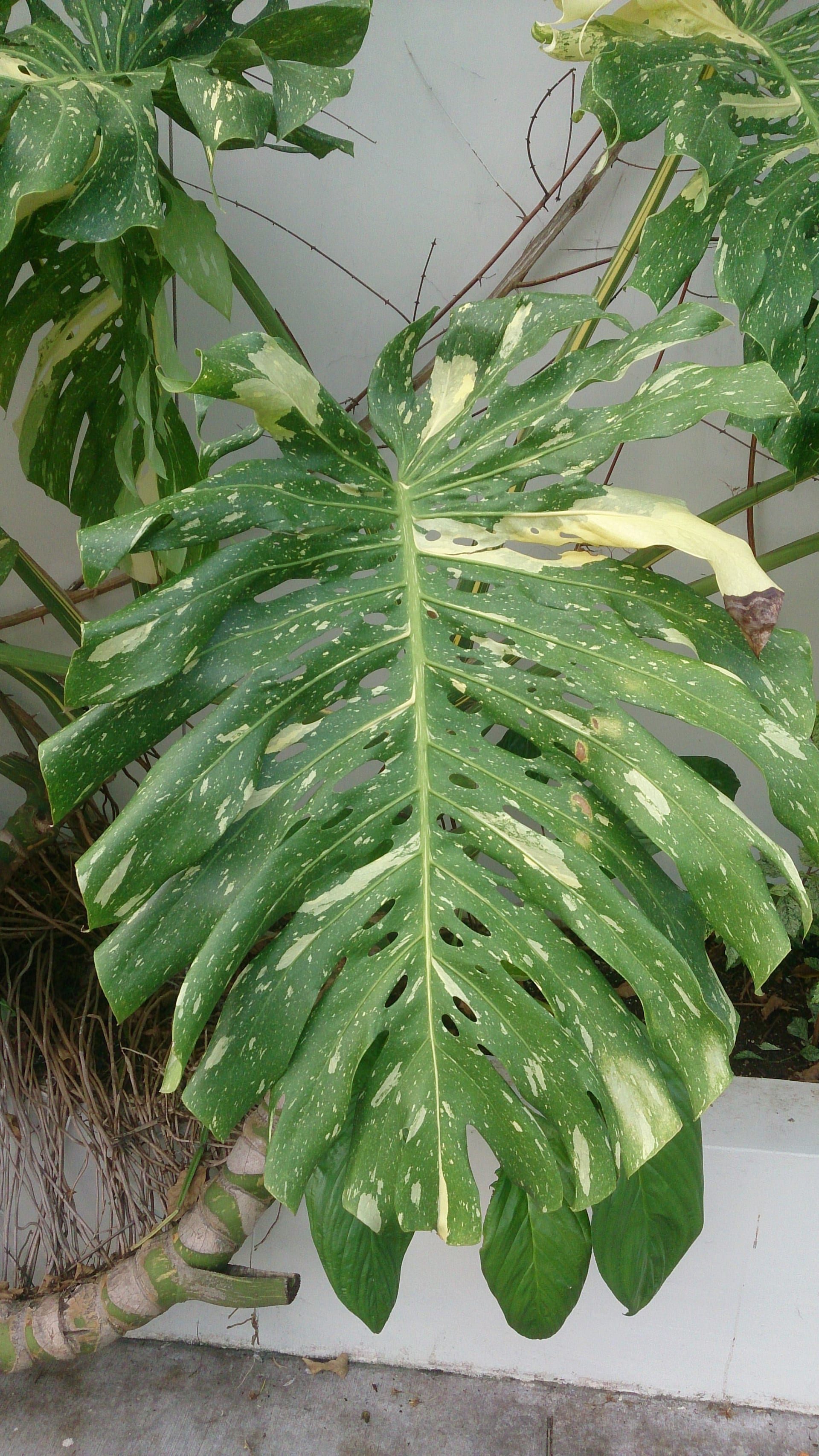
Source: Wikimedia Commons
Monstera Albo Variegata
IntermediateMonstera deliciosa 'Albo Variegata'
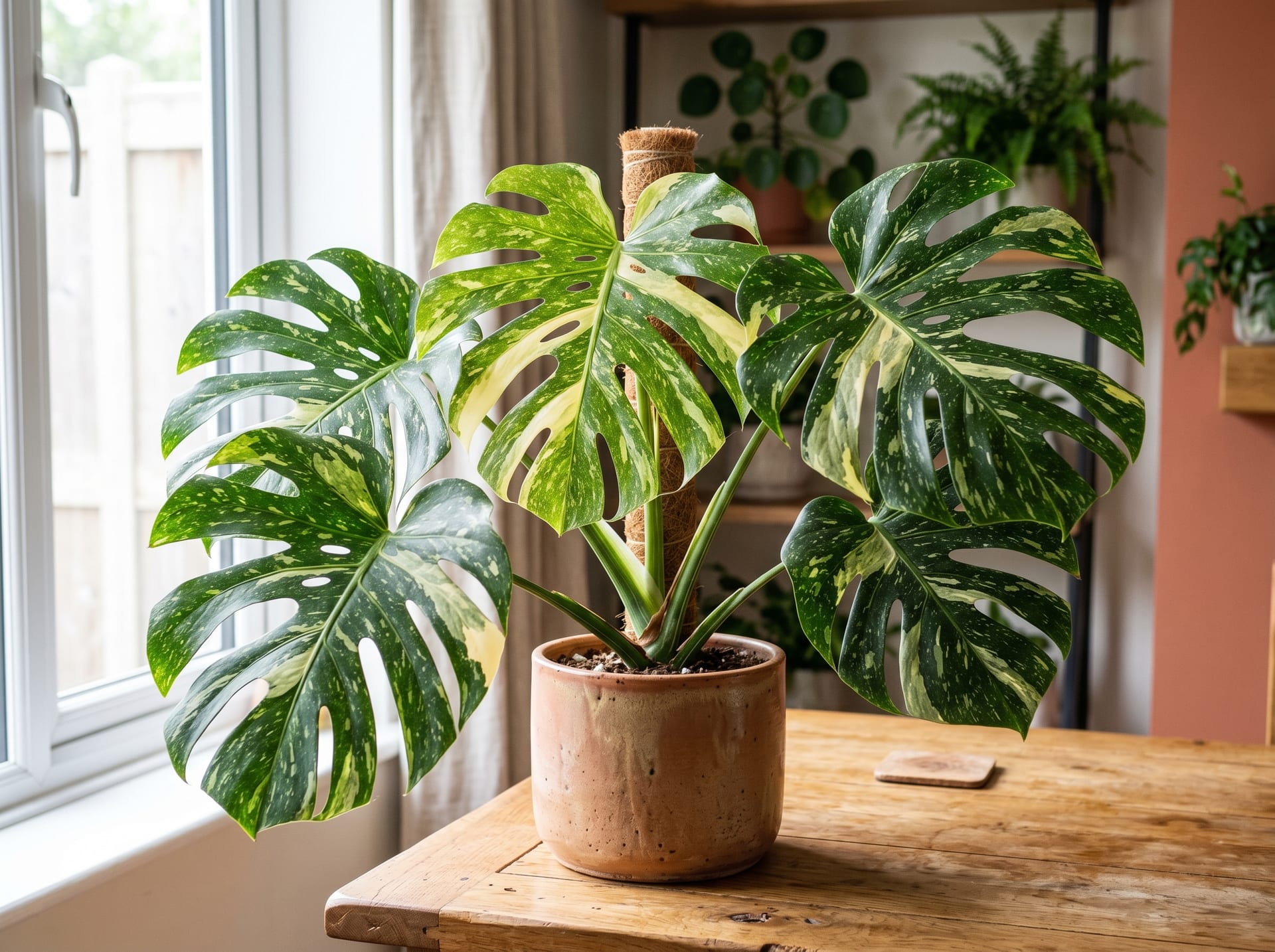
A variegated form of Monstera deliciosa whose large, split and perforated leaves are irregularly marked with white. The amount and pattern of variegation changes from leaf to leaf.
About
Monstera deliciosa 'Albo Variegata' is a white-variegated form of Monstera deliciosa, a species of tropical forests from southern Mexico to Panama. The species is a hemiepiphytic aroid that climbs trees with aerial roots, reaching 20 m in the wild and 2-3 m indoors. Young leaves are entire and heart-shaped, but as the plant matures it produces large leaves 25-90 cm long with pinnate splits and holes. 'Albo' has white variegation whose amount and position vary from leaf to leaf and plant to plant; North Carolina State Extension describes it as rare. Another variegated form, 'Thai Constellation', has creamy speckles scattered like a constellation, a different colour and pattern from 'Albo'. The trade name 'borsigiana' comes from Monstera borsigiana, formerly treated as a separate variety or species and now a synonym of M. deliciosa. Variegated plants need brighter light than plain green ones. In Japan it is sold through specialist shops and online, and even as a hometown-tax gift. Basic care is the same as for the parent species, M. deliciosa.
Source: Wikipedia (CC BY-SA 4.0)
Size of the Monstera Albo Variegata
The Monstera Albo Variegata grows to 2-3 m indoors; leaves 25-90 cm long.
Temperature & humidity for the Monstera Albo Variegata
The ideal temperature for the Monstera Albo Variegata is 16〜29℃.
Basic Info
Origin
Cultivar (species native from southern Mexico to Panama)
Lifespan
Perennial climber (long-lived)
Size
2-3 m indoors; leaves 25-90 cm long
Temperature
16〜29℃
Humidity
50〜70%
Watering & Fertilizer
Slow-release or liquid fertiliser in the growing season
Growing Tips
Light & Placement
Bright light without direct sun. Variegated plants need more light than green ones and are not suited to dim rooms.
Watering
Water thoroughly, then let the top quarter to third of the mix dry before watering again.
Temperature & Overwintering
Prefers about 16-29°C and high humidity. Keep it warm indoors in winter and raise humidity with a humidifier or a pebble tray.
Soil & Repotting
Plant in a free-draining organic mix and support the stems with a sturdy pole. Repot or prune in spring.
Propagation
Propagate by stem cuttings or layering. Variegation depends on the section used, so new plants may not match the parent.
Pests & Cautions
As an aroid it contains insoluble calcium oxalate; chewing causes intense mouth and lip pain, swelling, drooling, vomiting and difficulty swallowing, and the sap can irritate skin. Keep it away from pets and small children and wear gloves when handling. Wipe dust off the leaves regularly. It is not a registered variety in Japan.
Monstera Albo Variegata FAQ
QWhat is the growing difficulty level for Monstera Albo Variegata?
Intermediate. A variety suitable for intermediate growers. Requires some cultivation experience and knowledge of environment management. Pay careful attention to temperature and humidity control.
QWhat is the ideal temperature for Monstera Albo Variegata?
The ideal temperature for Monstera Albo Variegata is 16〜29℃. Avoid sudden temperature changes and maintain a stable environment.
QHow large does Monstera Albo Variegata get?
The mature size of Monstera Albo Variegata is 2-3 m indoors; leaves 25-90 cm long. This may vary slightly depending on cultivation environment and individual differences.
QHow should I water and fertilize Monstera Albo Variegata?
Monstera Albo Variegata: watering & fertilizer — Slow-release or liquid fertiliser in the growing season. Aim for appropriate frequency and amount.
QWhat is the typical price for Monstera Albo Variegata?
The price of Monstera Albo Variegata varies significantly by variety, characteristics, size, and lineage. Please check GrowerDirect's price guide for the latest market information.
Last updated: September 23, 2026
References & Sources
Edited & verified by: GrowerDirect Editorial Team
The classifications, regulations, and growing data on this page are created and verified based on the primary information database below.
Taxonomy & Authority
Regulations & Conservation Status
Not listed in the CITES Appendices. Not a designated invasive alien species in Japan, nor a nationally rare species under the Act on Conservation of Endangered Species.There is no application or registration for 'Albo' or similar names in Japan's plant variety database, and no Monstera varieties are registered.
Sources: Species+ (CITES listing check) / Ministry of the Environment: List of Invasive Alien Species / MAFF Plant Variety Registration Database
Regulations may change. Always verify the latest information with the relevant authorities.
Related Species
Find listings for this species
Related Articles
Why Monstera Fenestration Is Difficult to Develop: Causes and Solutions
Discover why Monstera leaves struggle to develop cuts and holes (fenestration). We break down the key causes—insufficient light, plant growth stage, nutrient balance, humidity and temperature, and air circulation—and share practical strategies to encourage fenestrated leaves.
Complete Monstera Care Guide | In-Depth Explanation of Leaf Fenestration, Aerial Roots, and Training Methods
Complete guide to caring for Monstera, a popular foliage plant. We explain in detail the conditions for leaf fenestration, how to utilize aerial roots, how to set up stakes and moss poles, managing variegated varieties, and propagation methods.
Advanced Monstera Care Guide | Rare Varieties, Variegation, Aerial Root Management, and Strategies for Growing Large Plants
From Monstera deliciosa to variegated varieties (Albo Variegata, Thai Constellation), this guide covers advanced cultivation techniques, strategies for growing larger plants, aerial root management, and sourcing and caring for rare varieties.
Monstera Types and Variety Guide | Comprehensive Comparison from Deliciosa to Adansonii
Comprehensive comparison of popular Monstera houseplant varieties. This guide explains the characteristics, identification methods, and cultivation differences of each variety.
🩺 Common diseases
Can't find the plant you're looking for?
Post your wishes for free and growers with matching plants will contact you with introductions.