Advanced Monstera Care Guide | Rare Varieties, Variegation, Aerial Root Management, and Strategies for Growing Large Plants
From Monstera deliciosa to variegated varieties (Albo Variegata, Thai Constellation), this guide covers advanced cultivation techniques, strategies for growing larger plants, aerial root management, and sourcing and caring for rare varieties.
Key Takeaways
From Monstera deliciosa to variegated varieties (Albo Variegata, Thai Constellation), this guide covers advanced cultivation techniques, strategies for growing larger plants, aerial root management, and sourcing and caring for rare varieties.
Related Species
Understanding Monstera Fundamentals: Environment and Soil Selection
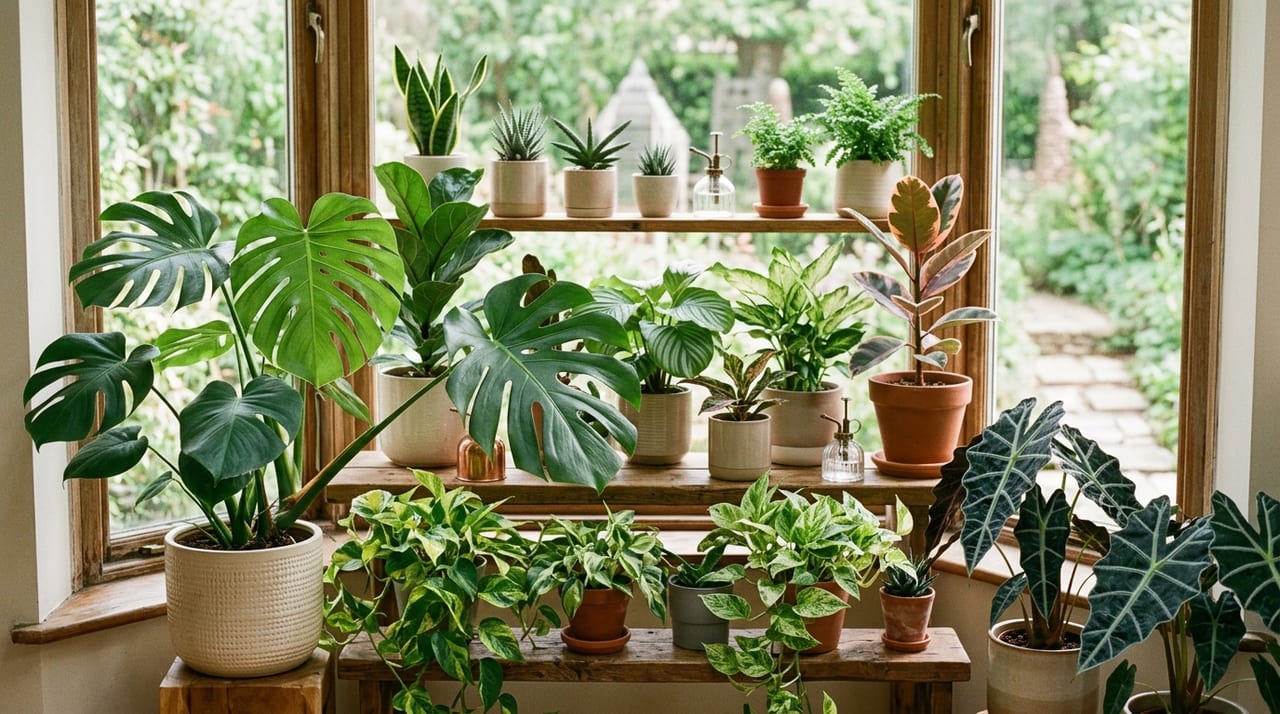
To cultivate Monstera healthily over the long term, you must begin with the perspective of "recreating the growth environment." The plant originates from tropical rainforests in Central and South America, growing naturally in the shade beneath large trees as a semi-shade-loving species. Direct sunlight causes leaf scorch, but insufficient light prevents fenestration and results in sparse, leggy growth. The ideal condition is to provide "bright indirect light through a lace curtain" for 6 to 8 hours per day. The conditions under which leaf fenestration forms are discussed in detail in Conditions for Monstera Leaf Fenestration Formation.
Soil balance is everything: aeration, water retention, and drainage must all be in harmony. Starting with a standard potting soil for foliage plants, mix in 20% perlite and 20% small red clay balls to significantly reduce root rot risk. Variegated varieties have particularly delicate roots; adding an additional 1–2% of bark chips to improve aeration brings greater stability. For more advanced soil mixes, refer to Aroid (Araceae Family) Soil Mix Guide. Terracotta pots are ideal, but if aesthetics take priority, perforated plastic pots work fine. Water when the soil surface dries, then wait another 2–3 days. Always keep in mind that over-watering and root rot are the leading causes of Monstera cultivation failure.
Characteristics and Care Differences for Rare and Variegated Varieties
Among Monstera species, variegated varieties have been making waves in the market in recent years. Here are the main types to know:
- Monstera deliciosa White Variegation (Albo): Characterized by white and green mottled patterns. The white portions have less chlorophyll and lower photosynthetic capacity than the green form, resulting in slower growth. Susceptible to strong light; leaf scorch often occurs from the white sections. Use weak fertilizer (half-strength) and limit feeding to once monthly during the growing season (May–September).
- Monstera Thai Constellation: A tissue-culture-derived variety with fine cream to white speckles scattered across a green background. Unlike Albo, the variegation is highly stable and resists reversion. However, growth is particularly slow, so patience in management is essential.
- Monstera deliciosa Yellow Variegation (Aurea): Yellow to lime-green variegation. Slightly hardier than white variegation with higher photosynthetic capacity. However, the yellow sections scorch easily in direct sunlight.
All variegated varieties share an aversion to the "triple threat" of over-watering, direct light, and excess fertilizer. Be conscious of watering 10–20% less frequently than you would for green varieties. General principles for variegated foliage plants are compiled in Variegated Foliage Plant Guide. Since variegated plants display different variegation patterns on each leaf, watching for new leaf emergence is part of the pleasure of growing them.
Aerial Root Function and Proper Management
One aspect of Monstera care often overlooked is management of "aerial roots" (気根). Aerial roots are adventitious roots that emerge from stem nodes and, in nature, cling to support trees and absorb water and nutrients from the ground and air.
In indoor cultivation, aerial roots may seem bothersome, but cutting them off is not advisable. By guiding aerial roots into the pot soil, you increase the entire plant's nutrient absorption, accelerating its growth. A practical technique is to wrap emerging aerial roots with moistened sphagnum moss and guide them toward the pot soil—this "aerial root induction technique" is highly effective. The more aerial roots a plant has, the greater its overall stability becomes.
If you must prune for aesthetic reasons, use clean scissors to cut just below the node. Let the cut surface dry thoroughly. However, remember that continuously cutting aerial roots slows the plant's growth rate.
Accelerating Large Plant Development: Training and Fertilization Strategy
To cultivate Monstera into its true form—a giant specimen surpassing adult human height—coordinate three key elements: support structures, fertilization, and addressing root-bound conditions.
Using Support Structures (Moss Poles and Coir Poles): Monstera is naturally a climbing plant with apical dominance—its leaves grow progressively larger as the plant climbs upward. By installing a moss pole or coir pole wrapped in sphagnum moss and training aerial roots to cling and climb, leaf size increases stepwise. Keeping the moss pole constantly moist encourages aerial roots to actively cling, developing a robust root system. For detailed guidance on pole selection, see Foliage Plant Support Structures and Moss Pole Guide.
Fertilization Timing and Type: During the growing season (May–September), apply liquid fertilizer with an NPK ratio around 5:5:5 to 7:3:6 at half to full strength every two weeks. Placing slow-release granular fertilizer on the soil surface is also reliably effective. Cease fertilization entirely during winter (November–February). Excess fertilizer causes salt accumulation and root damage, so use caution.
Repotting Indicators: Roots emerging profusely from the pot's drainage hole, soil drying immediately after watering, and markedly slowed growth are all signs it is time to repot. Select a pot only one size larger (2–3 cm wider diameter). Jumping to a much larger pot increases over-watering risk, so gradual upsizing is best practice.
Propagation and Selection Through Cuttings and Division
For propagating rare varieties, "stem cuttings" are standard. Cut a stem containing at least one node, allow the cut surface to dry for half a day to a full day, then insert it into sphagnum moss or perlite alone. Applying a light coat of rooting hormone (such as Rootone) to the cut surface improves rooting success. Water propagation is also effective: place a stem containing one node in clean water under bright indirect light, and roots often emerge within 2–4 weeks. The full spectrum of propagation methods is compiled in Foliage Plant Cutting and Water Propagation Guide and Foliage Plant Air Layering Propagation Guide.
When propagating variegated varieties, "variegation inheritance" is crucial. Select cuttings from nodes with well-balanced variegation. Nodes with excessive white (entirely white leaves) have low photosynthetic capacity and are prone to rooting failure, so avoid them. Conversely, nodes with insufficient variegation carry reversion risk. Select nodes where green and white are roughly equal—this is the standard approach.
Common Troubles and Solutions
Yellowing leaves: Over-watering and root rot are the most common causes. Remove the plant from its pot and inspect the roots; remove rotted brown roots and repot in fresh, dry soil. Insufficient light and nutrient deficiency also cause yellowing, so review the overall environment holistically.
Fenestration or holes not forming: Light intensity is insufficient, or the plant is still in a juvenile stage. Moving to a brighter location and using a support structure to encourage vertical growth will improve this.
Brown spots on leaves: Bacterial or fungal leaf blight is possible. Remove affected leaves and spray with fungicide. Preventing water from lingering on leaves during watering helps prevent infection.
Spider mite and scale insect infestations: These proliferate in dry indoor environments. Regular misting and wiping with alcohol at the first sign of infestation are effective. For severe cases, use products such as Venika X Fine Spray.
With proper environment and modest care, Monstera grows with remarkable speed, becoming a striking presence in any interior space. Even rare varieties reward meticulous adherence to basic care fundamentals, making that approach the fastest route to a beautiful, large specimen.