Guide to Variegated Houseplants | Popular Monstera and Philodendron Varieties and Care Tips
We introduce popular variegated houseplant varieties. Learn about variegation stability, price range, light management, and propagation tips for Monstera borsigiana 'White Tiger', Philodendron 'Pink Princess', and more.
Key Takeaways
We introduce popular variegated houseplant varieties. Learn about variegation stability, price range, light management, and propagation tips for Monstera borsigiana 'White Tiger', Philodendron 'Pink Princess', and more.
Related Species
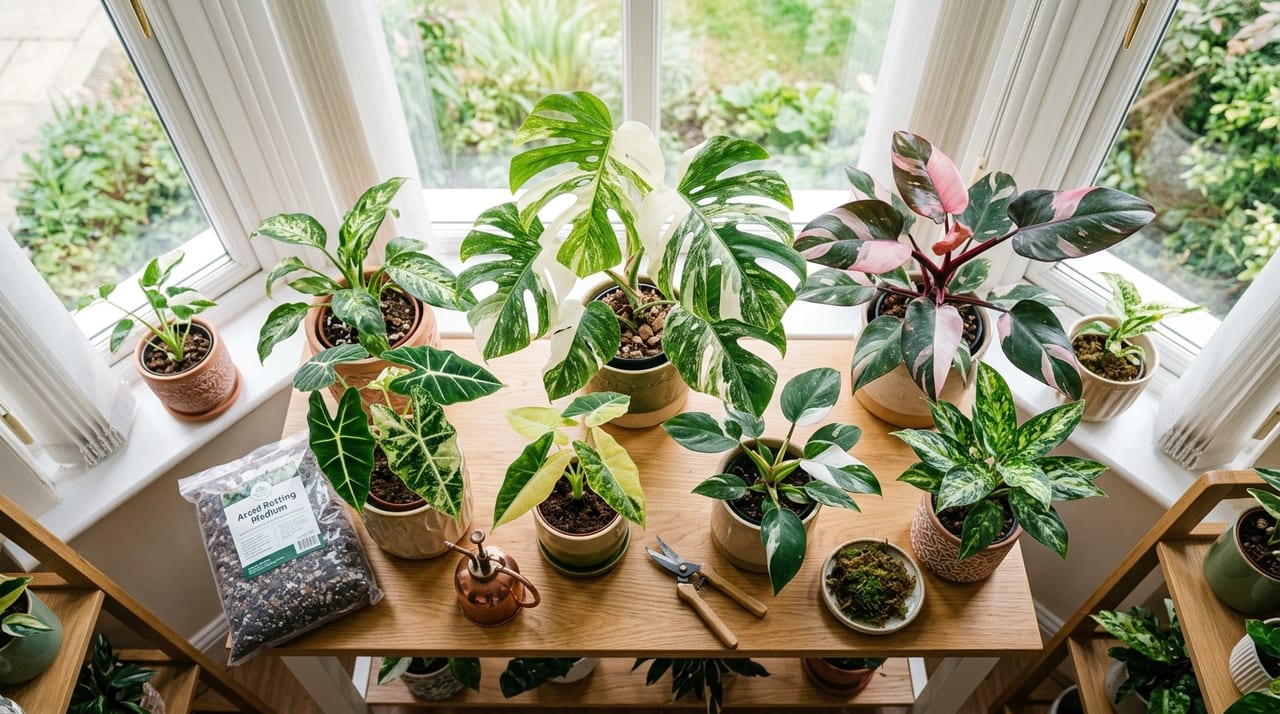
Variegated houseplants with white, yellow, or pink variegation on their leaves serve as interior accents and are also popular with collectors due to their rarity. However, their care differs from standard green-leafed varieties, so it is important to understand their characteristics before purchasing.
What is Variegation?
Variegation refers to patterns of white, cream, yellow, pink, or other colors appearing on portions of leaves where there is reduced chlorophyll. There are several causes of variegation.
- Chimeric Variegation: A condition where cells lacking chlorophyll and normal cells coexist at the cellular level. Monstera Albo and Philodendron Pink Princess are representative examples. The variegation pattern differs between individual plants and is often unstable.
- Stable Variegation: Some varieties, such as Thai Constellation, maintain relatively uniform variegation patterns.
Monstera Albo (Monstera deliciosa 'Albo Variegata')
It is one of the most popular variegated houseplants worldwide. The deeply lobed leaves feature white variegation, with each leaf displaying a unique pattern, giving it value as a "one-of-a-kind" specimen.
Variegation Stability Albo's variegation is unstable due to its chimeric nature, and it sometimes produces completely green or completely white leaves. Completely white leaves cannot photosynthesize, and if subsequent leaves are similarly white, the plant weakens—careful management is necessary. In such cases, it is common practice to cut back the completely white leaves at their base.
Light Management Direct sunlight is strictly prohibited as it causes leaf burn and loss of variegation. Provide bright indirect light (approximately 1–2 m from a window). When using LED indoors, maintain approximately 100–200 µmol/m²/s PPFD.
Watering Water thoroughly when the soil surface is dry. Excess moisture causes root rot, so well-draining soil (a mix of pumice and perlite) is recommended.
Price Range Prices vary significantly depending on the variegation pattern and plant size. A wide range is available, from small plants with just 1–2 leaves to large mature specimens.
Thai Constellation (Monstera deliciosa 'Thai Constellation')
This variety was created in Thai plant tissue culture facilities and is characterized by fine yellow-white speckling (star-like patterns) that uniformly covers the entire leaf surface.
Compared to Albo, its variegation pattern is more stable, and it rarely produces completely green or completely white leaves—a major advantage. Growth rate is slightly slower than Albo, and prices are relatively stable.
Light Management Like Albo, avoid direct sunlight and provide bright indirect light. The variegated portions are translucent to light, so prolonged exposure to strong light causes scorching.
Philodendron Pink Princess (Philodendron 'Pink Princess')
This variety is characterized by leaves with mixed patterns of pink, white, and deep green variegation and is also known by the abbreviation "PPP".
Variegation Stability This variety also has chimeric variegation, so the extent of pink coloration varies from leaf to leaf. Completely pink leaves have low photosynthetic capacity, and if they appear continuously, the plant weakens—careful management is necessary. Pink coloration can also fade when exposed to strong light (excessively bright environments).
Light Management Bright indirect light is optimal. If light is insufficient, variegation decreases and green coloration becomes more prominent; however, excessive light causes the pink to fade to white.
Propagation (Stem Cuttings)
Most variegated varieties can be propagated by stem cuttings.
- Cut the stem just below a node. Nodes with aerial roots are most likely to produce new roots.
- Allow the cut surface to dry for several hours, then place in sphagnum moss or water and wait for roots to develop.
- Once roots have formed, pot up into soil. Use well-draining soil with a high perlite content.
Note that growing variegated varieties from seed does not guarantee that the offspring will have the same variegation pattern as the parent. Stem cuttings are the most reliable method to maintain the variegation pattern.
Points to Check When Purchasing
- Check the variegation pattern (ensure it is not entirely green or entirely white)
- If possible, inspect the roots to confirm there is no root rot
- Verify that the growing point (apex) is healthy
Frequently Asked Questions and Practical Advice
Q. Only plain green leaves are appearing now. A. Insufficient light is the most common cause. Since the white portions of variegation cannot photosynthesize, the plant prioritizes green leaves to survive in darker conditions. Move the plant to a brighter location with indirect light. If variegation does not return, cut back above a variegated leaf, and side shoots may emerge with variegation.
Q. Conversely, only pure white leaves are appearing. A. This is called an "albino branch," and that branch cannot photosynthesize on its own and will eventually die. Leaving it untreated will drain energy from the entire plant, so cut back to a node with a balanced mix of green and white.
Q. Are variegated plants weaker than plain green ones? A. For the same species, it is reasonable to consider variegated plants weaker. Because the photosynthetic area is smaller, growth is slower and they are more sensitive to environmental changes. The key is to water sparingly, use dilute fertilizer, and handle them more carefully than green-leafed varieties.
Shop with Confidence at GrowerDirect
Post-purchase care is critical for variegated houseplants. On GrowerDirect, you can ask sellers questions directly, so you can confirm the specific variegation condition and care requirements for the individual plant before purchasing. Buying from reliable growers ensures you receive healthy plants.