Source: Wikimedia Commons
Japanese Gastrochilus
IntermediateGastrochilus japonicus
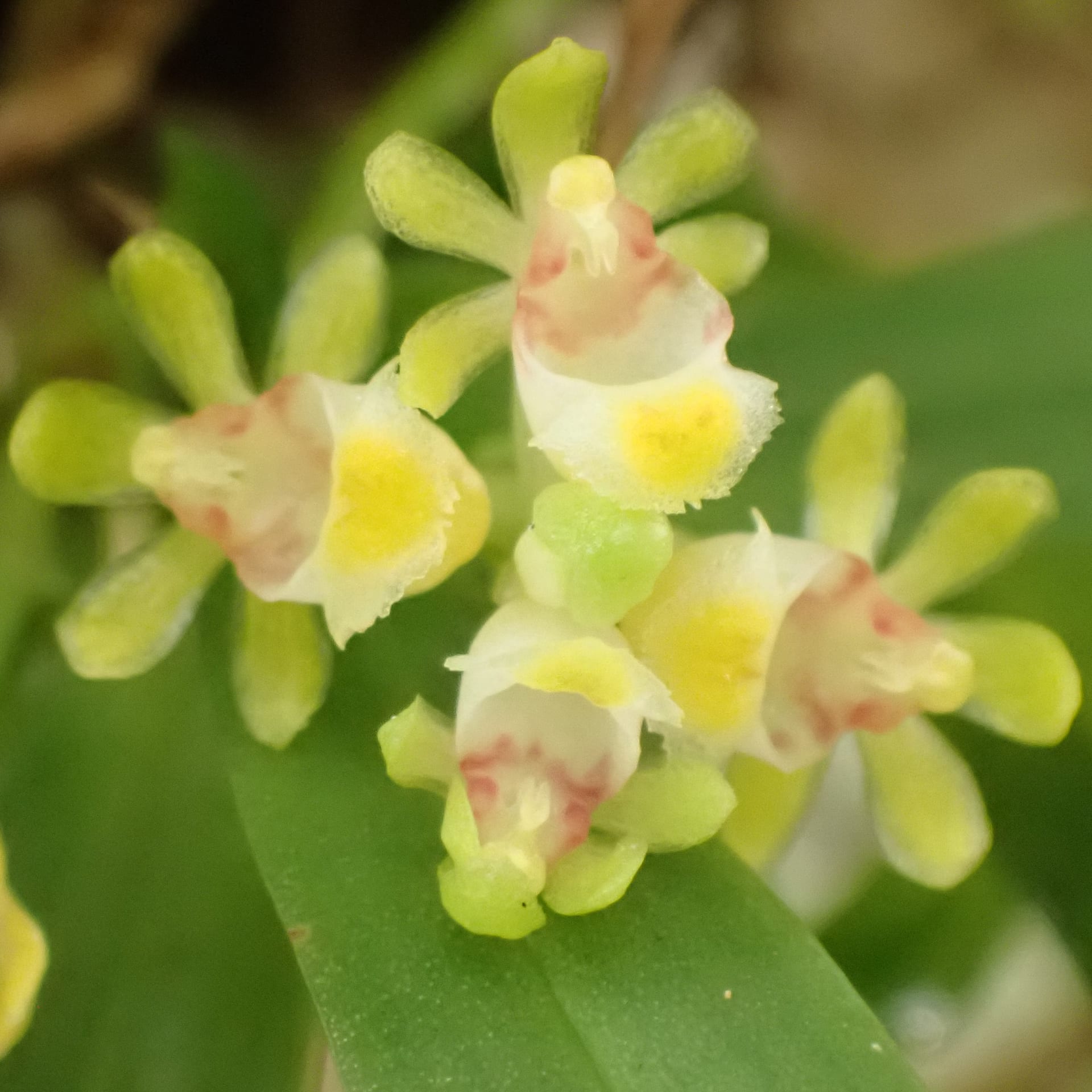
A small orchid growing on the trunks and branches of evergreen trees. It has leathery leaves like those of an evergreen oak in two rows and in summer opens clusters of pale yellow flowers about 1 cm across; the pouched lip is marked red-purple inside.
About
Kashinoki-ran (Gastrochilus japonicus) is an evergreen epiphytic orchid. The genus name combines the Greek for 'stomach' and 'lip', after the pouched lip, and the Japanese name is said to reflect its liking for evergreen oaks (kashi) and its oak-like leaves. It grows in Honshu from Chiba westwards, Shikoku, Kyushu and the Nansei Islands, and on Jeju Island, in Taiwan and in Hong Kong, on the trunks and branches of trees in evergreen broadleaf forest. The stem is about 8 cm long and clings to bark with many thick grey-green aerial roots. The leathery leaves alternate in two rows and are linear-oblong, 3-9 cm long and 0.6-1.5 cm wide, slightly curved. In July and August short hanging stems about 3 cm long emerge from the leaf axils with four to ten pale yellow flowers about 1 cm across, densely packed. The pouched base of the lip is marked pale red to red-purple inside, and the fan-shaped front has a large round yellow spot and an irregularly wavy edge. It is listed as Vulnerable on the Ministry of the Environment Red List and appears on the red lists of many prefectures west of Chiba. In Japan wildflower nurseries and others sell plants mounted on cork or wood.
Source: Wikipedia (CC BY-SA 4.0)
Size of the Japanese Gastrochilus
The Japanese Gastrochilus grows to Miniature; stem about 8 cm, leaves 3-9 cm, flowers about 1 cm across.
Basic Info
Origin
Japan (Honshu west of Chiba, Shikoku, Kyushu, Nansei Islands), Jeju Island, Taiwan and Hong Kong
Lifespan
Perennial (little data on lifespan)
Size
Miniature; stem about 8 cm, leaves 3-9 cm, flowers about 1 cm across
Temperature
15〜30℃
Humidity
50〜70%
Watering & Fertilizer
Sparing, very dilute liquid fertilizer while growing
Growing Tips
Light & Placement
Grow it in bright partial shade out of direct sun.
Watering
Water generously all year; mounted plants dry quickly, so water them often.
Temperature & Overwintering
It ranges from warm lowlands to mountains and is said to tolerate fairly cool conditions; protect it from frost and freezing in winter.
Soil & Repotting
An epiphyte that clings to bark with aerial roots; mount it on tree fern, cork or a branch.
Fertilizer
Feed very dilute liquid fertilizer sparingly in the growing season.
Pests & Cautions
A Japanese native; choose nursery-propagated plants rather than wild-collected ones. Some prefectures restrict collecting wild plants by ordinance. It is listed as Vulnerable on the Ministry of the Environment Red List.
Japanese Gastrochilus FAQ
QWhat is the growing difficulty level for Japanese Gastrochilus?
Intermediate. A variety suitable for intermediate growers. Requires some cultivation experience and knowledge of environment management. Pay careful attention to temperature and humidity control.
QHow large does Japanese Gastrochilus get?
The mature size of Japanese Gastrochilus is Miniature; stem about 8 cm, leaves 3-9 cm, flowers about 1 cm across. This may vary slightly depending on cultivation environment and individual differences.
QHow should I water and fertilize Japanese Gastrochilus?
Japanese Gastrochilus: watering & fertilizer — Sparing, very dilute liquid fertilizer while growing. Aim for appropriate frequency and amount.
QWhat is the typical price for Japanese Gastrochilus?
The price of Japanese Gastrochilus varies significantly by variety, characteristics, size, and lineage. Please check GrowerDirect's price guide for the latest market information.
Last updated: September 23, 2026
References & Sources
Edited & verified by: GrowerDirect Editorial Team
The classifications, regulations, and growing data on this page are created and verified based on the primary information database below.
Taxonomy & Authority
Regulations & Conservation Status
The whole orchid family is listed in CITES Appendix II (checked on Species+). International trade requires permits such as export permits, but no registration is needed to buy, sell or transfer plants within Japan. It is listed as Vulnerable on the Ministry of the Environment Red List. It is native to Japan and is not designated as a Nationally Rare Species under the Act on Conservation of Endangered Species (checked against the Ministry of the Environment list). Some prefectures restrict collecting wild plants by ordinance, so choose nursery-propagated plants rather than wild-collected ones.
Sources: Species+ (CITES) / Ministry of the Environment, Japan: list of Nationally Rare Species
Regulations may change. Always verify the latest information with the relevant authorities.
Related Species
Find listings for this species
Related Articles
Coelogyne Genus Seasonal Care Guide | Withholding Water in the Dry Season and Tips for Regulating the Bloom Cycle
A seasonal guide to Coelogyne, a type of epiphytic orchid, from watering during the growing season to dry-season drought management and tips for regulating the bloom cycle.
Post-Bloom Care: The Annual Cycle from New Growth to Flower Formation
Learn the annual care cycle for orchids from the end of flowering to the next bloom. This guide covers post-flower care including flower stem cutting methods, signs to observe during new shoot development, summer growth period considerations, requirements for flower bud formation, and finishing care from bud emergence through blooming.
A Complete Guide to Enjoying Orchid Exhibitions and Sales Events | Variety Selection and Post-Purchase Care
A guide to enjoying orchid exhibitions and sales events. Covering practical tips on variety selection, how to identify rare species, and post-purchase environmental acclimatization.
Complete Window-Sill Cultivation Guide for Mini Orchids | Techniques for Blooming Fragrant Orchids in Small Spaces and Low-Light Environments
A practical guide to growing miniature orchids on windowsills. Optimize light levels, humidity, and fertilizer management to achieve repeated blooms of fragrant orchids in confined indoor spaces.
Can't find the plant you're looking for?
Post your wishes for free and growers with matching plants will contact you with introductions.