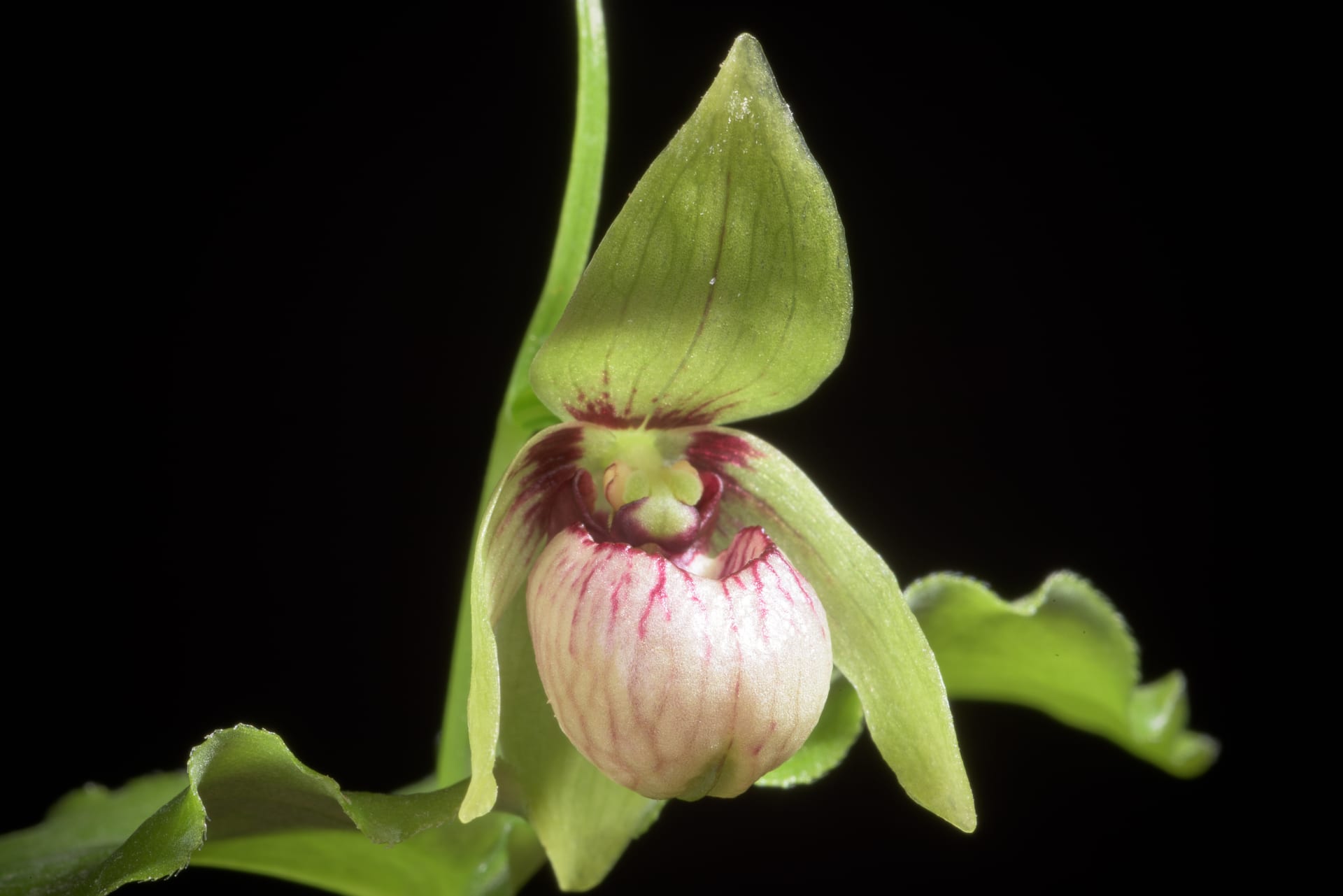
Source: Wikimedia Commons
Frail Cypripedium
AdvancedCypripedium debile
A tiny Cypripedium that spreads two rounded, heart-shaped leaves horizontally and hangs a flower only 1-2 cm across beneath them. Because the flower sits just above the ground, it is easy to miss without lifting the leaves.
About
Ko-atsumoriso (Cypripedium debile) is a tiny terrestrial slipper orchid described in 1874; the epithet means 'weak' or 'frail'. It grows in Japan, northern Taiwan and China (southern Gansu, western Hubei, western Sichuan and Chongqing), where it is found at 2,000-2,800 m in humus-rich, well-drained soil in forest, thickets and shady ravines. It is one of the Cypripedium species known from Japan. The slender stem has sheaths at the base and carries two thin, broadly ovate to heart-shaped leaves spreading horizontally opposite each other. In spring a slender stalk 2-5 cm long hangs from between the leaves, holding a single flower about 1-2 cm across, facing down just above the ground. Both plant and flower are much smaller than atsumoriso or kumagaiso; the two-leaved habit recalls kumagaiso, but the leaves are heart-shaped rather than fan-shaped and the flower hangs beneath them. Little has been published in Japanese on its cultivation or ecology, and it is treated as a plant of cool woodland floors. In Japan wildflower nurseries sell plants.
Size of the Frail Cypripedium
The Frail Cypripedium grows to Very small; flower stalk 2-5 cm, flowers 1-2 cm across.
Basic Info
Origin
Japan, northern Taiwan and China (Gansu, Hubei, Sichuan and nearby)
Lifespan
Perennial (little data on lifespan)
Size
Very small; flower stalk 2-5 cm, flowers 1-2 cm across
Temperature
15〜30℃
Humidity
50〜70%
Watering & Fertilizer
Very little fertilizer
Growing Tips
Light & Placement
It grows in shady forest and ravines; keep it in bright shade out of direct sun.
Watering
It likes humus-rich, well-drained soil; do not let it dry out in growth, but avoid waterlogging.
Temperature & Overwintering
A cool-growing plant of montane woodland floors; keep it somewhere cool away from summer heat and stagnant humidity.
Soil & Repotting
Plant it in a humus-rich, free-draining mix.
Dormancy Care
It dies back to dormancy after flowering; do not let the mix dry out completely while dormant.
Pests & Cautions
A Japanese native; choose nursery-propagated plants rather than wild-collected ones. Some prefectures restrict collecting wild plants by ordinance.
Frail Cypripedium FAQ
QWhat is the growing difficulty level for Frail Cypripedium?
Advanced. A variety suitable for advanced growers. Requires advanced cultivation techniques and specialized equipment, with careful environmental adjustments needed.
QHow large does Frail Cypripedium get?
The mature size of Frail Cypripedium is Very small; flower stalk 2-5 cm, flowers 1-2 cm across. This may vary slightly depending on cultivation environment and individual differences.
QHow should I water and fertilize Frail Cypripedium?
Frail Cypripedium: watering & fertilizer — Very little fertilizer. Aim for appropriate frequency and amount.
QWhat is the typical price for Frail Cypripedium?
The price of Frail Cypripedium varies significantly by variety, characteristics, size, and lineage. Please check GrowerDirect's price guide for the latest market information.
Last updated: September 23, 2026
References & Sources
Edited & verified by: GrowerDirect Editorial Team
The classifications, regulations, and growing data on this page are created and verified based on the primary information database below.
Taxonomy & Authority
Regulations & Conservation Status
The whole orchid family is listed in CITES Appendix II (checked on Species+). International trade requires permits such as export permits, but no registration is needed to buy, sell or transfer plants within Japan. It is native to Japan and is not designated as a Nationally Rare Species under the Act on Conservation of Endangered Species (checked against the Ministry of the Environment list). Some prefectures restrict collecting wild plants by ordinance, so choose nursery-propagated plants rather than wild-collected ones.
Sources: Species+ (CITES) / Ministry of the Environment, Japan: list of Nationally Rare Species
Regulations may change. Always verify the latest information with the relevant authorities.
Related Species
Find listings for this species
Related Articles
Coelogyne Genus Seasonal Care Guide | Withholding Water in the Dry Season and Tips for Regulating the Bloom Cycle
A seasonal guide to Coelogyne, a type of epiphytic orchid, from watering during the growing season to dry-season drought management and tips for regulating the bloom cycle.
Post-Bloom Care: The Annual Cycle from New Growth to Flower Formation
Learn the annual care cycle for orchids from the end of flowering to the next bloom. This guide covers post-flower care including flower stem cutting methods, signs to observe during new shoot development, summer growth period considerations, requirements for flower bud formation, and finishing care from bud emergence through blooming.
A Complete Guide to Enjoying Orchid Exhibitions and Sales Events | Variety Selection and Post-Purchase Care
A guide to enjoying orchid exhibitions and sales events. Covering practical tips on variety selection, how to identify rare species, and post-purchase environmental acclimatization.
Complete Window-Sill Cultivation Guide for Mini Orchids | Techniques for Blooming Fragrant Orchids in Small Spaces and Low-Light Environments
A practical guide to growing miniature orchids on windowsills. Optimize light levels, humidity, and fertilizer management to achieve repeated blooms of fragrant orchids in confined indoor spaces.
Can't find the plant you're looking for?
Post your wishes for free and growers with matching plants will contact you with introductions.