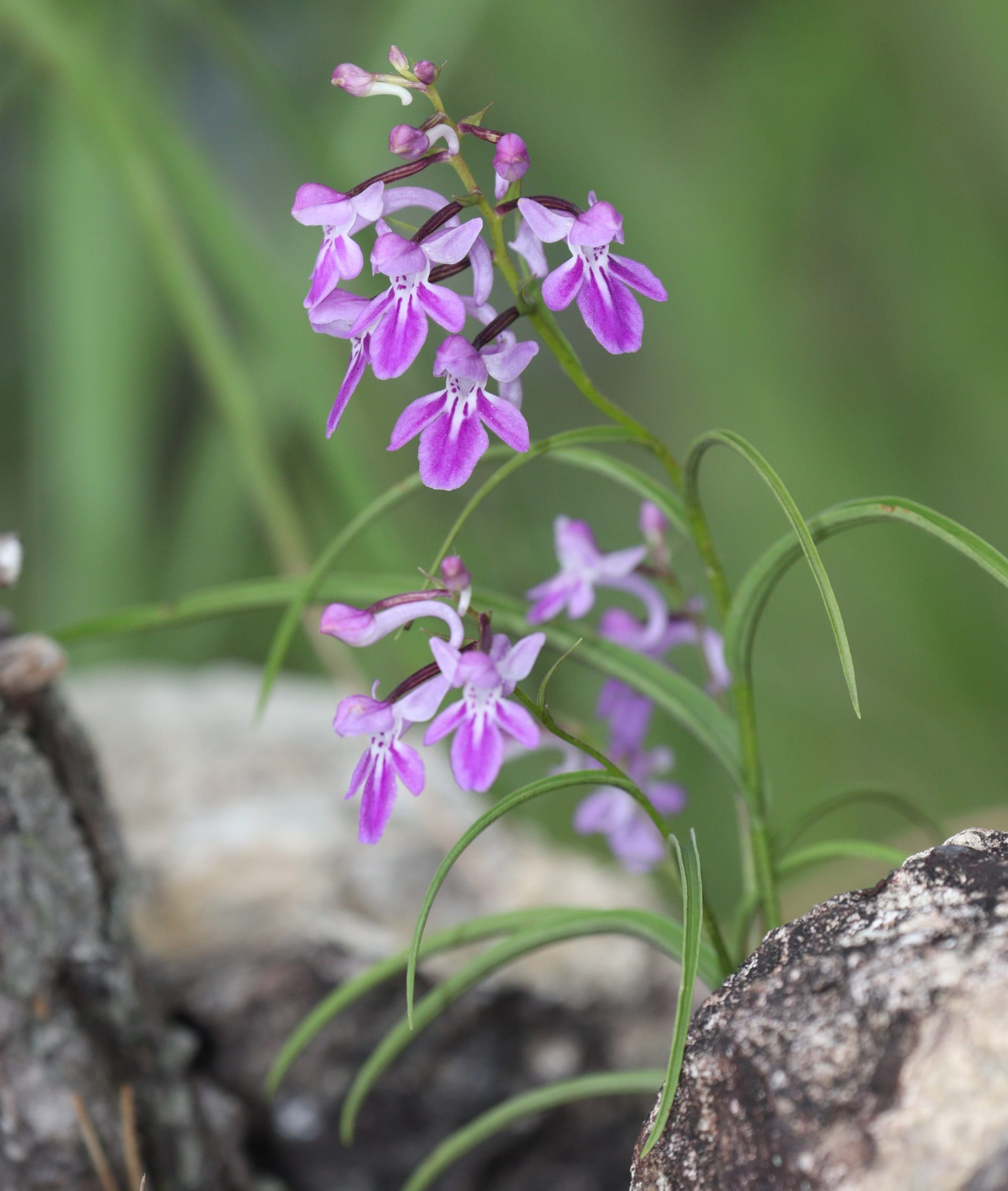
Source: Wikimedia Commons
Grass-leaved Hemipilia
IntermediateHemipilia graminifolia
A small terrestrial orchid of damp rock faces in the hills of Japan and southern Korea. Between narrow leaves it bears a few to dozens of small purple-pink flowers, and many cultivars with different lip markings and colours have been raised.
About
Ucho-ran (Hemipilia graminifolia) is a small perennial orchid long known as Ponerorchis graminifolia, a name still used on sale labels; the kanji spelling meaning 'feather-butterfly orchid' is a recent coinage, and the origin of the Japanese name is unclear. It grows in Honshu (Kanto westwards), Shikoku and Kyushu and in southern Korea, in soil and moss collected in crevices of damp rock faces in low mountains. Plants are 5-20 cm tall with two or three narrow leaves, and from May to August bear a few to several dozen purple-pink flowers with a spurred lip spotted deep purple. It grows from a small tuber, sprouts in spring, forms one to three new tubers in summer, and dies back in autumn to overwinter as tubers. A collecting boom around the late 1960s and 1970s stripped many wild populations, but asymbiotic seed culture and other propagation methods were later established, and propagated plants are now reliably available. It is listed as Vulnerable on the Ministry of the Environment Red List. It varies greatly by region: var. kurokamiana, var. micropunctata and var. suzukiana have been described, local strains carry place names, and there are many cultivars with different colours and markings. Among heavily bred garden plants, labels bearing a variety name often turn out to be hybrids.
Source: Wikipedia (CC BY-SA 4.0)
Size of the Grass-leaved Hemipilia
The Grass-leaved Hemipilia grows to 5-20 cm tall; flowers about 1.5 cm across.
Basic Info
Origin
Japan (Honshu west of Kanto, Shikoku, Kyushu) and southern Korea
Lifespan
Perennial; renews itself each year from new tubers
Size
5-20 cm tall; flowers about 1.5 cm across
Temperature
15〜30℃
Humidity
50〜70%
Watering & Fertilizer
Sparing, dilute liquid fertilizer in the growing season
Growing Tips
Light & Placement
Give bright partial shade in the spring-summer growing season, avoiding strong direct sun.
Watering
Keep the mix from drying out while in growth and cut back watering once the top dies down in autumn.
Temperature & Overwintering
It dies back in autumn and overwinters as tubers; keep them fairly dry and frost-free while dormant.
Soil & Repotting
Pot it in a gritty, free-draining mix and repot the dormant tubers.
Dormancy Care
From autumn to winter it rests as tubers; water little, avoid freezing and wait for spring growth.
Pests & Cautions
A Japanese native; choose nursery-propagated plants rather than wild-collected ones. Some prefectures restrict collecting wild plants by ordinance. Garden breeding is extensive, so treat variety or locality names on labels with caution.
Grass-leaved Hemipilia FAQ
QWhat is the growing difficulty level for Grass-leaved Hemipilia?
Intermediate. A variety suitable for intermediate growers. Requires some cultivation experience and knowledge of environment management. Pay careful attention to temperature and humidity control.
QHow large does Grass-leaved Hemipilia get?
The mature size of Grass-leaved Hemipilia is 5-20 cm tall; flowers about 1.5 cm across. This may vary slightly depending on cultivation environment and individual differences.
QHow should I water and fertilize Grass-leaved Hemipilia?
Grass-leaved Hemipilia: watering & fertilizer — Sparing, dilute liquid fertilizer in the growing season. Aim for appropriate frequency and amount.
QWhat is the typical price for Grass-leaved Hemipilia?
The price of Grass-leaved Hemipilia varies significantly by variety, characteristics, size, and lineage. Please check GrowerDirect's price guide for the latest market information.
Last updated: September 23, 2026
References & Sources
Edited & verified by: GrowerDirect Editorial Team
The classifications, regulations, and growing data on this page are created and verified based on the primary information database below.
Taxonomy & Authority
Accepted name: Hemipilia graminifolia (Rchb.f.) Y.Tang, H.Peng & T.Yukawa
Synonyms: Gymnadenia graminifolia (Rchb.f.) Rchb.f., Orchis graminifolia (Rchb.f.) Tang & F.T.Wang, Orchis rupestre var. chidori Soó, Ponerorchis graminifolia Rchb.f.
Authority databases: GBIF · GBIF
Nomenclature follows global taxonomic authority databases.
Regulations & Conservation Status
The whole orchid family is listed in CITES Appendix II (checked on Species+). International trade requires permits such as export permits, but no registration is needed to buy, sell or transfer plants within Japan. It is listed as Vulnerable on the Ministry of the Environment Red List. It is native to Japan and is not designated as a Nationally Rare Species under the Act on Conservation of Endangered Species (checked against the Ministry of the Environment list). Some prefectures restrict collecting wild plants by ordinance, so choose nursery-propagated plants rather than wild-collected ones.
Sources: Species+ (CITES) / Ministry of the Environment, Japan: list of Nationally Rare Species
Regulations may change. Always verify the latest information with the relevant authorities.
Related Species
Find listings for this species
Related Articles
Coelogyne Genus Seasonal Care Guide | Withholding Water in the Dry Season and Tips for Regulating the Bloom Cycle
A seasonal guide to Coelogyne, a type of epiphytic orchid, from watering during the growing season to dry-season drought management and tips for regulating the bloom cycle.
Post-Bloom Care: The Annual Cycle from New Growth to Flower Formation
Learn the annual care cycle for orchids from the end of flowering to the next bloom. This guide covers post-flower care including flower stem cutting methods, signs to observe during new shoot development, summer growth period considerations, requirements for flower bud formation, and finishing care from bud emergence through blooming.
A Complete Guide to Enjoying Orchid Exhibitions and Sales Events | Variety Selection and Post-Purchase Care
A guide to enjoying orchid exhibitions and sales events. Covering practical tips on variety selection, how to identify rare species, and post-purchase environmental acclimatization.
Complete Window-Sill Cultivation Guide for Mini Orchids | Techniques for Blooming Fragrant Orchids in Small Spaces and Low-Light Environments
A practical guide to growing miniature orchids on windowsills. Optimize light levels, humidity, and fertilizer management to achieve repeated blooms of fragrant orchids in confined indoor spaces.
Can't find the plant you're looking for?
Post your wishes for free and growers with matching plants will contact you with introductions.