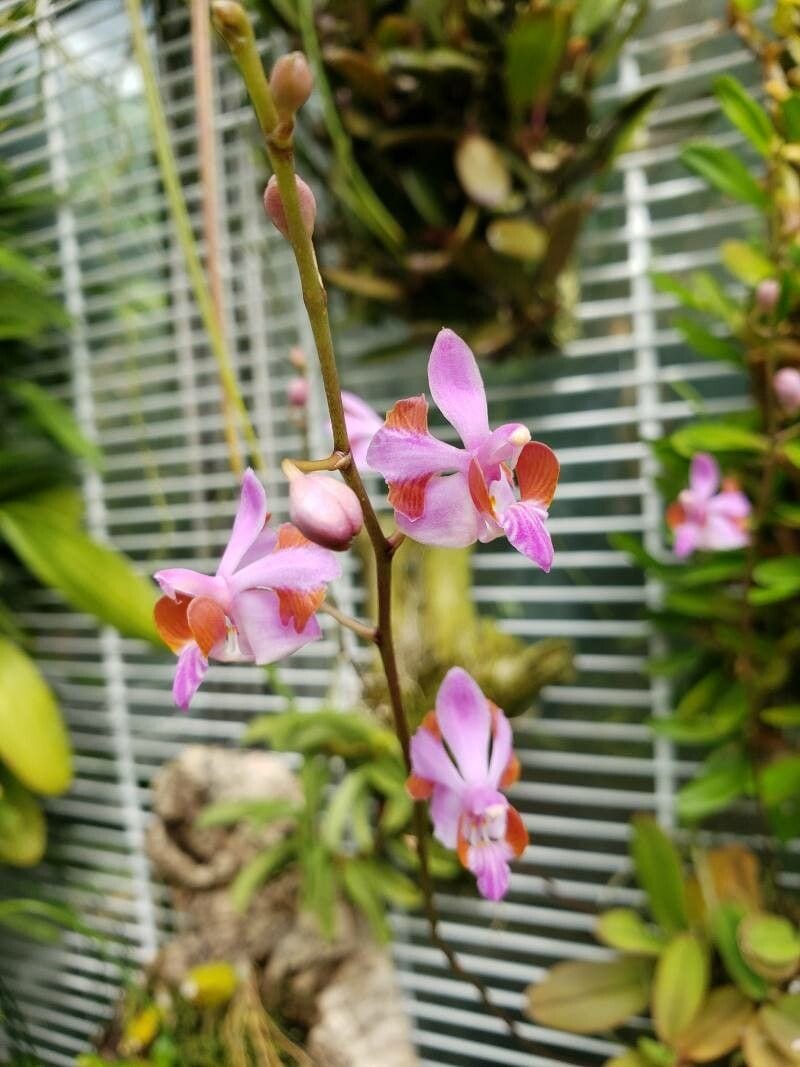
Source: Wikimedia Commons
Beautiful Doritis
IntermediatePhalaenopsis pulcherrima
A moth orchid species formerly placed in the genus Doritis. It has many stiff, fairly upright leaves and an erect, tall stem that opens small, bright pink-red flowers from the bottom up. It is known for wide variation in flower colour and shape.
About
Phalaenopsis pulcherrima is a small moth orchid. First described in Phalaenopsis, it was later placed in the single-species genus Doritis (as Doritis pulcherrima) and then returned to Phalaenopsis; the old genus name still appears on sale labels. It ranges from Assam and Myanmar through Thailand, Laos, Cambodia, Vietnam, Hainan and Yunnan to the Malay Peninsula, Sumatra and Borneo, growing at 50-600 m on rocks and sandy soil along streams and on trees. Its thick, stiff, leathery leaves are about 15 cm long, more numerous and more upright than in most moth orchids. The nearly erect stem reaches 40-60 cm, sometimes 1 m, and opens ten to twenty flowers 2-4 cm across from the bottom upwards. The flowers are basically bright pink-red but vary widely, including white (f. alba) and bluish forms, and plants are sold selected by colour and form. Its colour and compact, many-flowered habit have made it an important parent in moth orchid breeding. In Japan it is sold by specialist orchid nurseries that carry Phalaenopsis species.
Source: Wikipedia (CC BY-SA 4.0)
Size of the Beautiful Doritis
The Beautiful Doritis grows to Small; leaves about 15 cm, flower stem 40-60 cm (sometimes 1 m), flowers 2-4 cm across.
Basic Info
Origin
Assam to Southeast Asia, southern China, Sumatra and Borneo (50-600 m)
Lifespan
Perennial that can be kept for many years (little data on lifespan)
Size
Small; leaves about 15 cm, flower stem 40-60 cm (sometimes 1 m), flowers 2-4 cm across
Temperature
15〜30℃
Humidity
50〜70%
Watering & Fertilizer
Dilute liquid fertilizer year round
Growing Tips
Light & Placement
It needs more light than typical moth orchids; give bright light while avoiding harsh direct sun.
Watering
Water evenly throughout the year.
Temperature & Overwintering
A warm to intermediate grower; keep it indoors somewhere warm in winter.
Soil & Repotting
It grows on rocks and sandy soil, so pot it in a free-draining medium.
Fertilizer
Feed dilute liquid fertilizer regularly all year.
Choosing a Plant
Flower colour and shape vary widely and plants are sold selected by form; choose in flower or from a reliable colour label. It is also sold under the old name Doritis.
Beautiful Doritis FAQ
QWhat is the growing difficulty level for Beautiful Doritis?
Intermediate. A variety suitable for intermediate growers. Requires some cultivation experience and knowledge of environment management. Pay careful attention to temperature and humidity control.
QHow large does Beautiful Doritis get?
The mature size of Beautiful Doritis is Small; leaves about 15 cm, flower stem 40-60 cm (sometimes 1 m), flowers 2-4 cm across. This may vary slightly depending on cultivation environment and individual differences.
QHow should I water and fertilize Beautiful Doritis?
Beautiful Doritis: watering & fertilizer — Dilute liquid fertilizer year round. Aim for appropriate frequency and amount.
QWhat is the typical price for Beautiful Doritis?
The price of Beautiful Doritis varies significantly by variety, characteristics, size, and lineage. Please check GrowerDirect's price guide for the latest market information.
Last updated: September 23, 2026
References & Sources
Edited & verified by: GrowerDirect Editorial Team
The classifications, regulations, and growing data on this page are created and verified based on the primary information database below.
Taxonomy & Authority
Regulations & Conservation Status
The whole orchid family is listed in CITES Appendix II (checked on Species+). International trade requires permits such as export permits, but no registration is needed to buy, sell or transfer plants within Japan.
Sources: Species+ (CITES) / Ministry of the Environment, Japan: list of Nationally Rare Species
Regulations may change. Always verify the latest information with the relevant authorities.
Related Species
Find listings for this species
Related Articles
Complete Guide to Growing Phalaenopsis Orchids | Tips for Beginners to Keep Them Blooming Long-Term
A beginner-friendly guide to enjoying popular gift Phalaenopsis orchids long-term, covering watering, placement, fertilizing, and post-bloom care. We also introduce temperature management and techniques to encourage new flower buds.
Moth Orchid Reblooming Technique | How to Make Flowers Bloom Again After They Fade
Explains how to rebloom moth orchids after flowers fade. Introduces how to cut flower stems, temperature management, watering and fertilizer adjustment, and creating an environment for successful reblooming.
How to Care for Phalaenopsis After Blooming | Tips for Encouraging Re-blooms
Learn how to prune orchid flower stems after blooming, proper care methods, and temperature and fertilizer management to encourage second blooms.
Denphale Care Guide: Tips for Enjoying Long-Lasting Cluster Flowers with Year-Round Warm Management
This guide explains the characteristics of Denphale, a warm-climate hybrid of Dendrobium, how it differs from Nobile types, temperature and watering management, and how to propagate using high growths.
Can't find the plant you're looking for?
Post your wishes for free and growers with matching plants will contact you with introductions.