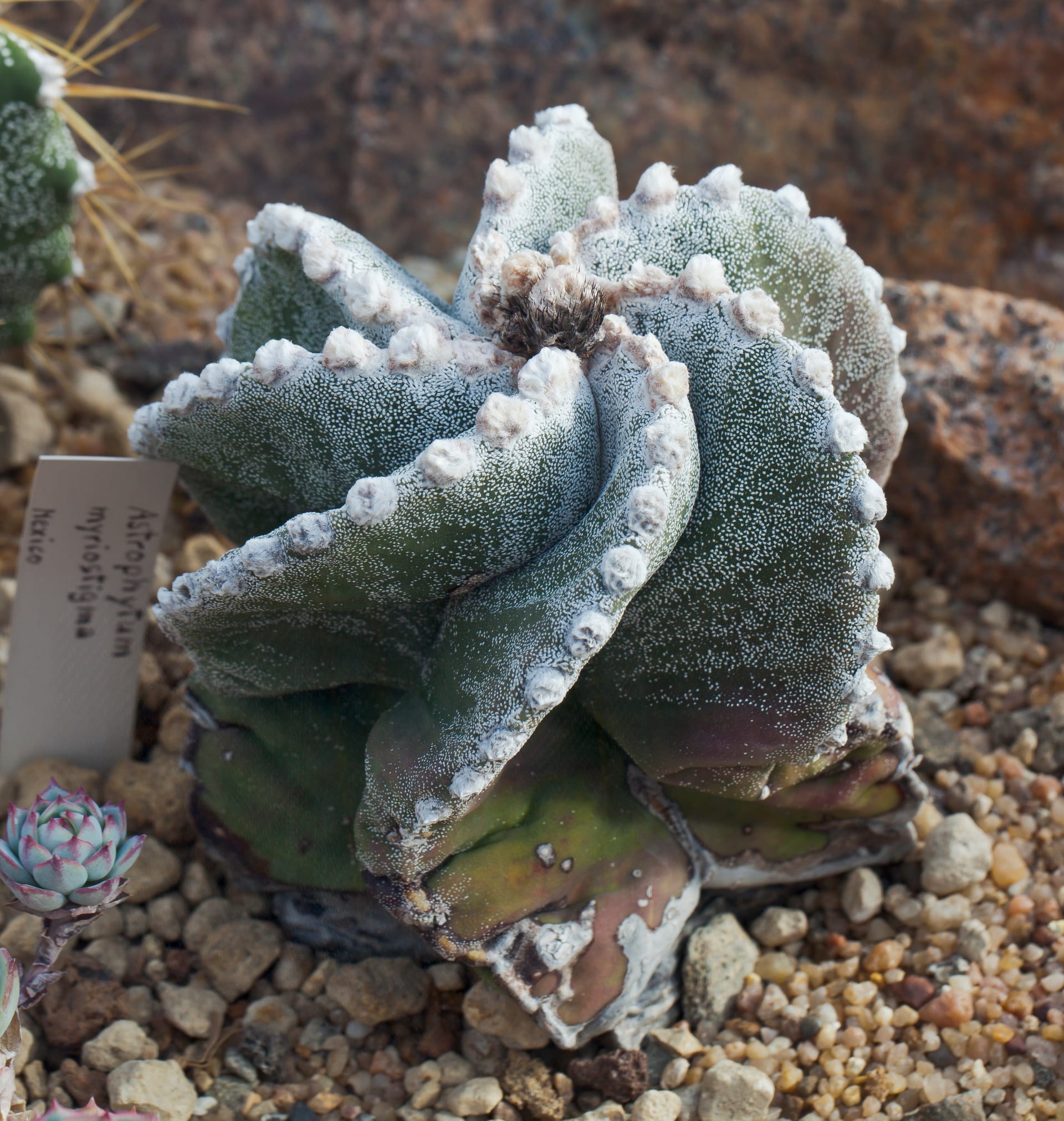
Source: Wikimedia Commons
Bishop's cap
BeginnerAstrophytum myriostigma
A spineless cactus, usually with five ribs that make a star shape from above, dusted with white flecks. Many forms differ in rib number and flecking; tough and an ideal first star cactus.
About
Astrophytum myriostigma, the bishop's cap, comes from the highlands of north-eastern and central Mexico at around 1,000 m. It has areoles but no spines, and usually five (three to seven) pronounced ribs give it a star-shaped outline; the genus name means 'star plant'. With age the ribs increase to eight or ten and the plant becomes columnar, 70 cm to 1 m tall and 10–20 cm across. Wild plants are covered in white hair-like flecks, though some garden forms lack them. Creamy-yellow flowers 4–6 cm across, sometimes orange or red at the base, open near the crown; flowering can take up to six years. It stays solitary unless the growing point is damaged or it is grafted. Japanese growers recognise many forms: three-ribbed sankaku, four-ribbed shikaku, heavily flecked Onzuka (named after its breeder), kikko forms with rib-side hollows, and the unflecked hekiruri (var. nudum). Very tough and easy, it is widely available in Japan if you are not after a particular form.
Source: Wikipedia (CC BY-SA 4.0)
Size of the Bishop's cap
The Bishop's cap grows to 70 cm–1 m tall, 10–20 cm across (mature).
Basic Info
Origin
Highlands of north-eastern and central Mexico
Lifespan
Perennial; stays solitary and becomes columnar over many years
Size
70 cm–1 m tall, 10–20 cm across (mature)
Temperature
5〜35℃
Humidity
30〜50%
Watering & Fertilizer
Light feeder; slow-release organic fertiliser mixed in at repotting
Growing Tips
Light & Placement
From spring to autumn keep it outdoors under cover or in a cold frame; in winter in a greenhouse or sunny room. Long periods in low light make it stretch.
Watering
A summer grower. Water thoroughly when the mix dries; in winter just moisten it about twice a month.
Temperature & Overwintering
A Japanese reference gives 3°C as the minimum survival temperature. Watch for sunburn when moving it outdoors after winter or during sunny breaks in the rainy season.
Soil & Repotting
Use a free-draining cactus mix and repot every 2–3 years, adding a little slow-release organic fertiliser.
Propagation
Raised from seed; it rarely produces offsets.
Pests & Cautions
Scale insects are uncommon, but plants left unrepotted for years can become infested and lose condition.
Bishop's cap FAQ
QWhat is the growing difficulty level for Bishop's cap?
Beginner. A variety suitable for beginners. No special equipment or experience is required—you can grow it without problems by setting up a basic cultivation environment.
QHow large does Bishop's cap get?
The mature size of Bishop's cap is 70 cm–1 m tall, 10–20 cm across (mature). This may vary slightly depending on cultivation environment and individual differences.
QHow should I water and fertilize Bishop's cap?
Bishop's cap: watering & fertilizer — Light feeder; slow-release organic fertiliser mixed in at repotting. Aim for appropriate frequency and amount.
QWhat is the typical price for Bishop's cap?
The price of Bishop's cap varies significantly by variety, characteristics, size, and lineage. Please check GrowerDirect's price guide for the latest market information.
Last updated: September 23, 2026
References & Sources
Edited & verified by: GrowerDirect Editorial Team
The classifications, regulations, and growing data on this page are created and verified based on the primary information database below.
Taxonomy & Authority
Accepted name: Astrophytum myriostigma Lem.
Synonyms: Astrophytum myriostigma glabrum, Astrophytum myriostigma potosinum, Astrophytum myriostigma quadricostatum, Astrophytum myriostigma tamaulipense, Echinocactus myriostigma coahuilensis
Authority databases: GBIF · GBIF
Nomenclature follows global taxonomic authority databases.
Regulations & Conservation Status
Listed in CITES Appendix II (as part of the family-level listing of Cactaceae). International trade requires export permits, but no registration is needed to transfer plants within Japan. It is not regulated under Japan's Invasive Alien Species Act.
Sources: Species+ (CITES): Astrophytum myriostigma / Ministry of the Environment: list of Invasive Alien Species
Regulations may change. Always verify the latest information with the relevant authorities.
Related Species
Find listings for this species
Related Articles
How to Care for Astrophytum: Preventing Root Rot Through Watering Control and the Summer Type Dormancy Cycle
A guide to caring for Astrophytum cactus. Introduces seasonal care steps from watering and light management during the growing period, water restriction during dormancy, to the timing of resuming watering in spring.
Autumn Preparation Management for Summer-Type Succulents
A guide to autumn care for summer-type succulents, covering plant changes from September to November, timing for gradual watering reduction, placement and temperature management for transitioning plants indoors, autumn fertilizing and pest control, variety-specific care checkpoints, and preparation for winter dormancy.
Mealybug Control on Succulents | Complete Guide to Early Detection, Removal, and Prevention
Mealybugs hide easily at the base of succulent leaves and on new growth. This guide covers their characteristics, the environments where they thrive, tips for early detection, removal methods using cotton swabs and alcohol, and daily care practices to prevent recurrence.
Summer and Winter Type Succulents: Growth Cycles and Watering Management Strategy
This article explains the differences in growth types of succulent plants, their annual growth cycles, seasonal watering management strategies, common failures, and countermeasures.
🩺 Common diseases
Can't find the plant you're looking for?
Post your wishes for free and growers with matching plants will contact you with introductions.