Source: Wikimedia Commons
Sea urchin cactus / Star cactus
IntermediateAstrophytum asterias
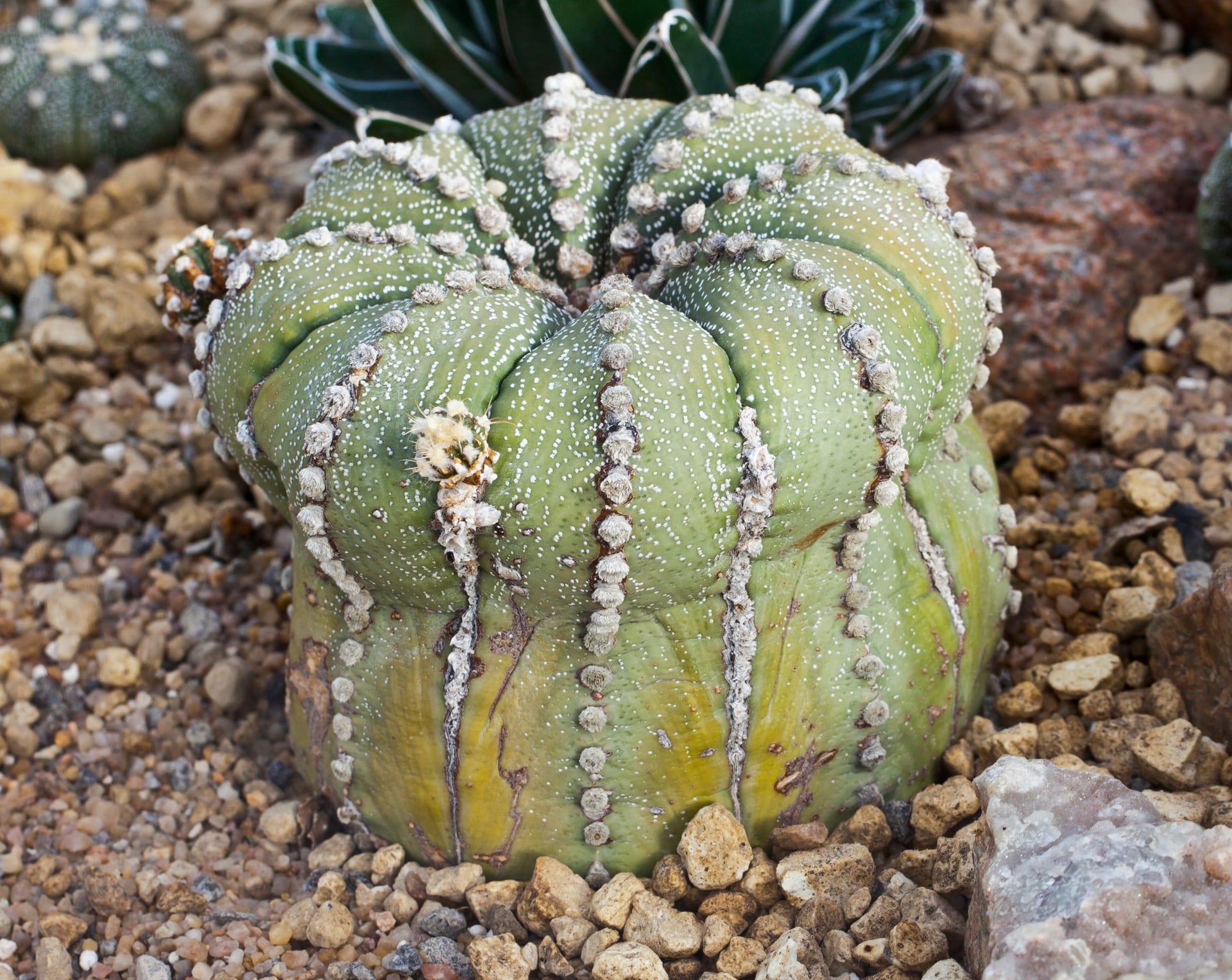
A spineless, flattened dome divided by about eight ribs, each with a line of woolly areoles and dusted with white flecks, like a sea urchin. The wild species behind Japan's 'Super Kabuto'.
About
Astrophytum asterias once grew in the lower Rio Grande Valley of Texas and in Nuevo León and Tamaulipas, Mexico. Today it survives only in part of Starr County, Texas, and a few sites in Tamaulipas, reduced by development and poaching. It is listed as endangered in the US, Vulnerable on the IUCN Red List and in CITES Appendix I. The small, flattened dome is 2.5–6 cm high and 5–15 cm across, divided into seven to ten (typically eight) ribs, each with a central line of woolly areoles and no spines. White hair-like flecks cover the greenish-brown skin; the name means 'star-like'. Yellow flowers with red centres open from March to June in habitat. It is easily raised from seed, and almost all plants in trade are seedlings. Japanese breeders have long selected for areole size and fleck density, producing the heavily flecked 'Super Kabuto' and many other strains; it even has dedicated collectors. Plants sold in Japan are domestically seed-raised, and as a CITES Appendix I species a registration certificate is required for any sale.
Source: Wikipedia (CC BY-SA 4.0)
Lifespan of the Sea urchin cactus / Star cactus
The Sea urchin cactus / Star cactus lives Perennial; reaches flowering size at 2–3 cm across.
Size of the Sea urchin cactus / Star cactus
The Sea urchin cactus / Star cactus grows to 2.5–6 cm tall, 5–15 cm across.
Basic Info
Origin
Southern Texas (USA) and north-eastern Mexico (Nuevo León, Tamaulipas)
Lifespan
Perennial; reaches flowering size at 2–3 cm across
Size
2.5–6 cm tall, 5–15 cm across
Temperature
5〜35℃
Humidity
30〜50%
Watering & Fertilizer
Light feeder; a little slow-release fertiliser at each annual repotting
Growing Tips
Light & Placement
Keep it in a sunny, airy spot outdoors or in a cold frame all year. It likes strong light, but the skin is delicate and burns easily after a move or a sudden sunny spell.
Watering
A summer grower, growing most strongly from spring to summer. Water thoroughly when the surface dries from early spring to early autumn. Total winter dryness makes the base shrink, so mist it about twice a month on warm days.
Temperature & Overwintering
It likes heat, and day–night temperature swings keep it compact. When lows drop below 15°C move it to a sunny greenhouse or windowsill, and keep it above 5°C.
Soil & Repotting
Use a free-draining cactus mix and add a little slow-release fertiliser at each annual repotting. Persistent humidity and low light brown the areoles and invite root rot.
Propagation
Raised from seed; it needs cross-pollination between two plants to set seed.
Pests & Cautions
As a CITES Appendix I and Japanese Internationally Endangered Species, transfers require a registration certificate, including for plants propagated in Japan; selected strains such as 'Super Kabuto' are treated the same way.
Sea urchin cactus / Star cactus FAQ
QWhat is the growing difficulty level for Sea urchin cactus / Star cactus?
Intermediate. A variety suitable for intermediate growers. Requires some cultivation experience and knowledge of environment management. Pay careful attention to temperature and humidity control.
QWhat is the lifespan of Sea urchin cactus / Star cactus?
The average lifespan of Sea urchin cactus / Star cactus is Perennial; reaches flowering size at 2–3 cm across. With proper cultivation environment and nutrient management, you can keep it healthy for a long time.
QHow large does Sea urchin cactus / Star cactus get?
The mature size of Sea urchin cactus / Star cactus is 2.5–6 cm tall, 5–15 cm across. This may vary slightly depending on cultivation environment and individual differences.
QHow should I water and fertilize Sea urchin cactus / Star cactus?
Sea urchin cactus / Star cactus: watering & fertilizer — Light feeder; a little slow-release fertiliser at each annual repotting. Aim for appropriate frequency and amount.
QWhat is the typical price for Sea urchin cactus / Star cactus?
The price of Sea urchin cactus / Star cactus varies significantly by variety, characteristics, size, and lineage. Please check GrowerDirect's price guide for the latest market information.
Last updated: September 23, 2026
References & Sources
Edited & verified by: GrowerDirect Editorial Team
The classifications, regulations, and growing data on this page are created and verified based on the primary information database below.
Primary sources
- Wikipedia
- Species+ (CITES): Astrophytum asterias
- Ministry of the Environment: registration of specimens under the Act on Conservation of Endangered Species
- e-Gov: Enforcement Order of the Act on Conservation of Endangered Species (Appended Table 2)
- NHK Publishing "Minna no Shumi no Engei" succulent database: アストロフィツム 兜丸
- NHK Publishing "Minna no Shumi no Engei" succulent database: アストロフィツム 'スーパー兜'
- GBIF
Taxonomy & Authority
Accepted name: Astrophytum asterias (Zucc.) Lem.
Synonyms: Astrophytum asterias magnipunctatum, Astrophytum asterias multipunctatum, Astrophytum asterias nudicarpa, Astrophytum asterias nudum, Astrophytum asterias pubescente, Astrophytum asterias roseiflorum, Astrophytum asterias seminudum, Astrophytum asterias striatipetalum
Authority databases: GBIF · GBIF
Nomenclature follows global taxonomic authority databases.
Regulations & Conservation Status
Listed in CITES Appendix I; commercial international trade is essentially prohibited. In Japan it is designated an Internationally Endangered Species under the Act on Conservation of Endangered Species of Wild Fauna and Flora, so any transfer (sale or gift) or display/advertising for sale requires a registration certificate for each plant, including plants propagated in Japan. Unregistered plants cannot be sold.
Sources: Species+ (CITES): Astrophytum asterias / Ministry of the Environment: registration of specimens under the Act on Conservation of Endangered Species / e-Gov: Enforcement Order of the Act on Conservation of Endangered Species (Appended Table 2)
Regulations may change. Always verify the latest information with the relevant authorities.
Related Species
Find listings for this species
Related Articles
How to Care for Astrophytum: Preventing Root Rot Through Watering Control and the Summer Type Dormancy Cycle
A guide to caring for Astrophytum cactus. Introduces seasonal care steps from watering and light management during the growing period, water restriction during dormancy, to the timing of resuming watering in spring.
Autumn Preparation Management for Summer-Type Succulents
A guide to autumn care for summer-type succulents, covering plant changes from September to November, timing for gradual watering reduction, placement and temperature management for transitioning plants indoors, autumn fertilizing and pest control, variety-specific care checkpoints, and preparation for winter dormancy.
Mealybug Control on Succulents | Complete Guide to Early Detection, Removal, and Prevention
Mealybugs hide easily at the base of succulent leaves and on new growth. This guide covers their characteristics, the environments where they thrive, tips for early detection, removal methods using cotton swabs and alcohol, and daily care practices to prevent recurrence.
Summer and Winter Type Succulents: Growth Cycles and Watering Management Strategy
This article explains the differences in growth types of succulent plants, their annual growth cycles, seasonal watering management strategies, common failures, and countermeasures.
🩺 Common diseases
Can't find the plant you're looking for?
Post your wishes for free and growers with matching plants will contact you with introductions.