Source: Wikimedia Commons
Spiral aloe
AdvancedAloe polyphylla
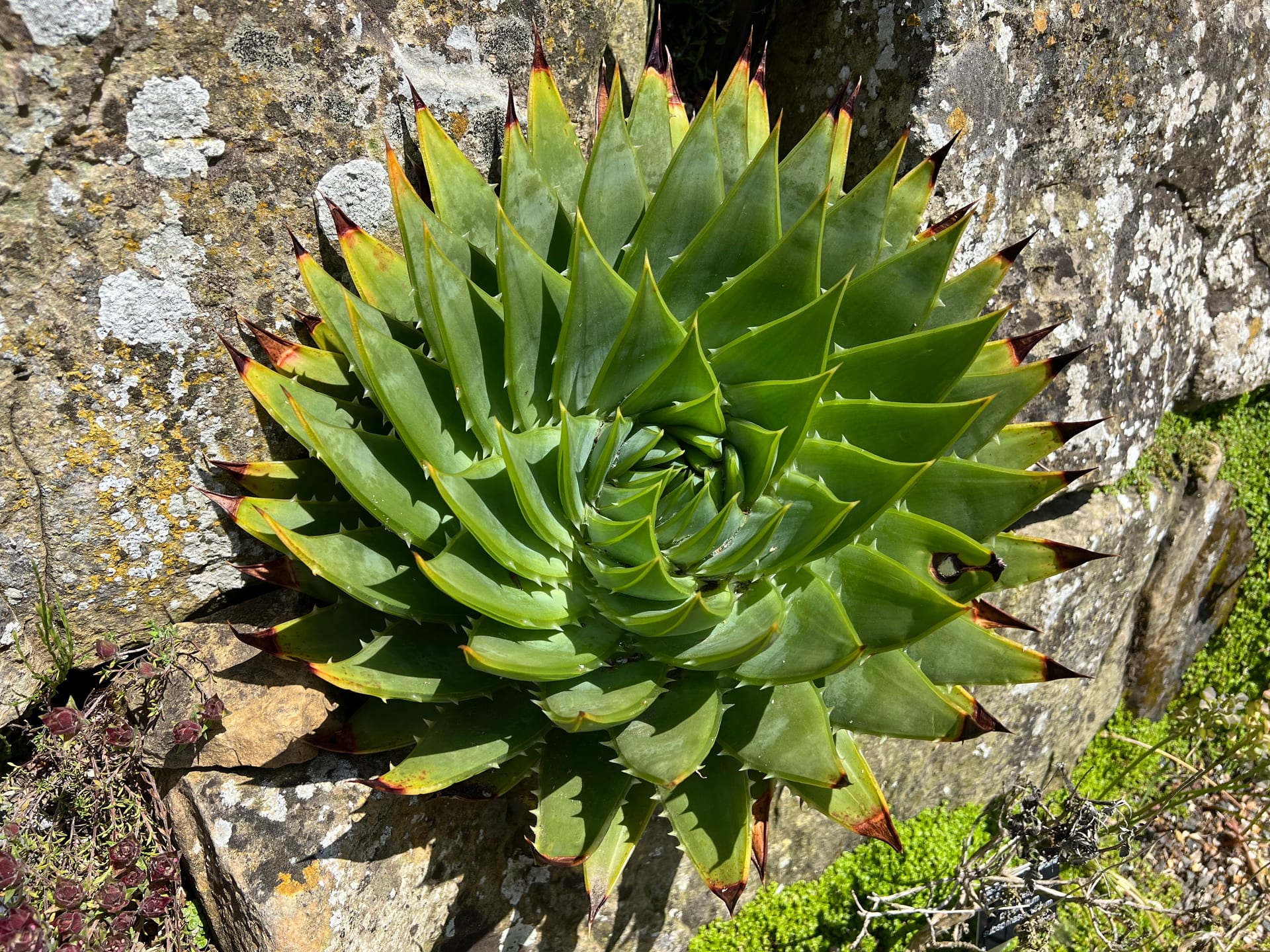
A stemless aloe whose broad grey-green leaves form five ranks in a striking clockwise or anticlockwise spiral. Found only in the high mountains of Lesotho and listed in CITES Appendix I.
About
Aloe polyphylla is endemic to the Maluti (Drakensberg) mountains of Lesotho, where it grows at 2,000–2,500 m in basalt crevices and on well-drained scree of steep slopes. Winters can bring snow, and summers are cool, with ample rain and mist. Its hallmark is the leaf arrangement: five ranks of 15–30 leaves spiral neatly clockwise or anticlockwise, about 150 leaves per plant, hence the name 'many-leaved'. The broad grey-green leaves end in sharp, dark purplish-brown tips and have irregular marginal teeth. Dull-red to salmon-pink, occasionally yellow flowers are borne in compact heads on branched inflorescences in spring and early summer. It rarely offsets, so wild populations regenerate only from seed. Collecting has reduced wild numbers, and in South Africa it is illegal to remove plants from habitat or buy them from roadside sellers. Plants taken from the wild seldom survive more than a few years, and it is considered difficult in cultivation; a US grower notes it is thirstier than most aloes and does best in cool climates. Plants sold in Japan are seed-raised or tissue-cultured, mainly through specialist nurseries, and because it is a CITES Appendix I species a registration certificate is required for any sale in Japan.
Source: Wikipedia (CC BY-SA 4.0)
Size of the Spiral aloe
The Spiral aloe grows to About 30 cm tall, 30–60 cm across.
Basic Info
Origin
Lesotho (Maluti Mountains, 2,000–2,500 m)
Lifespan
Perennial; rarely offsets and usually stays solitary
Size
About 30 cm tall, 30–60 cm across
Temperature
5〜35℃
Humidity
30〜50%
Watering & Fertilizer
Feed sparingly in the growing season
Growing Tips
Light & Placement
Bright sun to light shade. It comes from cool high mountains, so in hot weather keep it airy and cool and soften strong sun.
Watering
Considered thirstier than most aloes. In the growing season water thoroughly when the mix dries, provided it drains freely.
Temperature & Overwintering
Cold-hardy; a US grower rates it to around -12°C. Hot, humid summers are the main challenge, when heat and stagnant air damage it.
Soil & Repotting
It grows in rock crevices and scree, so use a very coarse, gritty, well-aerated mix.
Propagation
It rarely offsets, so propagation is from seed; plants in trade are seed-raised or tissue-cultured.
Pests & Cautions
As a CITES Appendix I and Japanese Internationally Endangered Species, transfers require a registration certificate, including for plants propagated in Japan; always check that one comes with the plant.
Spiral aloe FAQ
QWhat is the growing difficulty level for Spiral aloe?
Advanced. A variety suitable for advanced growers. Requires advanced cultivation techniques and specialized equipment, with careful environmental adjustments needed.
QHow large does Spiral aloe get?
The mature size of Spiral aloe is About 30 cm tall, 30–60 cm across. This may vary slightly depending on cultivation environment and individual differences.
QHow should I water and fertilize Spiral aloe?
Spiral aloe: watering & fertilizer — Feed sparingly in the growing season. Aim for appropriate frequency and amount.
QWhat is the typical price for Spiral aloe?
The price of Spiral aloe varies significantly by variety, characteristics, size, and lineage. Please check GrowerDirect's price guide for the latest market information.
Last updated: September 23, 2026
References & Sources
Edited & verified by: GrowerDirect Editorial Team
The classifications, regulations, and growing data on this page are created and verified based on the primary information database below.
Primary sources
- Wikipedia
- Species+ (CITES): Aloe polyphylla
- Ministry of the Environment: registration of specimens under the Act on Conservation of Endangered Species
- e-Gov: Enforcement Order of the Act on Conservation of Endangered Species (Appended Table 2)
- SANBI PlantZAfrica: Aloe polyphylla
- San Marcos Growers: Aloe polyphylla
- GBIF
Taxonomy & Authority
Regulations & Conservation Status
Listed in CITES Appendix I; commercial international trade is essentially prohibited. In Japan it is designated an Internationally Endangered Species under the Act on Conservation of Endangered Species of Wild Fauna and Flora, so any transfer (sale or gift) or display/advertising for sale requires a registration certificate for each plant, including plants propagated in Japan. Unregistered plants cannot be sold.
Sources: Species+ (CITES): Aloe polyphylla / Ministry of the Environment: registration of specimens under the Act on Conservation of Endangered Species / e-Gov: Enforcement Order of the Act on Conservation of Endangered Species (Appended Table 2)
Regulations may change. Always verify the latest information with the relevant authorities.
Related Species
Find listings for this species
Related Articles
Complete Guide to Growing Aloe | Sunlight, Watering, and Propagation from Offsets
From the basic characteristics of drought-tolerant succulent aloe to detailed guidance on sunlight, watering, repotting, propagation by offsetting, and root rot prevention.
Autumn Preparation Management for Summer-Type Succulents
A guide to autumn care for summer-type succulents, covering plant changes from September to November, timing for gradual watering reduction, placement and temperature management for transitioning plants indoors, autumn fertilizing and pest control, variety-specific care checkpoints, and preparation for winter dormancy.
Mealybug Control on Succulents | Complete Guide to Early Detection, Removal, and Prevention
Mealybugs hide easily at the base of succulent leaves and on new growth. This guide covers their characteristics, the environments where they thrive, tips for early detection, removal methods using cotton swabs and alcohol, and daily care practices to prevent recurrence.
Summer and Winter Type Succulents: Growth Cycles and Watering Management Strategy
This article explains the differences in growth types of succulent plants, their annual growth cycles, seasonal watering management strategies, common failures, and countermeasures.
🩺 Common diseases
Can't find the plant you're looking for?
Post your wishes for free and growers with matching plants will contact you with introductions.