Source: Wikimedia Commons
Artichoke cactus
AdvancedObregonia denegrii
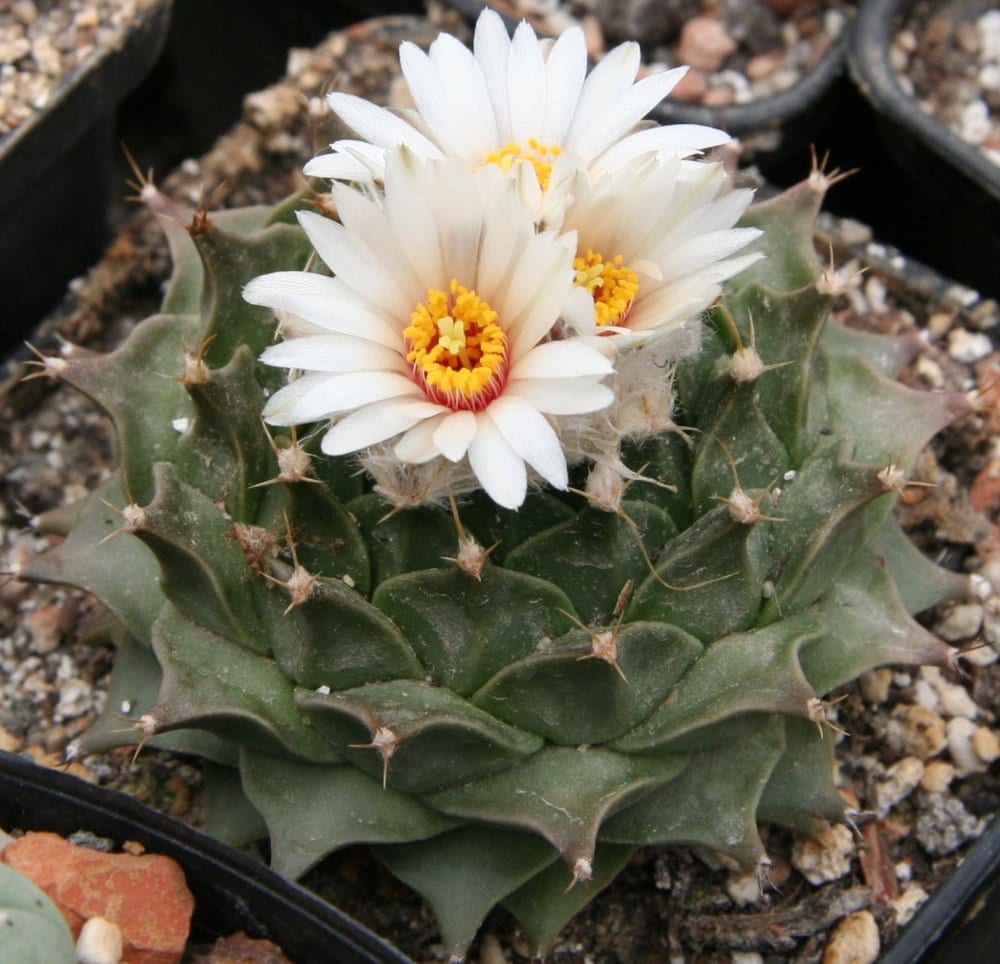
The only species in its genus, with leaf-like triangular tubercles spiralled into a shape like an artichoke or upturned pine cone. The woolly crown bears white flowers in summer.
About
Obregonia denegrii is the only species in its genus and is related to Ariocarpus. It is confined to the Jaumave valley near Ciudad Victoria in Tamaulipas, Mexico, at about 1,000 m, on limestone gravel slopes in semi-desert and scrub. Its range is tiny, with no more than five subpopulations and fewer than 5,000 plants, and numbers continue to fall through illegal collecting and habitat change from grazing. The stem is usually solitary and grows flat, level with the ground, reaching 15 cm or more across. Leaf-like triangular tubercles, flat above and keeled below, are arranged in a spiral so the plant resembles an artichoke or upturned pine cone. The slightly sunken crown is woolly, and young tubercles bear 2-4 soft spines 5-15 mm long that soon fall. In summer white day-flowers about 2.5 cm across appear from the wool at the crown. It has a thick taproot. It is listed in CITES Appendix I and is an internationally rare species under Japan's Act on Conservation of Endangered Species. In Japan seed-grown and grafted plants are sold by specialist nurseries.
Lifespan of the Artichoke cactus
The Artichoke cactus lives Long-lived perennial (little published data on lifespan); takes 7-8 years to flower.
Size of the Artichoke cactus
The Artichoke cactus grows to 15 cm or more across, growing flat and level with the ground.
Basic Info
Origin
Jaumave valley, Tamaulipas, Mexico (about 1,000 m)
Lifespan
Long-lived perennial (little published data on lifespan); takes 7-8 years to flower
Size
15 cm or more across, growing flat and level with the ground
Temperature
5〜35℃
Humidity
30〜50%
Watering & Fertilizer
Very little fertiliser
Growing Tips
Light & Placement
It needs good sun to stay compact and flat. Keep it well ventilated at all times, including the rest period, somewhere that does not trap humidity.
Watering
Cacti are grown much like summer-growing succulents. Water sparingly and infrequently from March to October; too much water makes the stem elongate and lose its natural shape. Keep it completely dry in winter or whenever night temperatures stay below 10°C.
Temperature & Overwintering
Kept dry it reportedly survives brief cold to about -4°C, but winter it dry and frost-free. Humid air during dormancy is harmful.
Soil & Repotting
Use a very free-draining mineral mix with little organic matter, in a pot deep enough for the thick taproot.
Propagation
It is propagated almost only from seed. Seedlings are tiny and slow, reaching only 3-5 mm in their first year or two and taking 7-8 years to reach flowering size; grafting onto columnar stock is often used to speed growth.
Pests & Cautions
It is a CITES Appendix I species. Transfers within Japan require a registration certificate under the Act on Conservation of Endangered Species (including plants propagated in Japan), so always confirm the certificate accompanies the plant when buying or receiving one.
Artichoke cactus FAQ
QWhat is the growing difficulty level for Artichoke cactus?
Advanced. A variety suitable for advanced growers. Requires advanced cultivation techniques and specialized equipment, with careful environmental adjustments needed.
QWhat is the lifespan of Artichoke cactus?
The average lifespan of Artichoke cactus is Long-lived perennial (little published data on lifespan); takes 7-8 years to flower. With proper cultivation environment and nutrient management, you can keep it healthy for a long time.
QHow large does Artichoke cactus get?
The mature size of Artichoke cactus is 15 cm or more across, growing flat and level with the ground. This may vary slightly depending on cultivation environment and individual differences.
QHow should I water and fertilize Artichoke cactus?
Artichoke cactus: watering & fertilizer — Very little fertiliser. Aim for appropriate frequency and amount.
QWhat is the typical price for Artichoke cactus?
The price of Artichoke cactus varies significantly by variety, characteristics, size, and lineage. Please check GrowerDirect's price guide for the latest market information.
Last updated: September 23, 2026
References & Sources
Edited & verified by: GrowerDirect Editorial Team
The classifications, regulations, and growing data on this page are created and verified based on the primary information database below.
Taxonomy & Authority
Accepted name: Obregonia denegrii Fric
Synonyms: Ariocarpus denegrii (Fric) W.T.Marshall, Strombocactus denegrii (Fric) G.D.Rowley
Authority databases: GBIF · GBIF: Obregonia denegrii
Nomenclature follows global taxonomic authority databases.
Regulations & Conservation Status
Listed in CITES Appendix I and designated an internationally rare species under Japan's Act on Conservation of Endangered Species. Transfers within Japan require a registration certificate under that Act (plants propagated in Japan are also subject to registration). In principle, plants without a certificate may not be sold, transferred, displayed or advertised for sale.
Sources: Species+ (CITES): Obregonia denegrii / e-Gov: Enforcement Order of the Act on Conservation of Endangered Species
Regulations may change. Always verify the latest information with the relevant authorities.
Related Species
Find listings for this species
Related Articles
Autumn Preparation Management for Summer-Type Succulents
A guide to autumn care for summer-type succulents, covering plant changes from September to November, timing for gradual watering reduction, placement and temperature management for transitioning plants indoors, autumn fertilizing and pest control, variety-specific care checkpoints, and preparation for winter dormancy.
Mealybug Control on Succulents | Complete Guide to Early Detection, Removal, and Prevention
Mealybugs hide easily at the base of succulent leaves and on new growth. This guide covers their characteristics, the environments where they thrive, tips for early detection, removal methods using cotton swabs and alcohol, and daily care practices to prevent recurrence.
Summer and Winter Type Succulents: Growth Cycles and Watering Management Strategy
This article explains the differences in growth types of succulent plants, their annual growth cycles, seasonal watering management strategies, common failures, and countermeasures.
Selecting Pots for Succulents: The Relationship Between Root Development and Pot Choice | A Complete Guide to Pot Size, Material, and Drainage
Essential guide to pot selection for succulent growth. From choosing the right size to comparing terracotta vs. plastic, and optimizing drainage—practical tips for developing healthy root systems.
🩺 Common diseases
Can't find the plant you're looking for?
Post your wishes for free and growers with matching plants will contact you with introductions.