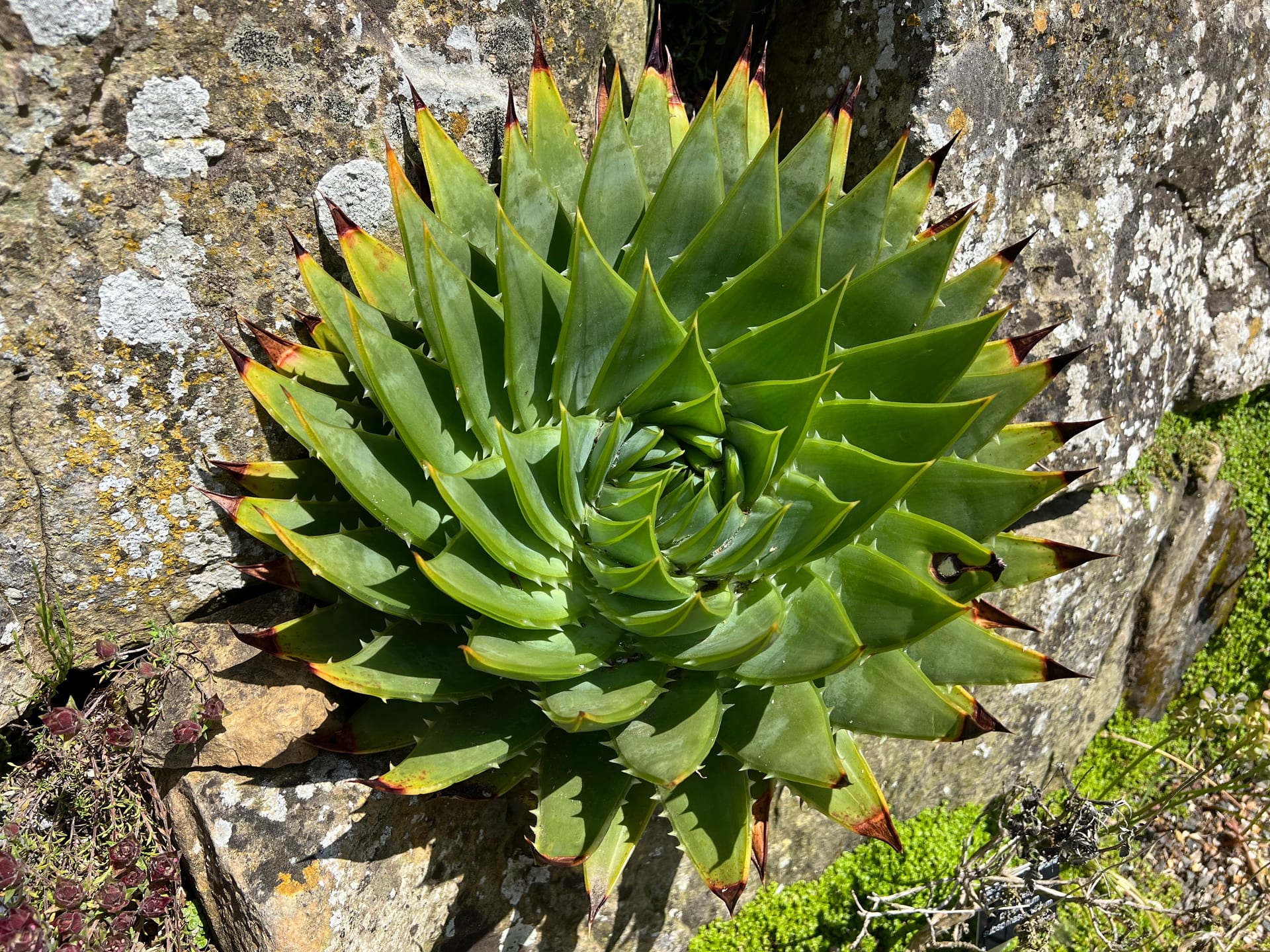
 © LavaLampBamboo / CC BY-SA 4.0
Spiral aloe
Aloe polyphylla is a striking, stemless aloe whose broad grey-green leaves form five neat rows that spiral outward in a clockwise or counterclockwise pattern, no two plants look quite the same. It grows naturally only in the cool, high-altitude mountains of Lesotho, above 2,000 meters. As a perennial, it rarely produces offsets and develops slowly as a single rosette that can carry around 150 leaves. Keeping that perfect spiral shape takes careful, experienced care, which is why this species is considered suitable for advanced growers rather than beginners. For those willing to take the time, it rewards patience with a one-of-a-kind sculptural form. It is listed in CITES Appendix I and designated an Internationally Endangered Species under Japan's Act on Conservation of Endangered Species (種の保存法), so transferring a plant by sale or gift, or displaying or advertising it for sale, requires an individual registration certificate, and this applies to plants propagated in Japan too. Plants without a certificate cannot be bought or sold, so always confirm the certificate when buying.
View Spiral aloe encyclopedia →0% commission on your first sales!Register by September 30, 2026 and your first 2 plants are commission-free!
Grower Wanted!
List your plants on GrowerDirect and sell directly to customers nationwide!
6 Transparency Commitments from GrowerDirect
Grower disclose this information for Succulents & Cacti. We guarantee transparency in variety, origin, light requirements, and difficulty level.
- Variety Disclosed
- Real Photos
- Color Details
- Origin Disclosed
- Light Requirements
- Difficulty Level
Browse all 131 varieties
Light Requirements
Difficulty Level
Verified growers wanted for Succulents & Cacti
Growers are signing up now ahead of launch. Subscribe to be notified when new listings go live.
Getting alerts is free with a member account. When new listings match your saved search, we'll notify you by email and in-app.
Browse other categories
Verified growers (preview)
Are you growing succulents & cacti?
Register as a grower and connect with buyers directly.
Apply as a growerSpiral aloe key facts
- Growing Difficulty
- Advanced
- Lifespan
- Perennial; rarely offsets and usually stays solitary
- Size
- About 30 cm tall, 30–60 cm across
- Watering
- Feed sparingly in the growing season
- Light & Placement
- Bright sun to light shade. It comes from cool high mountains, so in hot weather keep it airy and cool and soften strong sun.
- Watering
- Considered thirstier than most aloes. In the growing season water thoroughly when the mix dries, provided it drains freely.
- Temperature & Overwintering
- Cold-hardy; a US grower rates it to around -12°C. Hot, humid summers are the main challenge, when heat and stagnant air damage it.
- Soil & Repotting
- It grows in rock crevices and scree, so use a very coarse, gritty, well-aerated mix.
- Propagation
- It rarely offsets, so propagation is from seed; plants in trade are seed-raised or tissue-cultured.
- Pests & Cautions
- As a CITES Appendix I and Japanese Internationally Endangered Species, transfers require a registration certificate, including for plants propagated in Japan; always check that one comes with the plant.
About Spiral aloe
A stemless aloe with broad grey-green leaves arranged in five spiraling rows, native only to Lesotho's high mountains. It grows slowly as a single rosette, rarely producing offsets, making it a plant for experienced growers.
7 things to know before growing Spiral aloe
1Placement and Sunlight
This aloe prefers bright light and good airflow, but intense midsummer sun can scorch the leaves. In summer, a spot with bright, filtered light or light afternoon shade is safer.
2Watering
This aloe is said to like more water than other aloes. Provided it is planted in a fast-draining mix where water never lingers, water thoroughly during the growing season whenever the soil has dried, and never let water pool at the base of the pot.
3Well-Draining Soil
A well-draining succulent or cactus mix suits this plant best. Water pooling in the center of the rosette can cause rot, so water the soil directly rather than the crown of the plant.
4Repotting
Because it grows slowly as a single rosette, frequent repotting isn't necessary. Move it into a slightly larger pot only once the roots have filled the current one.
5Seasonal Care
During hot, humid weather, keep airflow good and adjust watering to avoid rot. Coming from cool mountain habitats, it tolerates cold reasonably well, but some winter protection is still a good idea.
6Choosing a Plant and the Registration Certificate
Look for a plant with a neat, well-formed spiral and a firm, healthy center. As a CITES Appendix I species designated under Japan's Act on Conservation of Endangered Species (種の保存法), any transfer requires a registration certificate, including for plants propagated in Japan. Always confirm the certificate comes with the plant when buying.
7Rarely Offsets
This aloe rarely produces offsets and grows as a single head, which makes propagation by division difficult. It's a plant best enjoyed for the long-term growth of a single specimen rather than for multiplying easily.
Frequently asked questions about Spiral aloe
- Q.Is this suitable for beginners?
- A.This species is generally considered suitable for advanced growers. Because watering and placement require some care, it's best attempted after you've gained experience with succulents.
- Q.How large does it grow?
- A.Its leaves form five rows of 15 to 30 each, for around 150 leaves on a single plant. Since it grows slowly as a single rosette, it takes many years to develop its full spiral form.
- Q.Can I choose the direction of the spiral?
- A.The spiral can turn either clockwise or counterclockwise, and this is fixed for each individual plant. Checking the direction at the time of purchase lets you pick the one you prefer.
- Q.Can it be propagated from offsets?
- A.Because it rarely produces offsets and grows as a single head, propagation by division is difficult. Growing new plants from seed is the main method used instead.
- Q.What kind of environment does it grow in naturally?
- A.It grows naturally in the cool, high mountains of Lesotho, at elevations above 2,000 meters. In the wild, it's found on rocky, high-altitude slopes.
Handy Growing Tools for Spiral aloe
Learn more about Spiral aloe in the encyclopedia
View Spiral aloe encyclopedia entry →
Care difficulty, size, origin and light needs — all basics covered.
More in this category
Can't find the plant you're looking for?
Post your wishes for free and growers with matching plants will contact you with introductions.