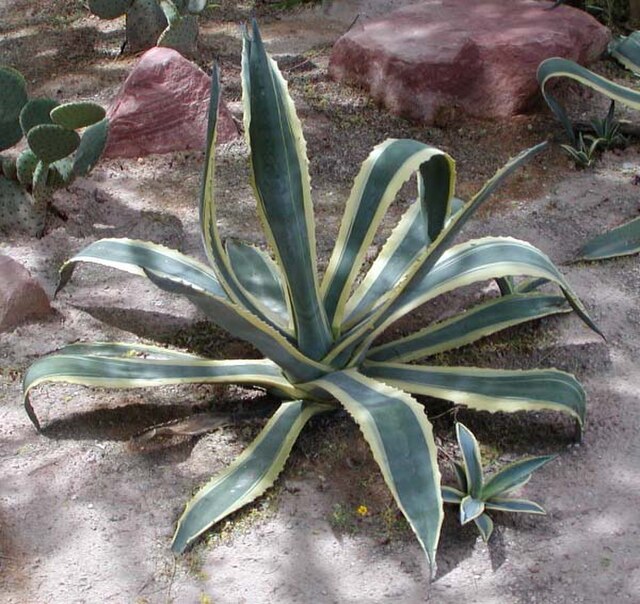
Source: Wikimedia Commons
Agave (General)
IntermediateExtremely popular succulent genus. Ranges from expensive Titanota to garden-friendly Attenuata.
About
Agave is a genus of monocots in the family Asparagaceae, comprising about 200 species native to arid and semi-arid regions of southern North America, Mexico, and Central America. The plants form bold, architectural rosettes of stiff, thick leaves typically edged with teeth and tipped with a sharp terminal spine. Agaves grow very slowly but can reach impressive sizes; some species attain several meters in height and spread. All species are monocarpic, meaning they flower only once at the end of their long lives—ranging from 10 to 30 years—after which the parent rosette dies, often leaving offsets. The genus encompasses plants from highly valued collector specimens such as A. titanota to garden-friendly soft-leaved types like A. attenuata. Full sun and extremely well-draining soil are essential; watering should be infrequent. Cold hardiness varies widely by species, from frost-sensitive to extremely hardy.
Lifespan of the Agave (General)
The Agave (General) lives 10-30 years (monocarpic — dies after flowering).
Size of the Agave (General)
The Agave (General) grows to 10cm-2m.
Temperature & humidity for the Agave (General)
The Agave (General) tolerates temperatures of 0〜40℃.
Basic Info
Origin
southern North America, Mexico, and Central America
Lifespan
10-30 years (monocarpic — dies after flowering)
Size
10cm-2m
Temperature
0〜40℃
Humidity
30〜50%
Growing Tips
Light & Placement
Loves direct sun and an airy spot. More and more varieties overwinter outdoors in Japan, making it suitable for garden beds.
Watering
After soil fully dries. Keep minimal
Soil
Extremely well-draining soil. Mainly pumice and Hyuga soil
Temperature & Overwintering
Growing range is 0-40°C. Cold hardiness varies by species; the hardiest tolerate -15°C, so choose the overwintering spot per variety.
Propagation
Propagate from offsets or seed. The plant is monocarpic and dies after flowering, but many species produce offsets afterward.
Notes
Sharp leaf tips — caution with children and pets
Agave (General) FAQ
QWhat is the growing difficulty level for Agave (General)?
Intermediate. A variety suitable for intermediate growers. Requires some cultivation experience and knowledge of environment management. Pay careful attention to temperature and humidity control.
QWhat temperatures can Agave (General) tolerate?
Agave (General) tolerates temperatures of 0〜40℃. This is the tolerated range, not the ideal growing temperature. Keep conditions well inside it and avoid sudden temperature changes.
QWhat is the lifespan of Agave (General)?
The average lifespan of Agave (General) is 10-30 years (monocarpic — dies after flowering). With proper cultivation environment and nutrient management, you can keep it healthy for a long time.
QHow large does Agave (General) get?
The mature size of Agave (General) is 10cm-2m. This may vary slightly depending on cultivation environment and individual differences.
QWhat is the typical price for Agave (General)?
The price of Agave (General) varies significantly by variety, characteristics, size, and lineage. Please check GrowerDirect's price guide for the latest market information.
Last updated: June 13, 2026
References & Sources
Edited & verified by: GrowerDirect Editorial Team
The classifications, regulations, and growing data on this page are created and verified based on the primary information database below.
Related Species
Find listings for this species
Related Articles
Succulent & Agave Pest & Disease Management Guide | Root Rot, Scale Insects, Black Spot
Guide to common pests and diseases affecting succulents and agave, explaining symptoms, causes, and countermeasures. Includes treatment methods and prevention strategies for root rot, scale insects, spider mites, and black spot.
Preventing Leaf Burn in Agave and Light Management | Transition Strategy from Indoor to Outdoor Cultivation
Light management strategy to prevent agave leaf burn completely while successfully transitioning from indoor to outdoor environments. This article explains practical methods including gradual light intensity adjustment, seasonal placement changes, and UV protection measures.
Tips for Cultivating White Variegated Agave Varieties
Tips for Cultivating White Variegated Agave Varieties
Complete Care Guide for Agave oteroi | Tips for Training Beautiful Large Rosettes
We explain the characteristics and cultivation of Agave oteroi, a large agave native to Oaxaca, Mexico. From placement location and soil to watering and overwintering—a practical guide for those beginning to cultivate this species.
🩺 Common diseases
Can't find the plant you're looking for?
Post your wishes for free and growers with matching plants will contact you with introductions.