Source: Wikimedia Commons
Living rock cactus
AdvancedAriocarpus fissuratus
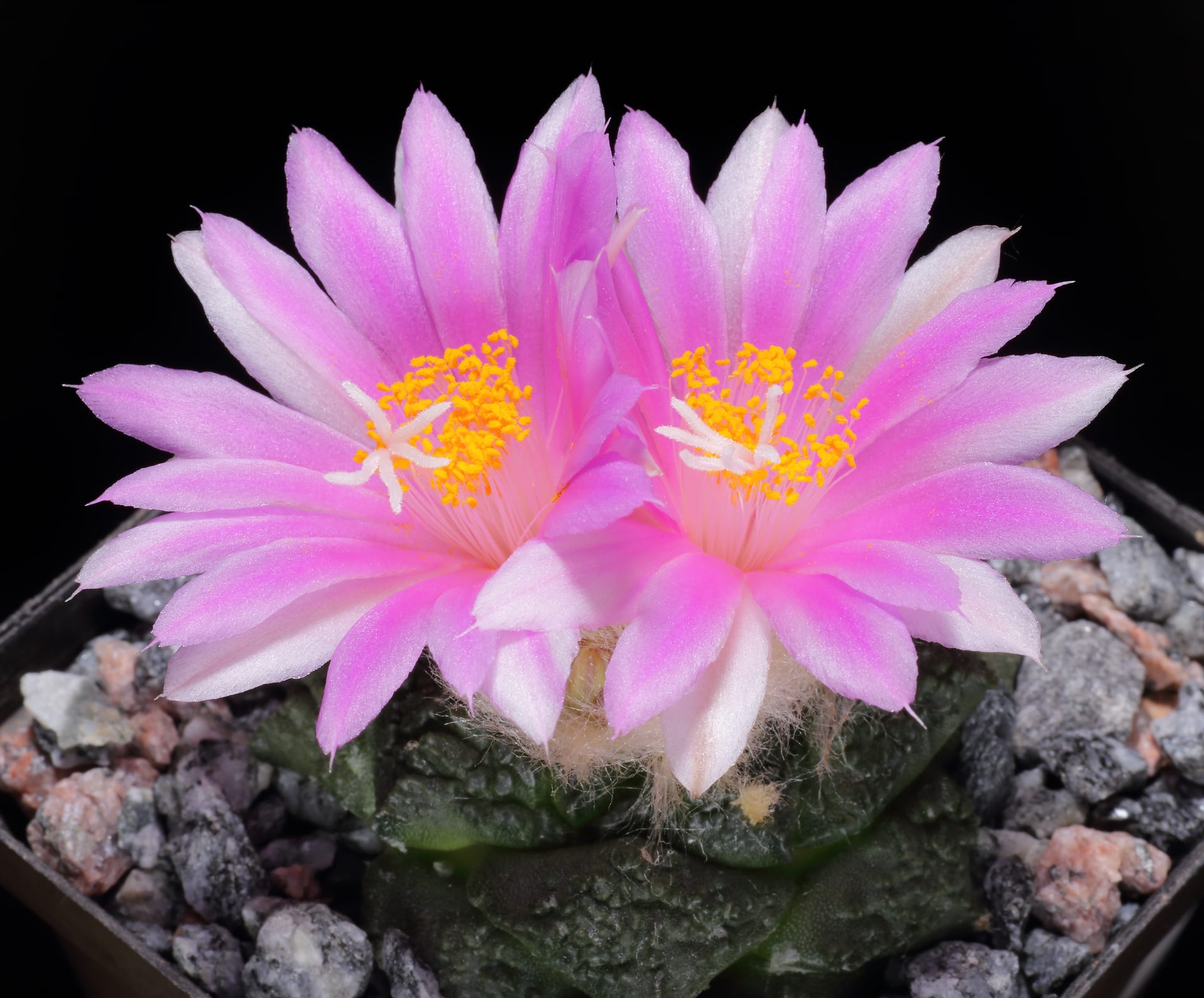
A spineless, flattened cactus whose triangular, furrowed tubercles overlap like a tortoise shell. It flowers pinkish-purple from the crown in autumn; a classic of the genus Ariocarpus.
About
Ariocarpus fissuratus grows on limestone plains and low hills at about 500–1,170 m from south-western Texas into northern Mexico (Coahuila, Chihuahua, Durango, Nuevo León, Tamaulipas and Zacatecas). From a large taproot it forms a flattened to hemispherical body 1.5–10 cm high and up to 10 cm (rarely 15 cm) across. There are no spines: hard, triangular to rhombic tubercles spiral around the plant, each split by a deep furrow joining the areole and axil, giving the tortoise-shell look behind the Japanese name. Wool in the furrows is straw-coloured at first and later greys. Light purple to pinkish-red flowers, 2.5–4.5 cm across, open from the crown in October–November. Growth is extremely slow, taking a decade or more to maturity, so plants are sometimes grafted onto columnar cacti. Poaching in habitat is severe and the species is listed in CITES Appendix I. Plants in Japan are essentially domestically seed-raised, mostly by hobby growers, and wide-tubercled forms are prized as 'o-ibo' kikko-botan.
Source: Wikipedia (CC BY-SA 4.0)
Lifespan of the Living rock cactus
The Living rock cactus lives Perennial; extremely slow, taking a decade or more to mature.
Size of the Living rock cactus
The Living rock cactus grows to 10–15 cm across, 1.5–10 cm tall (up to about 20 cm across in cultivation).
Basic Info
Origin
South-western Texas (USA) and northern Mexico
Lifespan
Perennial; extremely slow, taking a decade or more to mature
Size
10–15 cm across, 1.5–10 cm tall (up to about 20 cm across in cultivation)
Temperature
5〜35℃
Humidity
30〜50%
Watering & Fertilizer
Little needed; a small amount of slow-release organic fertiliser at repotting
Growing Tips
Light & Placement
In habitat most of the body is buried, so it dislikes intense light. From spring to autumn keep it under 30–50% shade, out of the rain or in a cold frame; in winter keep it in a greenhouse or a sunny room.
Watering
A summer grower. Water thoroughly when the mix dries; in midsummer and winter just moisten it about twice a month. Water at the base so the woolly crown is not washed away.
Temperature & Overwintering
It likes warmth and starts growing later in spring than most cacti. A Japanese reference gives 3°C as the minimum survival temperature. Watch for sunburn when moving plants or during sudden sunny spells.
Soil & Repotting
It has a thick taproot, so use a deeper pot and a free-draining mix. Repot every 2–3 years, adding a little slow-release organic fertiliser.
Propagation
Raised from seed; sometimes grafted onto a columnar stock to speed growth.
Pests & Cautions
Scale insects are common and hide between the tubercles. As a CITES Appendix I and Japanese Internationally Endangered Species, transfers require a registration certificate, including for plants propagated in Japan.
Living rock cactus FAQ
QWhat is the growing difficulty level for Living rock cactus?
Advanced. A variety suitable for advanced growers. Requires advanced cultivation techniques and specialized equipment, with careful environmental adjustments needed.
QWhat is the lifespan of Living rock cactus?
The average lifespan of Living rock cactus is Perennial; extremely slow, taking a decade or more to mature. With proper cultivation environment and nutrient management, you can keep it healthy for a long time.
QHow large does Living rock cactus get?
The mature size of Living rock cactus is 10–15 cm across, 1.5–10 cm tall (up to about 20 cm across in cultivation). This may vary slightly depending on cultivation environment and individual differences.
QHow should I water and fertilize Living rock cactus?
Living rock cactus: watering & fertilizer — Little needed; a small amount of slow-release organic fertiliser at repotting. Aim for appropriate frequency and amount.
QWhat is the typical price for Living rock cactus?
The price of Living rock cactus varies significantly by variety, characteristics, size, and lineage. Please check GrowerDirect's price guide for the latest market information.
Last updated: September 23, 2026
References & Sources
Edited & verified by: GrowerDirect Editorial Team
The classifications, regulations, and growing data on this page are created and verified based on the primary information database below.
Primary sources
- Wikipedia
- Species+ (CITES): Ariocarpus fissuratus
- Ministry of the Environment: registration of specimens under the Act on Conservation of Endangered Species
- e-Gov: Enforcement Order of the Act on Conservation of Endangered Species (Appended Table 2)
- NHK Publishing "Minna no Shumi no Engei" succulent database: アリオカルプス 亀甲牡丹
- GBIF
Taxonomy & Authority
Accepted name: Ariocarpus fissuratus (Engelm.) K.Schum.
Synonyms: Anhalonium engelmannii, Anhalonium fissuratum, Ariocarpus fissuratus fissuratus, Ariocarpus fissuratus lloydii, Ariocarpus fissuratus pailanus, Ariocarpus intermedius, Ariocarpus lloydii, Ariocarpus lloydii mayor
Authority databases: GBIF · GBIF
Nomenclature follows global taxonomic authority databases.
Regulations & Conservation Status
Listed in CITES Appendix I; commercial international trade is essentially prohibited. In Japan it is designated an Internationally Endangered Species under the Act on Conservation of Endangered Species of Wild Fauna and Flora, so any transfer (sale or gift) or display/advertising for sale requires a registration certificate for each plant, including plants propagated in Japan. Unregistered plants cannot be sold.
Sources: Species+ (CITES): Ariocarpus fissuratus / Ministry of the Environment: registration of specimens under the Act on Conservation of Endangered Species / e-Gov: Enforcement Order of the Act on Conservation of Endangered Species (Appended Table 2)
Regulations may change. Always verify the latest information with the relevant authorities.
Related Species
Find listings for this species
Related Articles
Autumn Preparation Management for Summer-Type Succulents
A guide to autumn care for summer-type succulents, covering plant changes from September to November, timing for gradual watering reduction, placement and temperature management for transitioning plants indoors, autumn fertilizing and pest control, variety-specific care checkpoints, and preparation for winter dormancy.
Mealybug Control on Succulents | Complete Guide to Early Detection, Removal, and Prevention
Mealybugs hide easily at the base of succulent leaves and on new growth. This guide covers their characteristics, the environments where they thrive, tips for early detection, removal methods using cotton swabs and alcohol, and daily care practices to prevent recurrence.
Summer and Winter Type Succulents: Growth Cycles and Watering Management Strategy
This article explains the differences in growth types of succulent plants, their annual growth cycles, seasonal watering management strategies, common failures, and countermeasures.
Selecting Pots for Succulents: The Relationship Between Root Development and Pot Choice | A Complete Guide to Pot Size, Material, and Drainage
Essential guide to pot selection for succulent growth. From choosing the right size to comparing terracotta vs. plastic, and optimizing drainage—practical tips for developing healthy root systems.
🩺 Common diseases
Can't find the plant you're looking for?
Post your wishes for free and growers with matching plants will contact you with introductions.