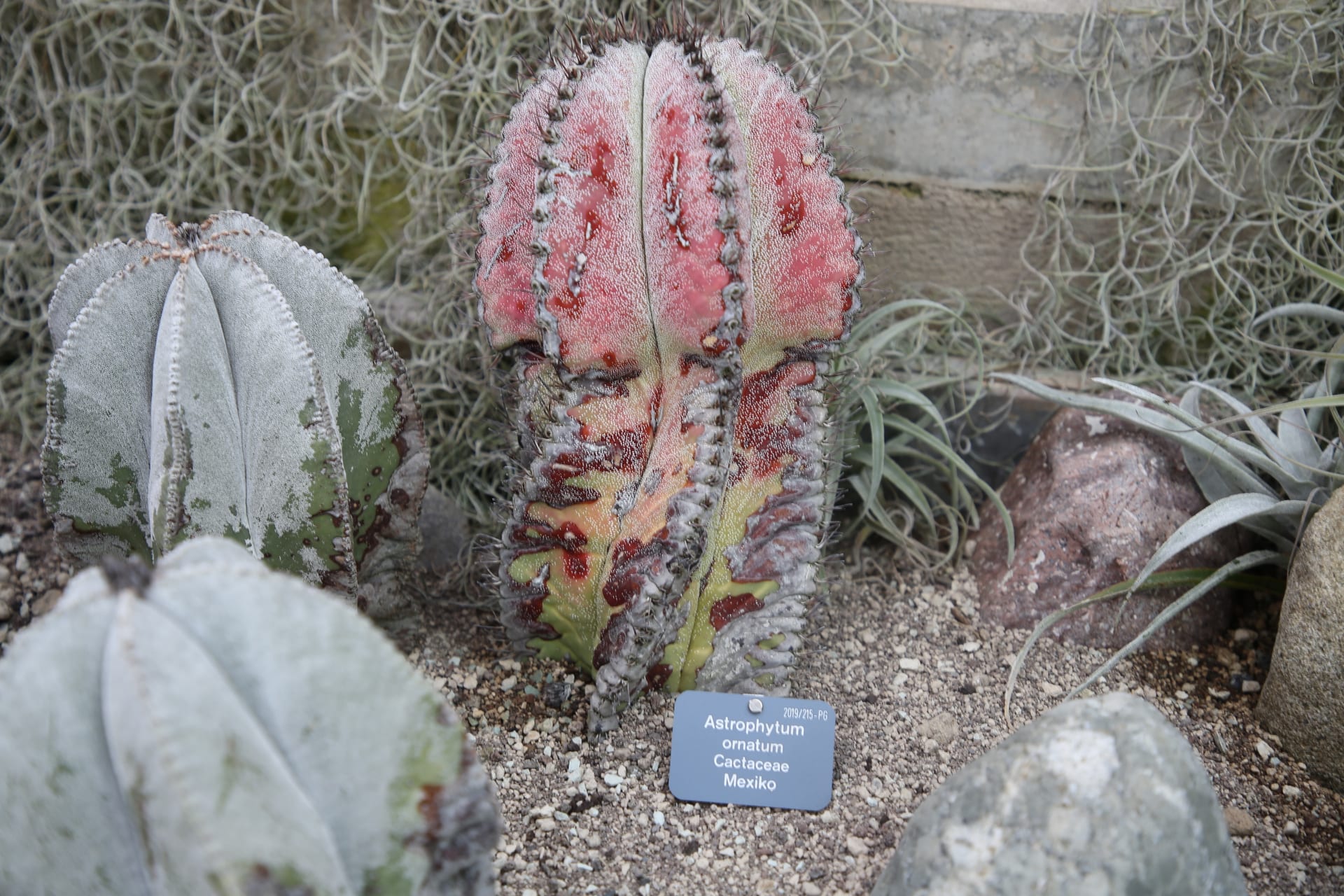
Source: Wikimedia Commons
Bishop's cap / Star cactus
BeginnerAstrophytum ornatum
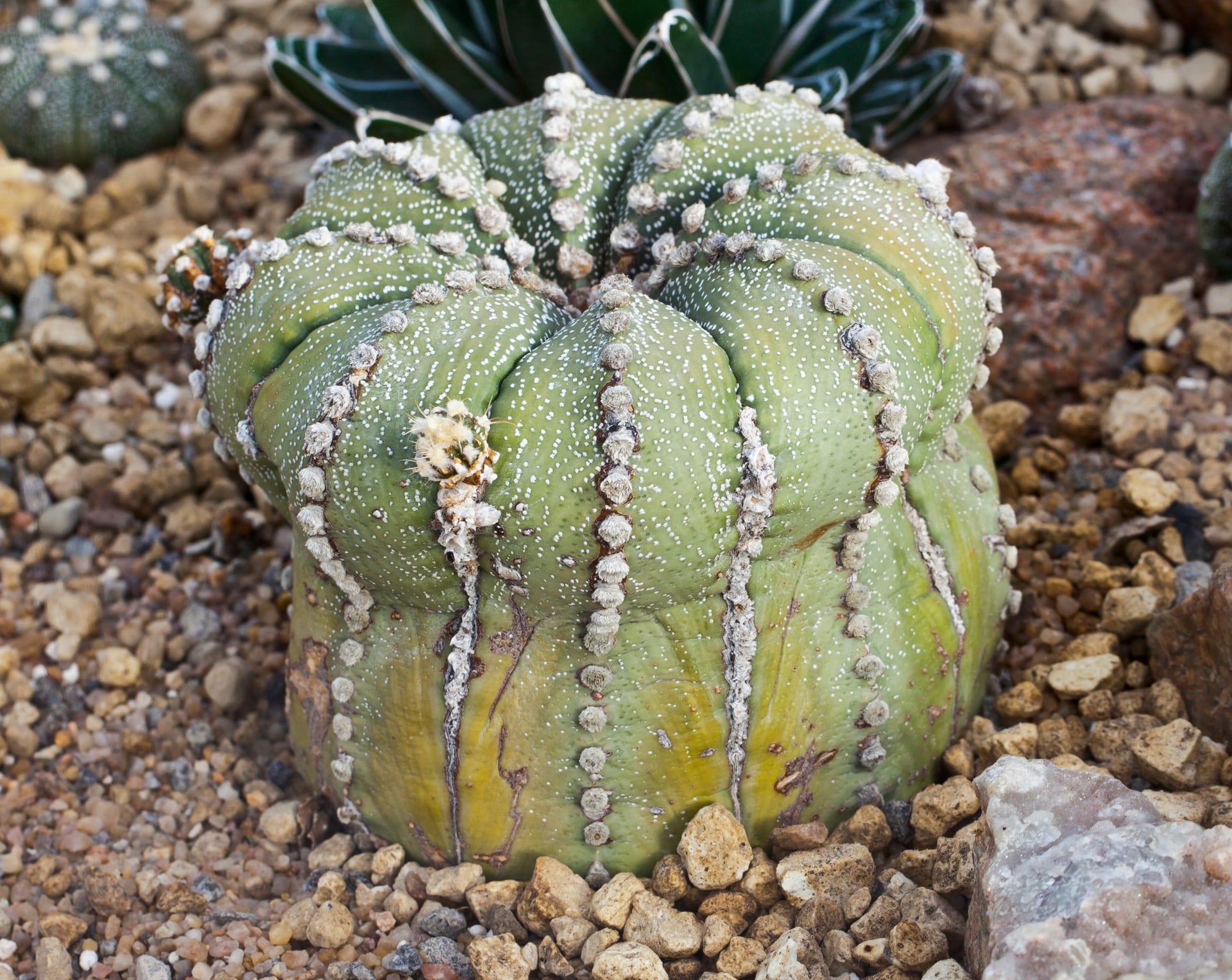
The largest Astrophytum, becoming columnar and up to 2 m tall in habitat. Sharp ribs carry stout spines, and white woolly flecks pattern the dark green skin. Yellow flowers in summer.
About
Astrophytum ornatum is endemic to the Central Plateau of Mexico and is the largest and tallest species of the star cacti. It grows as a solitary column up to 2 m tall and 30 cm wide in habitat. Numerous white woolly flakes on the skin help protect it from the sun. Young plants are small, with deep ribs and curving reddish spines, and are common in garden centres; with age the areoles line the ribs more fiercely, the base becomes bark-like, and each plant shows its own pattern of white flecks. Canary-yellow flowers 7–8 cm long appear in summer. Like other Astrophytum it is self-sterile and raised from cross-pollinated seed, so every plant is different. It is rugged, resistant to root rot and easy in well-drained soil, and turns darker green in filtered light. It holds the RHS Award of Garden Merit. In Japan young seedlings are widely sold as an entry-level star cactus, while old specimens are handled by specialist nurseries.
Source: Wikipedia (CC BY-SA 4.0)
Size of the Bishop's cap / Star cactus
The Bishop's cap / Star cactus grows to Up to 2 m tall and 30 cm wide in habitat.
Temperature & humidity for the Bishop's cap / Star cactus
Established plants are said to tolerate about -4°C, though potted plants are safer kept from freezing.
Basic Info
Origin
Central Plateau of Mexico
Lifespan
Perennial; becomes a tall column over many years
Size
Up to 2 m tall and 30 cm wide in habitat
Temperature
5〜35℃
Humidity
30〜50%
Watering & Fertilizer
Light feeder; a little slow-release fertiliser at repotting
Growing Tips
Light & Placement
Grow in good light; in filtered shade the skin turns darker green. Sudden strong sun after a spell in low light can scorch it.
Watering
A summer grower. Robust and resistant to root rot, but still water only when a free-draining mix has dried. Keep it drier in winter.
Temperature & Overwintering
Established plants are said to tolerate about -4°C; a Japanese reference gives 5°C as a guide, so keep potted plants free of frost and freezing in winter.
Soil & Repotting
Use a free-draining cactus mix. It grows large, so pot on when the roots fill the container.
Propagation
Self-sterile, so it is raised from seed produced by crossing two plants; every seedling differs in flecking and spination.
Pests & Cautions
The spines on the ribs are hard and sharp; handle with thick gloves or wrap the plant in paper when repotting.
Bishop's cap / Star cactus FAQ
QWhat is the growing difficulty level for Bishop's cap / Star cactus?
Beginner. A variety suitable for beginners. No special equipment or experience is required—you can grow it without problems by setting up a basic cultivation environment.
QHow large does Bishop's cap / Star cactus get?
The mature size of Bishop's cap / Star cactus is Up to 2 m tall and 30 cm wide in habitat. This may vary slightly depending on cultivation environment and individual differences.
QHow should I water and fertilize Bishop's cap / Star cactus?
Bishop's cap / Star cactus: watering & fertilizer — Light feeder; a little slow-release fertiliser at repotting. Aim for appropriate frequency and amount.
QWhat is the typical price for Bishop's cap / Star cactus?
The price of Bishop's cap / Star cactus varies significantly by variety, characteristics, size, and lineage. Please check GrowerDirect's price guide for the latest market information.
Last updated: September 23, 2026
References & Sources
Edited & verified by: GrowerDirect Editorial Team
The classifications, regulations, and growing data on this page are created and verified based on the primary information database below.
Taxonomy & Authority
Accepted name: Astrophytum ornatum (DC.) Britton & Rose
Synonyms: Astrophytum glabrescens, Astrophytum ornatum, Astrophytum ornatum glabrescens, Astrophytum ornatum mirbelii, Astrophytum ornatum niveum, Astrophytum ornatum pubescente, Astrophytum ornatum virens, Echinocactus ghiesbrechtii
Authority databases: GBIF · GBIF
Nomenclature follows global taxonomic authority databases.
Regulations & Conservation Status
Listed in CITES Appendix II (as part of the family-level listing of Cactaceae). International trade requires export permits, but no registration is needed to transfer plants within Japan. It is not regulated under Japan's Invasive Alien Species Act.
Sources: Species+ (CITES): Astrophytum ornatum / Ministry of the Environment: list of Invasive Alien Species
Regulations may change. Always verify the latest information with the relevant authorities.
Related Species
Find listings for this species
Related Articles
How to Care for Astrophytum: Preventing Root Rot Through Watering Control and the Summer Type Dormancy Cycle
A guide to caring for Astrophytum cactus. Introduces seasonal care steps from watering and light management during the growing period, water restriction during dormancy, to the timing of resuming watering in spring.
Autumn Preparation Management for Summer-Type Succulents
A guide to autumn care for summer-type succulents, covering plant changes from September to November, timing for gradual watering reduction, placement and temperature management for transitioning plants indoors, autumn fertilizing and pest control, variety-specific care checkpoints, and preparation for winter dormancy.
Mealybug Control on Succulents | Complete Guide to Early Detection, Removal, and Prevention
Mealybugs hide easily at the base of succulent leaves and on new growth. This guide covers their characteristics, the environments where they thrive, tips for early detection, removal methods using cotton swabs and alcohol, and daily care practices to prevent recurrence.
Summer and Winter Type Succulents: Growth Cycles and Watering Management Strategy
This article explains the differences in growth types of succulent plants, their annual growth cycles, seasonal watering management strategies, common failures, and countermeasures.
🩺 Common diseases
Can't find the plant you're looking for?
Post your wishes for free and growers with matching plants will contact you with introductions.