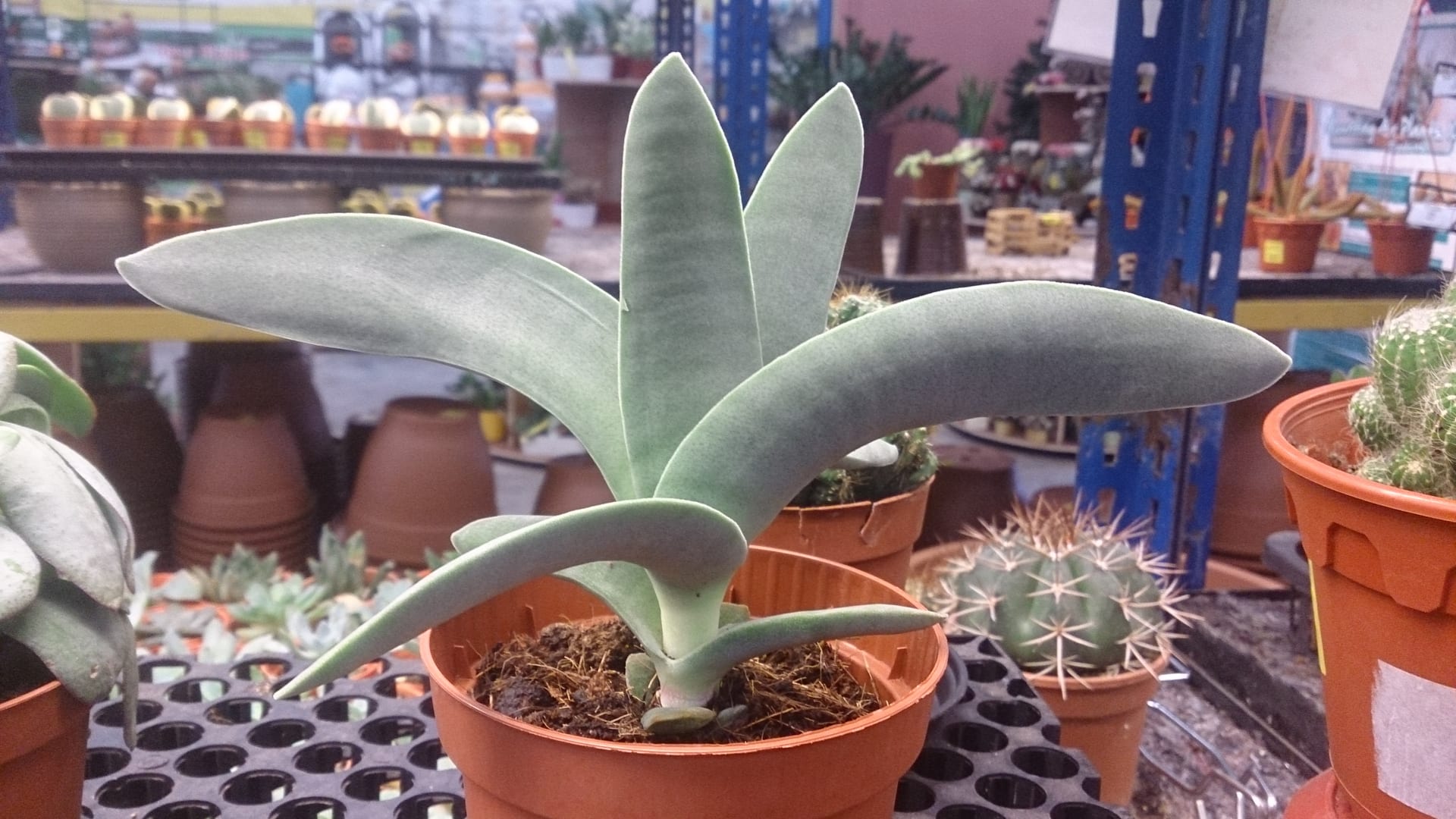
Source: Wikimedia Commons
Propeller plant
BeginnerCrassula perfoliata var. falcata
A Crassula whose thick, grey-green, sickle-shaped leaves overlap in opposite pairs like propeller blades. The leaf surface is finely papillate, and dense heads of scarlet flowers appear in summer.
About
Crassula perfoliata var. falcata is the best-known garden form of C. perfoliata, the type species of the genus. It grows on quartzite sandstone outcrops, cliffs and valley slopes from the Western to the Eastern Cape of South Africa, and was long grown as Rochea falcata or Crassula falcata. The thick grey-green, sickle-shaped leaves, up to about 9 cm long and 3 cm wide, are arranged in opposite, criss-crossing pairs along a lengthening stem, spreading like propeller blades. The leaf surface is covered in small rounded papillae and the margins bear minute teeth. Unlike most crassulas, which flower in winter, it blooms in summer: dense rounded heads of scarlet tubular flowers on long stalks, lasting close to a month according to a US grower. Plants reach 60 cm to 1 m and may form aerial roots. It does not tolerate freezing, so it must come indoors or under glass in cold weather, and too little light makes it stretch. It holds the RHS Award of Garden Merit. In Japan it is a staple large crassula, sold as 'jinto' in garden centres and specialist nurseries.
Source: Wikipedia (CC BY-SA 4.0)
Size of the Propeller plant
The Propeller plant grows to 60 cm–1 m tall.
Basic Info
Origin
South Africa (Western to Eastern Cape)
Lifespan
Perennial
Size
60 cm–1 m tall
Temperature
5〜35℃
Humidity
30〜50%
Watering & Fertilizer
Light feeder
Growing Tips
Light & Placement
Grow in good light; indoors use a sunny south- or west-facing window. Too little light makes the stem stretch and the plant lose shape.
Watering
Drought tolerant; water sparingly, only after the mix dries, and even less in cool weather.
Temperature & Overwintering
It does not tolerate freezing. A US grower reports it surviving around -6°C, but potted plants should come into a frost-free room or greenhouse in winter.
Soil & Repotting
Plant in a loose, well-aerated mix. Tall plants become top-heavy, so choose a stable pot.
Pests & Cautions
The summer flowers last nearly a month. It may also be labelled with the older name Crassula falcata or as var. minor.
Propeller plant FAQ
QWhat is the growing difficulty level for Propeller plant?
Beginner. A variety suitable for beginners. No special equipment or experience is required—you can grow it without problems by setting up a basic cultivation environment.
QHow large does Propeller plant get?
The mature size of Propeller plant is 60 cm–1 m tall. This may vary slightly depending on cultivation environment and individual differences.
QHow should I water and fertilize Propeller plant?
Propeller plant: watering & fertilizer — Light feeder. Aim for appropriate frequency and amount.
QWhat is the typical price for Propeller plant?
The price of Propeller plant varies significantly by variety, characteristics, size, and lineage. Please check GrowerDirect's price guide for the latest market information.
Last updated: September 23, 2026
References & Sources
Edited & verified by: GrowerDirect Editorial Team
The classifications, regulations, and growing data on this page are created and verified based on the primary information database below.
Taxonomy & Authority
Accepted name: Crassula perfoliata var. falcata (J.C.Wendl.) Toelken
Synonyms: Crassula decussata, Crassula falcata, Crassula falx, Crassula perfoliata minor, Crassula retroflexa, Crassula swellingrebliana, Larochea falcata, Larochea falcata minor
Authority databases: GBIF · GBIF
Nomenclature follows global taxonomic authority databases.
Regulations & Conservation Status
Not listed in the CITES Appendices and not regulated under Japan's Invasive Alien Species Act.
Sources: Species+ (CITES) query for Crassula perfoliata: not listed / Ministry of the Environment: list of Invasive Alien Species
Regulations may change. Always verify the latest information with the relevant authorities.
Related Species
Find listings for this species
Related Articles
Crassula Growing Guide | How to Manage Popular Varieties like Campfire and Prince of Stars
Explains how to grow Crassula, a popular succulent genus. Introduces characteristics of varieties like "Campfire," "Prince of Stars," and "Gollum," detailed information on bringing out autumn and winter color, propagation methods, and winter management.
Autumn Preparation Management for Summer-Type Succulents
A guide to autumn care for summer-type succulents, covering plant changes from September to November, timing for gradual watering reduction, placement and temperature management for transitioning plants indoors, autumn fertilizing and pest control, variety-specific care checkpoints, and preparation for winter dormancy.
Mealybug Control on Succulents | Complete Guide to Early Detection, Removal, and Prevention
Mealybugs hide easily at the base of succulent leaves and on new growth. This guide covers their characteristics, the environments where they thrive, tips for early detection, removal methods using cotton swabs and alcohol, and daily care practices to prevent recurrence.
Summer and Winter Type Succulents: Growth Cycles and Watering Management Strategy
This article explains the differences in growth types of succulent plants, their annual growth cycles, seasonal watering management strategies, common failures, and countermeasures.
🩺 Common diseases
Can't find the plant you're looking for?
Post your wishes for free and growers with matching plants will contact you with introductions.