Source: Wikimedia Commons
Echeveria cante
IntermediateEcheveria cante
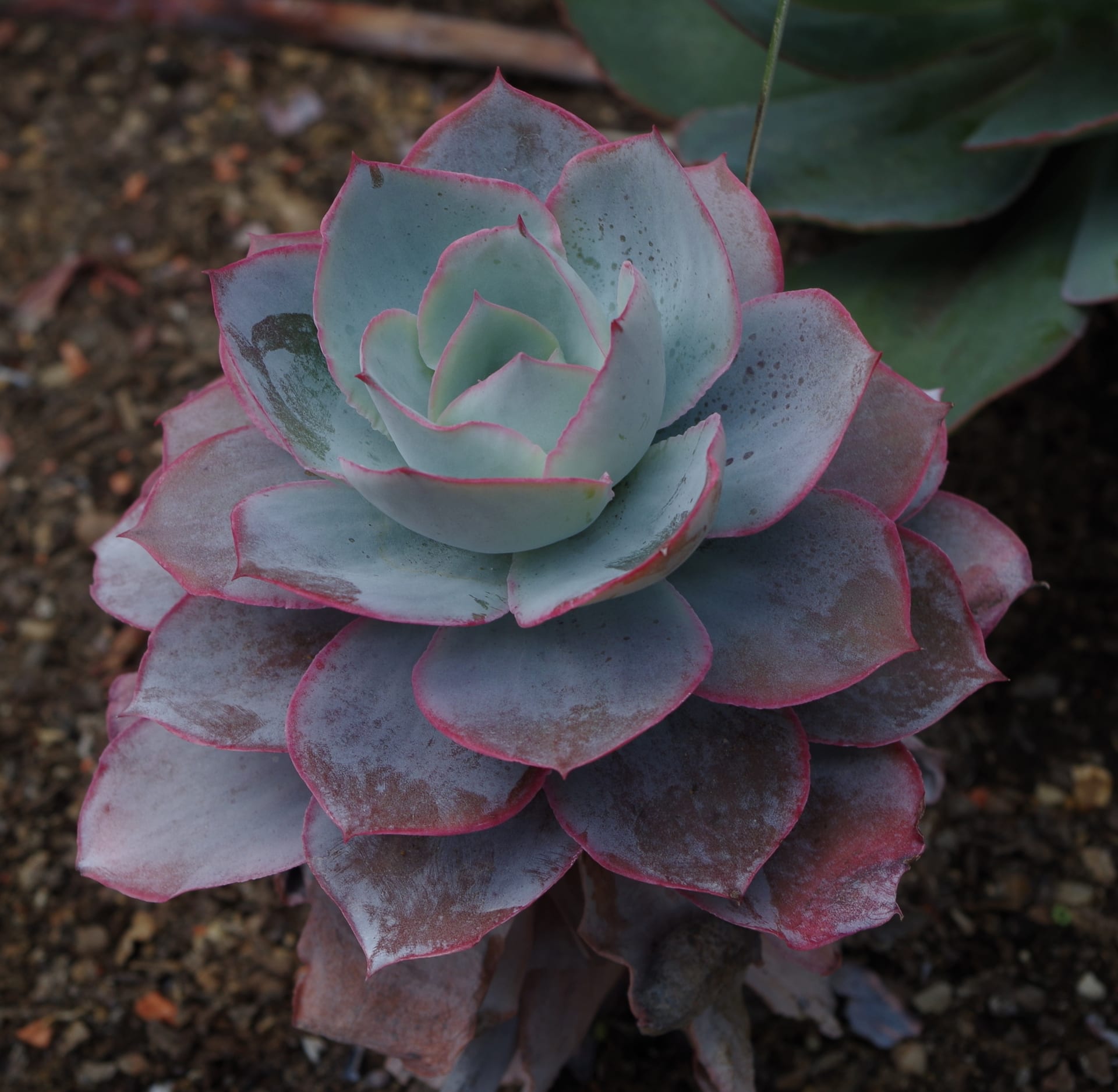
A large solitary rosette up to 30–40 cm across, with pale blue-green, lavender-tinged leaves under a thick white bloom and a fine red edge. A Mexican species nicknamed 'queen of echeverias'.
About
Echeveria cante grows in the mountains of north-western Zacatecas, Mexico, between Sombrerete and Fresnillo. Though described only fairly recently, it had long been cultivated as a form of E. subrigida or under the name E. rosei. The name honours the Cante botanic garden in Guanajuato, where one of its describers worked. The solitary rosette reaches 30–40 cm across, with 35–50 leaves 15–18 cm long and 6.5–7.5 cm wide. They are pale blue-green tinged lavender, coated in a thick whitish-lavender bloom and often edged with a fine red line. Compared with E. subrigida its leaves are narrower, thicker, usually longer and powdery rather than glaucous. In summer it sends up stout stalks about 45 cm tall with orange-pink flowers. Japanese growers class it as a spring–autumn grower, but it wants stronger sun than most echeverias and steady moisture without stagnant heat in summer to form a large, handsome rosette, so it takes some care. It rarely offsets; propagation is mainly from seed, as leaves root poorly. It holds the RHS Award of Garden Merit. In Japan it is a popular large species offered mainly by specialist nurseries.
Source: Wikipedia (CC BY-SA 4.0)
Size of the Echeveria cante
The Echeveria cante grows to Rosette 30–40 cm across (solitary).
Basic Info
Origin
Mexico (north-western Zacatecas)
Lifespan
Perennial; grows into a large solitary rosette
Size
Rosette 30–40 cm across (solitary)
Temperature
5〜35℃
Humidity
30〜50%
Watering & Fertilizer
Modest; a little in the growing season
Growing Tips
Light & Placement
The more light it gets, the better its colour and form; it likes stronger sun than most echeverias.
Watering
Treat it as a spring–autumn grower. It grows stronger with adequate water in the growing season, but never let the pot stay waterlogged. In summer do not dry it out completely, and keep air moving.
Temperature & Overwintering
Best overwintered at about 5–10°C; it can take light frost, but keep potted plants free of frost and freezing.
Soil & Repotting
Easiest in a pot with free-draining mix. Remove old dead leaves that build up at the base.
Propagation
It rarely offsets; propagation is mainly from seed. Leaf cuttings are possible but root with difficulty.
Pests & Cautions
The white bloom rubs off and does not regrow; water at the base rather than over the leaves and avoid touching them.
Echeveria cante FAQ
QWhat is the growing difficulty level for Echeveria cante?
Intermediate. A variety suitable for intermediate growers. Requires some cultivation experience and knowledge of environment management. Pay careful attention to temperature and humidity control.
QHow large does Echeveria cante get?
The mature size of Echeveria cante is Rosette 30–40 cm across (solitary). This may vary slightly depending on cultivation environment and individual differences.
QHow should I water and fertilize Echeveria cante?
Echeveria cante: watering & fertilizer — Modest; a little in the growing season. Aim for appropriate frequency and amount.
QWhat is the typical price for Echeveria cante?
The price of Echeveria cante varies significantly by variety, characteristics, size, and lineage. Please check GrowerDirect's price guide for the latest market information.
Last updated: September 23, 2026
References & Sources
Edited & verified by: GrowerDirect Editorial Team
The classifications, regulations, and growing data on this page are created and verified based on the primary information database below.
Taxonomy & Authority
Regulations & Conservation Status
Not listed in the CITES Appendices and not regulated under Japan's Invasive Alien Species Act.
Sources: Species+ (CITES) query for Echeveria cante: not listed / Ministry of the Environment: list of Invasive Alien Species
Regulations may change. Always verify the latest information with the relevant authorities.
Related Species
Find listings for this species
Related Articles
Complete Guide to Echeveria Types | Characteristics of Popular Varieties and How to Choose Plants for Arrangements
A comprehensive explanation of Echeveria variety classification, differences in characteristics, and how to combine plants for arrangements among popular succulents. We introduce tips for choosing varieties that both beginners and advanced growers can enjoy.
Popular Echeveria Varieties and Care Guide | Complete Guide for Beginners
Explains the characteristics of popular Echeveria varieties, basic care methods, and tips for watering, lighting, and repotting for beginners.
Propagation and Leaf-Cutting Techniques for Echeveria
A practical guide to leaf-cutting specialized for the Echeveria genus. Covers everything from selecting healthy leaves to callus formation and root management, species-specific failure factors for powder-coated varieties, and when to use pup division or stem cuttings instead.
Echeveria subsessilis Offset Propagation — Separation from Parent Plants, Root Promotion, and Parent Plant Recovery Management
Detailed guide on safely separating Echeveria subsessilis offsets from parent plants, promoting root development, and managing parent plant recovery after offset removal.
🩺 Common diseases
Can't find the plant you're looking for?
Post your wishes for free and growers with matching plants will contact you with introductions.