Source: Wikimedia Commons
Watch chain
BeginnerCrassula muscosa
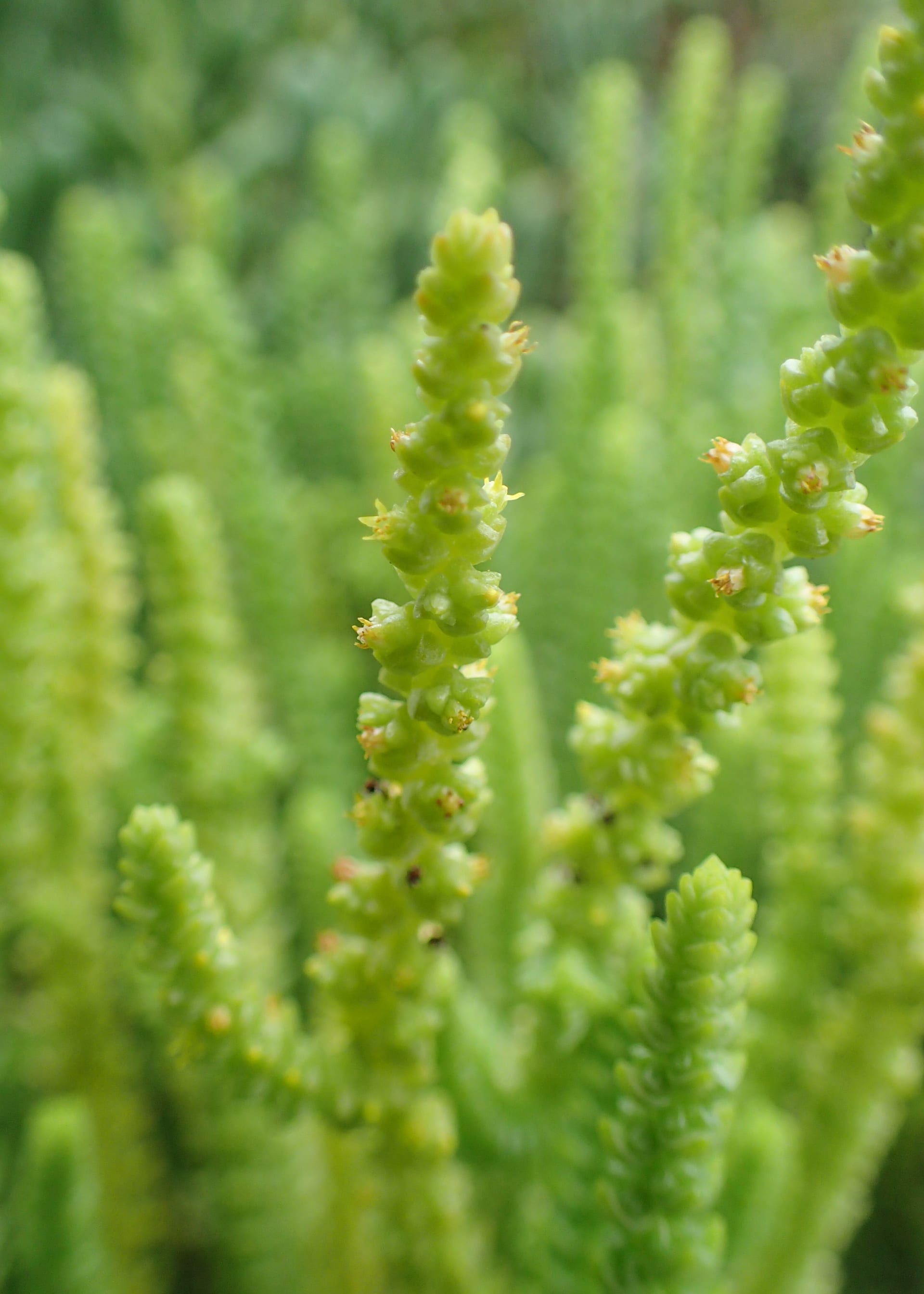
A Crassula whose slender stems are hidden by tiny, tightly stacked leaves, looking like a watch chain. It branches into a small bush, and even broken pieces root readily.
About
Crassula muscosa grows widely in South Africa, from the Cape provinces and Free State into Namibia, from the winter-rainfall Western Cape to the summer-rainfall Eastern Cape, often on well-drained quartz gravel. It has also been known as C. lycopodioides and C. pseudolycopodioides. The name means 'mossy', and in English it is likened to a watch chain, a rat's tail or a zipper. Tiny pale green leaves are packed tightly around thin stems, hiding them completely and giving a square cross-section. Small yellow-green, oddly scented flowers appear between the leaves, mostly in spring and summer. Japanese growers treat it as a spring–autumn grower, active in March–June and mid-September to mid-November. It is very tough and easy to propagate; broken bits scattered on soil will root. In Japan it is sold as 'wakamidori' or 'seisaryu', and a slender form as 'himemidori', and is common in garden centres for mixed plantings.
Source: Wikipedia (CC BY-SA 4.0)
Size of the Watch chain
The Watch chain grows to 15–30 cm tall, sprawling.
Stems start upright, then droop under their own weight, forming a dense bush 15–30 cm tall.
Basic Info
Origin
South Africa (Cape provinces, Free State and elsewhere) and Namibia
Lifespan
Perennial; long-lived when renewed by cutting back
Size
15–30 cm tall, sprawling
Temperature
5〜35℃
Humidity
30〜50%
Watering & Fertilizer
Slow-release fertiliser about every two months in the growing season
Growing Tips
Light & Placement
Grow it in sun outdoors during the growing season. Summer humidity makes lower leaves drop and the base turn brown, so move it to bright, airy shade in summer.
Watering
A spring–autumn grower. Water thoroughly when the pot dries during growth; at other times a light misting about once a month is enough.
Temperature & Overwintering
Fairly cold-tolerant but suffers when cold and wet together; bring it into a sunny room around mid-November.
Soil & Repotting
Root-bound plants stop growing and can die; repot every spring so the plant goes into summer in good condition.
Fertiliser
Give slow-release fertiliser about every two months in the growing season.
Propagation
Cuttings from growing shoots root very easily; even broken pieces scattered on soil will root. Cutting back also tidies an untidy plant.
Watch chain FAQ
QWhat is the growing difficulty level for Watch chain?
Beginner. A variety suitable for beginners. No special equipment or experience is required—you can grow it without problems by setting up a basic cultivation environment.
QHow large does Watch chain get?
The mature size of Watch chain is 15–30 cm tall, sprawling. This may vary slightly depending on cultivation environment and individual differences.
QHow should I water and fertilize Watch chain?
Watch chain: watering & fertilizer — Slow-release fertiliser about every two months in the growing season. Aim for appropriate frequency and amount.
QWhat is the typical price for Watch chain?
The price of Watch chain varies significantly by variety, characteristics, size, and lineage. Please check GrowerDirect's price guide for the latest market information.
Last updated: September 23, 2026
References & Sources
Edited & verified by: GrowerDirect Editorial Team
The classifications, regulations, and growing data on this page are created and verified based on the primary information database below.
Taxonomy & Authority
Accepted name: Crassula muscosa L.
Synonyms: Combesia muscosa, Combesia muscosa acuminata, Combesia muscosa anguina, Combesia muscosa fragilis, Combesia muscosa fulva, Combesia muscosa littoralis, Combesia muscosa obtusifolia, Combesia muscosa pseudolycopodioides
Authority databases: GBIF · GBIF
Nomenclature follows global taxonomic authority databases.
Regulations & Conservation Status
Not listed in the CITES Appendices and not regulated under Japan's Invasive Alien Species Act.
Sources: Species+ (CITES) query for Crassula muscosa: not listed / Ministry of the Environment: list of Invasive Alien Species
Regulations may change. Always verify the latest information with the relevant authorities.
Related Species
Find listings for this species
Related Articles
Crassula Growing Guide | How to Manage Popular Varieties like Campfire and Prince of Stars
Explains how to grow Crassula, a popular succulent genus. Introduces characteristics of varieties like "Campfire," "Prince of Stars," and "Gollum," detailed information on bringing out autumn and winter color, propagation methods, and winter management.
Autumn Preparation Management for Summer-Type Succulents
A guide to autumn care for summer-type succulents, covering plant changes from September to November, timing for gradual watering reduction, placement and temperature management for transitioning plants indoors, autumn fertilizing and pest control, variety-specific care checkpoints, and preparation for winter dormancy.
Mealybug Control on Succulents | Complete Guide to Early Detection, Removal, and Prevention
Mealybugs hide easily at the base of succulent leaves and on new growth. This guide covers their characteristics, the environments where they thrive, tips for early detection, removal methods using cotton swabs and alcohol, and daily care practices to prevent recurrence.
Summer and Winter Type Succulents: Growth Cycles and Watering Management Strategy
This article explains the differences in growth types of succulent plants, their annual growth cycles, seasonal watering management strategies, common failures, and countermeasures.
🩺 Common diseases
Can't find the plant you're looking for?
Post your wishes for free and growers with matching plants will contact you with introductions.