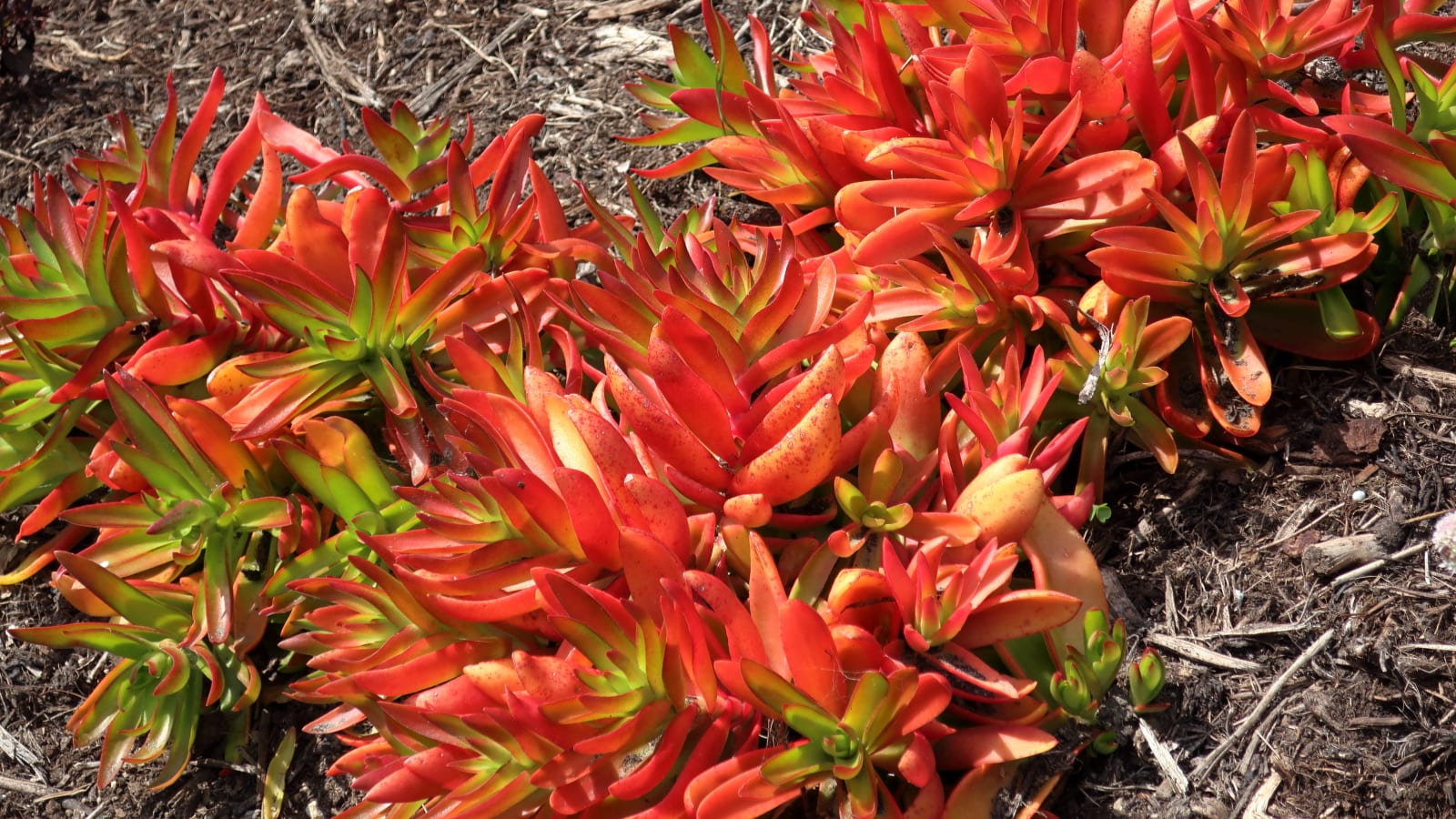
Source: Wikimedia Commons
Crassula capitella 'Campfire'
BeginnerCrassula capitella 'Campfire'
Pointed leaves stacked crosswise like propellers turn from lime green in summer to fiery red in winter cold and sun. A fast-growing, spreading Crassula cultivar.
About
'Campfire' is a Crassula cultivar famous for turning brilliant red in winter. It is generally treated as a form of Crassula capitella, a widespread South African species, but a US grower notes that its species identity is uncertain and that it is sometimes attributed to the similar C. erosula (C. subacaulis subsp. erosula). It is also known in English as 'Blaze' or 'Flame'. Fleshy, pointed leaves stack crosswise like propellers, starting bright green and turning red; the colour is strongest in winter, when cool nights combine with bright sun, and fades to lime green in summer. Stems grow to about 15 cm, then lean over and root at the nodes, forming mats 60–90 cm across. Clusters of small white flowers sit on the foliage in summer. It is among the fastest-growing succulents. The separate species C. fusca shows similar red colour, and related cultivars include the variegated 'Campfire' and 'Ringo'. In Japan it is an everyday plant for mixed succulent arrangements, sold widely in garden centres.
Size of the Crassula capitella 'Campfire'
The Crassula capitella 'Campfire' grows to About 15 cm tall, spreading 60–90 cm.
Basic Info
Origin
Cultivar (C. capitella is native to southern Africa)
Lifespan
Perennial; flowered stems decline and are best cut back and renewed
Size
About 15 cm tall, spreading 60–90 cm
Temperature
5〜35℃
Humidity
30〜50%
Watering & Fertilizer
Modest; a little compost or slow-release fertiliser about twice a year
Growing Tips
Light & Placement
Grows in sun to part shade. Good winter sun is needed for red colour; in hot inland areas give some shade in midsummer.
Watering
Fairly drought tolerant; water when the soil is dry, roughly every two weeks. Overwatering and poor drainage invite powdery mildew and stem or root rot.
Temperature & Overwintering
Tolerates light frost but is damaged below about -1°C; frost shows as small brown spots. In cold areas keep it in a pot and protect it in winter.
Soil & Repotting
Use a free-draining mix. Sudden changes in moisture can cause oedema (blistered leaves), so keep watering regular.
Propagation
Roots easily from stem or leaf cuttings; stems that have lain down and rooted at the nodes can simply be cut off and potted.
Pests & Cautions
Plants deteriorate after flowering, so cut back and renew them. It is not a registered variety, so propagation is unrestricted.
Crassula capitella 'Campfire' FAQ
QWhat is the growing difficulty level for Crassula capitella 'Campfire'?
Beginner. A variety suitable for beginners. No special equipment or experience is required—you can grow it without problems by setting up a basic cultivation environment.
QHow large does Crassula capitella 'Campfire' get?
The mature size of Crassula capitella 'Campfire' is About 15 cm tall, spreading 60–90 cm. This may vary slightly depending on cultivation environment and individual differences.
QHow should I water and fertilize Crassula capitella 'Campfire'?
Crassula capitella 'Campfire': watering & fertilizer — Modest; a little compost or slow-release fertiliser about twice a year. Aim for appropriate frequency and amount.
QWhat is the typical price for Crassula capitella 'Campfire'?
The price of Crassula capitella 'Campfire' varies significantly by variety, characteristics, size, and lineage. Please check GrowerDirect's price guide for the latest market information.
Last updated: September 23, 2026
References & Sources
Edited & verified by: GrowerDirect Editorial Team
The classifications, regulations, and growing data on this page are created and verified based on the primary information database below.
Primary sources
- Species+ (CITES) query for Crassula capitella: not listed
- Ministry of the Environment: list of Invasive Alien Species
- MAFF plant variety registration database (no matching registration)
- San Marcos Growers: Crassula capitella 'Campfire'
- SANBI PlantZAfrica: Crassula capitella
- PUKUBOOK succulent encyclopedia: 火祭り
- GBIF
Taxonomy & Authority
Accepted name: Crassula capitella Thunb. 'Campfire'
Synonyms: Crassula avismontana, Crassula capitella, Crassula capitellata, Crassula corymbosula, Crassula corymbosula cordata, Crassula corymbosula lanceolata, Crassula corymbosula major, Crassula luederitzii
Authority databases: GBIF · GBIF
Nomenclature follows global taxonomic authority databases.
Regulations & Conservation Status
Not listed in the CITES Appendices and not regulated under Japan's Invasive Alien Species Act. It is not a registered variety under Japan's Plant Variety Protection and Seed Act.
Sources: Species+ (CITES) query for Crassula capitella: not listed / Ministry of the Environment: list of Invasive Alien Species / MAFF plant variety registration database (no matching registration)
Regulations may change. Always verify the latest information with the relevant authorities.
Related Species
Find listings for this species
Related Articles
Crassula Growing Guide | How to Manage Popular Varieties like Campfire and Prince of Stars
Explains how to grow Crassula, a popular succulent genus. Introduces characteristics of varieties like "Campfire," "Prince of Stars," and "Gollum," detailed information on bringing out autumn and winter color, propagation methods, and winter management.
Autumn Preparation Management for Summer-Type Succulents
A guide to autumn care for summer-type succulents, covering plant changes from September to November, timing for gradual watering reduction, placement and temperature management for transitioning plants indoors, autumn fertilizing and pest control, variety-specific care checkpoints, and preparation for winter dormancy.
Mealybug Control on Succulents | Complete Guide to Early Detection, Removal, and Prevention
Mealybugs hide easily at the base of succulent leaves and on new growth. This guide covers their characteristics, the environments where they thrive, tips for early detection, removal methods using cotton swabs and alcohol, and daily care practices to prevent recurrence.
Summer and Winter Type Succulents: Growth Cycles and Watering Management Strategy
This article explains the differences in growth types of succulent plants, their annual growth cycles, seasonal watering management strategies, common failures, and countermeasures.
🩺 Common diseases
Can't find the plant you're looking for?
Post your wishes for free and growers with matching plants will contact you with introductions.