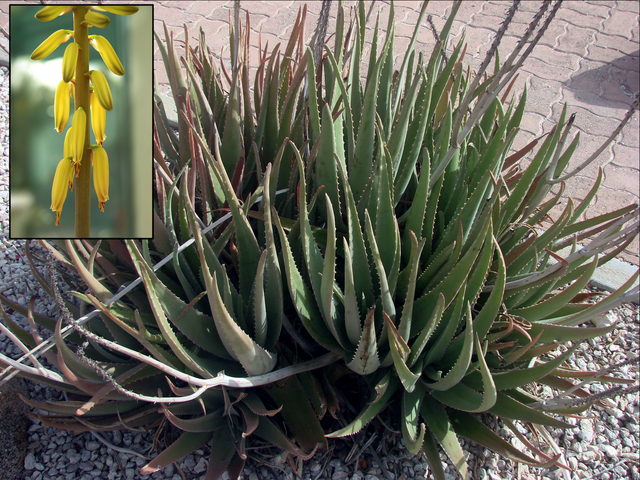
Source: Wikimedia Commons
Aloe Vera
BeginnerAloe vera
World-famous succulent for medicinal and beauty uses. Thick leaves contain gel-like compounds.
Overview
Aloe vera is a succulent plant species of the genus Aloe, believed to originate from the Arabian Peninsula and North Africa, though now naturalized and cultivated throughout the tropics and subtropics. It is among the most commercially significant succulent plants in the world, harvested extensively for its gel-rich leaf interior, which is used in cosmetics, pharmaceuticals, and food products. Research suggests the gel contains polysaccharides, anthraquinones, and lectins with potential anti-inflammatory and wound-healing properties. Plants form stemless or short-stemmed rosettes of fleshy, grey-green leaves edged with small teeth, and produce tall racemes of yellow to orange tubular flowers. In cultivation, Aloe vera requires bright light, well-draining soil, and infrequent watering. It is propagated by offsets, which are produced abundantly from the base.
Source: Wikipedia (CC BY-SA 4.0)
Lifespan of the Aloe Vera
The Aloe Vera lives Perennial (decades).
Size of the Aloe Vera
The Aloe Vera grows to 30-60cm.
Basic Info
Lifespan
Perennial (decades)
Size
30-60cm
Temperature
5〜35℃
Humidity
30〜50%
Watering & Fertilizer
Moderate watering
Growing Tips
Lighting
Grows robustly in well-lit location
Watering
Water sparingly. Overwatering causes root rot
Soil & Repotting
A plant that grows even in arid regions, so pot it in a well-draining succulent mix and make sure the pot drains well.
Propagation
Propagate by cuttings or division. It produces offsets vigorously, so cut them from the base and pot them up.
Aloe Vera FAQ
QWhat is the growing difficulty level for Aloe Vera?
Beginner. A variety suitable for beginners. No special equipment or experience is required—you can grow it without problems by setting up a basic cultivation environment.
QWhat is the lifespan of Aloe Vera?
The average lifespan of Aloe Vera is Perennial (decades). With proper cultivation environment and nutrient management, you can keep it healthy for a long time.
QHow large does Aloe Vera get?
The mature size of Aloe Vera is 30-60cm. This may vary slightly depending on cultivation environment and individual differences.
QHow should I water and fertilize Aloe Vera?
Aloe Vera: watering & fertilizer — Moderate watering. Aim for appropriate frequency and amount.
QWhat is the typical price for Aloe Vera?
The price of Aloe Vera varies significantly by variety, characteristics, size, and lineage. Please check GrowerDirect's price guide for the latest market information.
Last updated: June 24, 2026
Growing Specifications
- Hardiness (RHS)
- H1c
Sources: RHS Find a Plant
References & Sources
Edited & verified by: GrowerDirect Editorial Team
The classifications, regulations, and growing data on this page are created and verified based on the primary information database below.
Taxonomy & Authority
Regulations & Conservation Status
Aloe vera was delisted from the CITES appendices in 1995 (the genus remains in Appendix II).
Sources: CITES — Aloe spp. Appendix II (A. vera excluded)
Regulations may change. Always verify the latest information with the relevant authorities.
Related Species
Find listings for this species
Related Articles
Complete Guide to Growing Aloe | Sunlight, Watering, and Propagation from Offsets
From the basic characteristics of drought-tolerant succulent aloe to detailed guidance on sunlight, watering, repotting, propagation by offsetting, and root rot prevention.
Autumn Preparation Management for Summer-Type Succulents
A guide to autumn care for summer-type succulents, covering plant changes from September to November, timing for gradual watering reduction, placement and temperature management for transitioning plants indoors, autumn fertilizing and pest control, variety-specific care checkpoints, and preparation for winter dormancy.
Mealybug Control on Succulents | Complete Guide to Early Detection, Removal, and Prevention
Mealybugs hide easily at the base of succulent leaves and on new growth. This guide covers their characteristics, the environments where they thrive, tips for early detection, removal methods using cotton swabs and alcohol, and daily care practices to prevent recurrence.
Summer and Winter Type Succulents: Growth Cycles and Watering Management Strategy
This article explains the differences in growth types of succulent plants, their annual growth cycles, seasonal watering management strategies, common failures, and countermeasures.
🩺 Common diseases
Can't find the plant you're looking for?
Post your wishes for free and growers with matching plants will contact you with introductions.