Source: Wikimedia Commons
Crassula ovata 'Gollum'
BeginnerCrassula ovata 'Gollum'
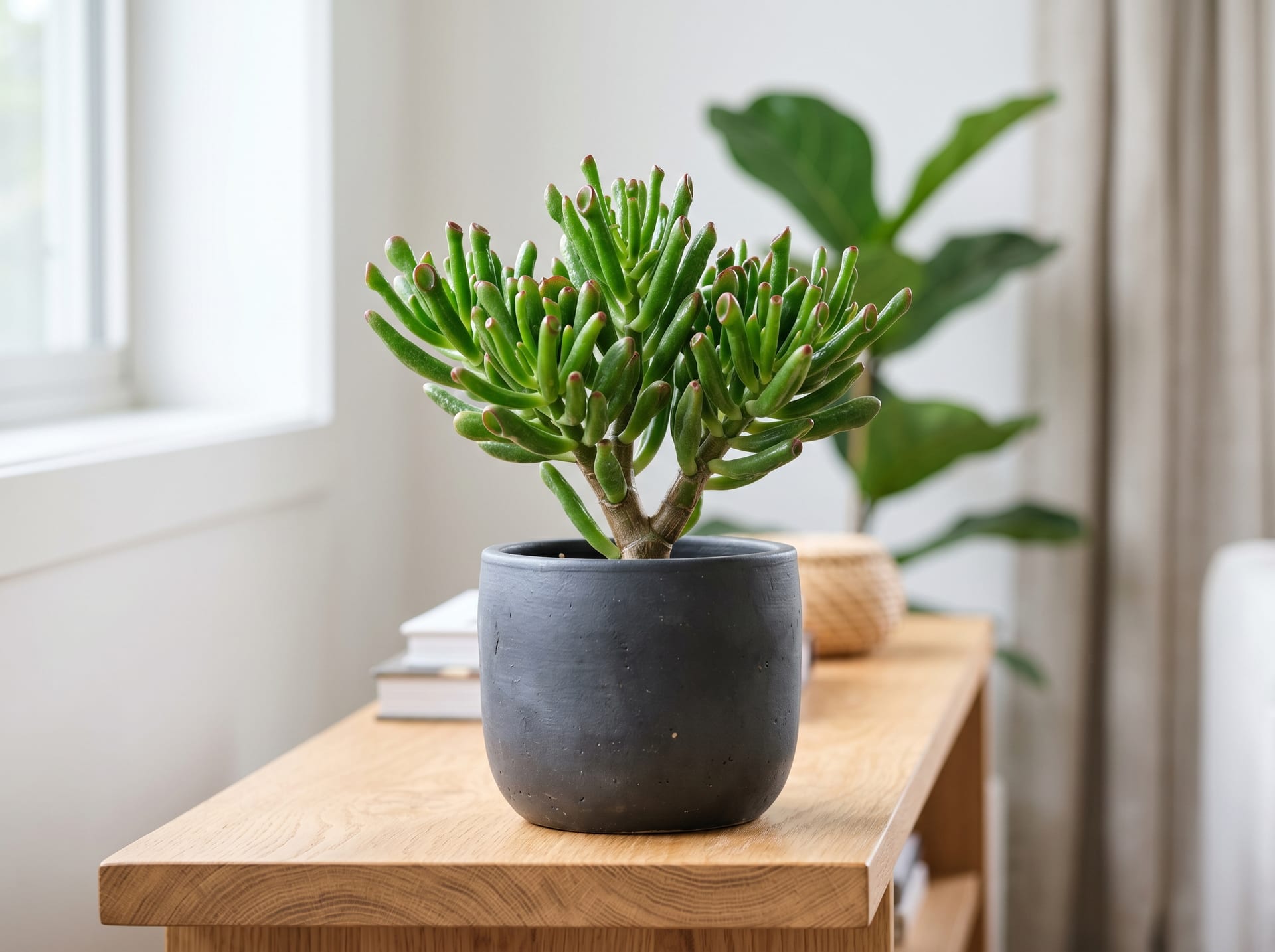
A sport of the jade plant with tubular leaves whose tips are hollowed like suction cups and turn red in cold weather. Finely branched stems thicken with age; also sold as 'tree of the universe'.
About
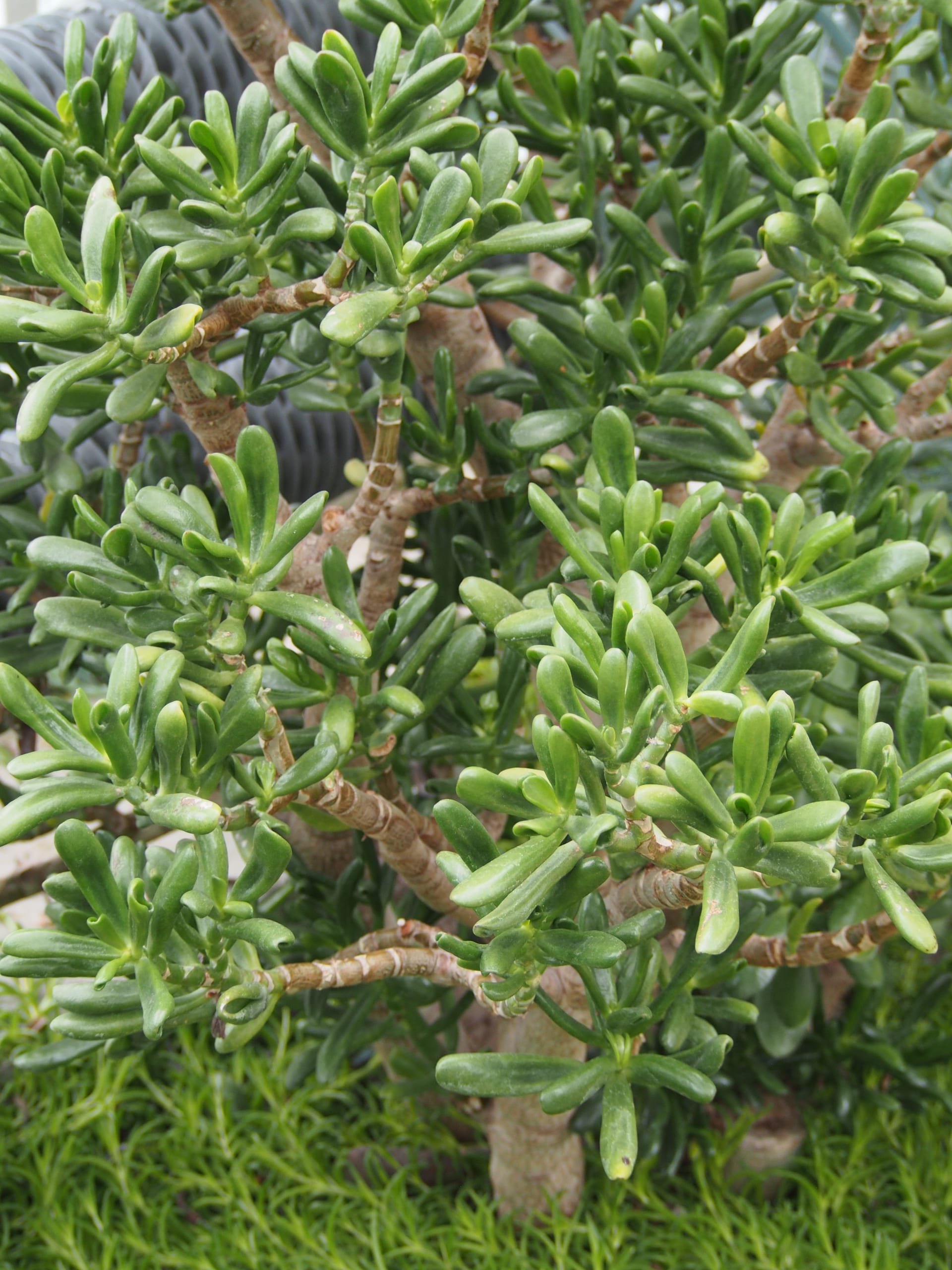
'Gollum' is a cultivar of the jade plant, Crassula ovata, reported to have arisen as a sport. Where the species has flat oval leaves, 'Gollum' has almost tubular leaves with hollowed tips that look like fingertips or suction cups. The similar 'Hobbit' has leaves that curl back outward rather than forming tubes; the two are treated as one group and are sometimes confused in trade, so check the leaf shape. According to a US grower, the plant passed from a Brazilian plantsman to US nurserymen and spread in the US from the mid-1970s; the name 'Gollum' was coined by nurseryman David Grigsby and first appeared in his 1981 catalogue. The stems branch repeatedly rather than growing straight, and the trunk thickens into a bonsai-like shape with age. Leaf tips redden in cold weather. It grows to about 60–90 cm. Japanese growers classify it as a spring–autumn grower, though it keeps growing through summer. It rarely flowers. In Japan it is also called 'uchu no ki' (tree of the universe) and is easy to find in garden centres.
Size of the Crassula ovata 'Gollum'
The Crassula ovata 'Gollum' grows to 60–90 cm tall, 30–60 cm wide.
Basic Info
Origin
Cultivar (the species is native to South Africa)
Lifespan
Perennial; long-lived, with a thickening trunk
Size
60–90 cm tall, 30–60 cm wide
Temperature
5〜35℃
Humidity
30〜50%
Watering & Fertilizer
Slow-release fertiliser about every three months in the growing season
Growing Tips
Light & Placement
Give as much light as possible; in poor light it stretches and loses shape. In summer avoid direct midday sun and keep it in bright shade with good air.
Watering
Water thoroughly when the pot dries. Beware of humid heat in midsummer and water less in winter.
Temperature & Overwintering
It is not cold-hardy; keep it in a bright room from November to March. A Japanese reference gives 5°C as the minimum survival temperature.
Fertiliser
A lack of fertiliser makes the lower leaves yellow and drop; give slow-release fertiliser about every three months from April to October.
Propagation
Propagate by leaf or stem cuttings or by beheading; let cuts dry before inserting them.
Pests & Cautions
Easily confused with 'Hobbit': tubular leaves with hollow tips mean 'Gollum', outward-curling leaves mean 'Hobbit'. It is not a registered variety, so propagating it is unrestricted.
Crassula ovata 'Gollum' FAQ
QWhat is the growing difficulty level for Crassula ovata 'Gollum'?
Beginner. A variety suitable for beginners. No special equipment or experience is required—you can grow it without problems by setting up a basic cultivation environment.
QHow large does Crassula ovata 'Gollum' get?
The mature size of Crassula ovata 'Gollum' is 60–90 cm tall, 30–60 cm wide. This may vary slightly depending on cultivation environment and individual differences.
QHow should I water and fertilize Crassula ovata 'Gollum'?
Crassula ovata 'Gollum': watering & fertilizer — Slow-release fertiliser about every three months in the growing season. Aim for appropriate frequency and amount.
QWhat is the typical price for Crassula ovata 'Gollum'?
The price of Crassula ovata 'Gollum' varies significantly by variety, characteristics, size, and lineage. Please check GrowerDirect's price guide for the latest market information.
Last updated: September 23, 2026
References & Sources
Edited & verified by: GrowerDirect Editorial Team
The classifications, regulations, and growing data on this page are created and verified based on the primary information database below.
Primary sources
Taxonomy & Authority
Regulations & Conservation Status
Not listed in the CITES Appendices and not regulated under Japan's Invasive Alien Species Act. It is not a registered variety under Japan's Plant Variety Protection and Seed Act.
Sources: Species+ (CITES) query for Crassula ovata: not listed / Ministry of the Environment: list of Invasive Alien Species / MAFF plant variety registration database (no matching registration)
Regulations may change. Always verify the latest information with the relevant authorities.
Related Species
Find listings for this species
Related Articles
Crassula Growing Guide | How to Manage Popular Varieties like Campfire and Prince of Stars
Explains how to grow Crassula, a popular succulent genus. Introduces characteristics of varieties like "Campfire," "Prince of Stars," and "Gollum," detailed information on bringing out autumn and winter color, propagation methods, and winter management.
Autumn Preparation Management for Summer-Type Succulents
A guide to autumn care for summer-type succulents, covering plant changes from September to November, timing for gradual watering reduction, placement and temperature management for transitioning plants indoors, autumn fertilizing and pest control, variety-specific care checkpoints, and preparation for winter dormancy.
Mealybug Control on Succulents | Complete Guide to Early Detection, Removal, and Prevention
Mealybugs hide easily at the base of succulent leaves and on new growth. This guide covers their characteristics, the environments where they thrive, tips for early detection, removal methods using cotton swabs and alcohol, and daily care practices to prevent recurrence.
Summer and Winter Type Succulents: Growth Cycles and Watering Management Strategy
This article explains the differences in growth types of succulent plants, their annual growth cycles, seasonal watering management strategies, common failures, and countermeasures.
🩺 Common diseases
Can't find the plant you're looking for?
Post your wishes for free and growers with matching plants will contact you with introductions.