Source: Wikimedia Commons
Melon spurge
BeginnerEuphorbia meloformis
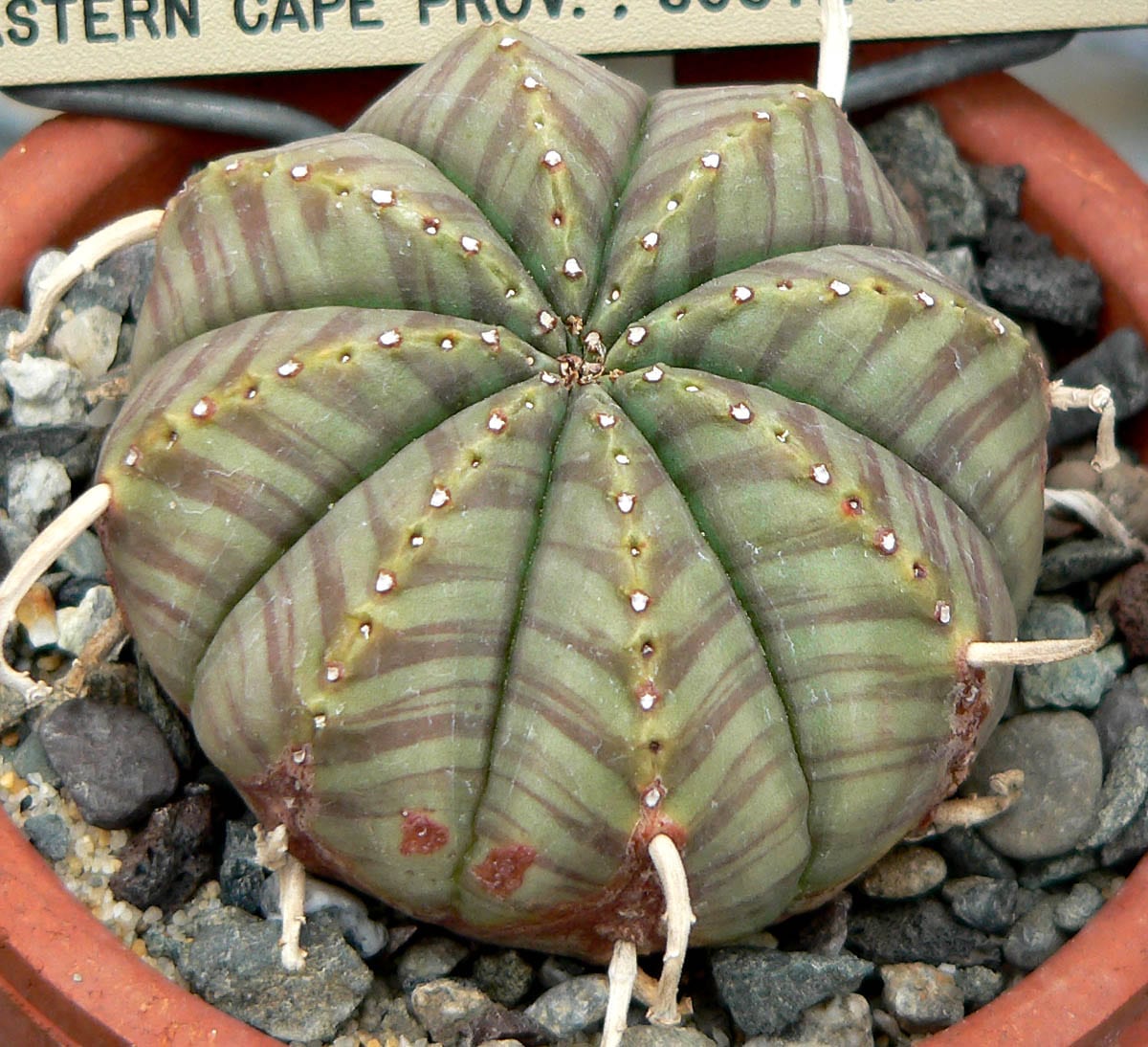
A melon-shaped Euphorbia with eight ribs striped light green and purplish-brown. Old flower stalks persist on the plant, a key difference from the similar E. obesa.
About
Euphorbia meloformis is endemic to the Eastern Cape of South Africa, around Kariega (Uitenhage), Gqeberha (Port Elizabeth), Makhanda (Grahamstown) and Peddie, where it grows in short grassland and gaps in succulent thicket on flats of limestone or calcrete. It is a small, spineless succulent rarely over 10 cm tall, forming a dome with a flattened top above a long taproot. The body is 5–10 cm across, with eight ribs striped light green to purplish-brown and reddish cross-bands. It is usually solitary but may clump with age. Plants are male or female; small yellow-green flowers appear at the top from early summer to autumn (November–March in habitat), and the flower stalks persist long afterwards. It differs from the similar E. obesa in its long-lasting stalks, finely hairy ovaries and wider spacing between tubercles and flowering points. The South African Red List rates it Near Threatened because of its small range and illegal collecting. The related subspecies valida is larger and prized when thick, hardened stalks persist. In Japan it is a standard item at specialist nurseries and is also seen in home centres. The white latex from wounds irritates skin and eyes, so take care.
Source: Wikipedia (CC BY-SA 4.0)
Size of the Melon spurge
The Melon spurge grows to Under 10 cm tall, 5–10 cm across.
Basic Info
Origin
South Africa (Eastern Cape)
Lifespan
Perennial
Size
Under 10 cm tall, 5–10 cm across
Temperature
5〜35℃
Humidity
30〜50%
Watering & Fertilizer
Light feeder; slow-release organic fertiliser as a base dressing
Growing Tips
Light & Placement
From spring to autumn keep it in sun and good air, out of the rain, with about 20–30% shade to prevent sunburn when conditions change.
Watering
Japanese sources class it as a summer or spring–autumn grower; either way it grows from spring to autumn. Water thoroughly when the mix is dry, less often on hot nights in midsummer, and keep it dry through winter dormancy.
Temperature & Overwintering
It has some cold tolerance but must be protected from frost and freezing; overwinter it in a sunny room or cold frame. Japanese references give 3–5°C as its limit.
Soil & Repotting
Use a free-draining mix with slow-release organic fertiliser mixed in. It has a long taproot, so a deeper pot suits it.
Propagation
Plants are male or female, so both are needed for seed. Offsets, when produced, can be removed and rooted.
Pests & Cautions
The white latex from wounds strongly irritates skin and eyes; wear gloves when repotting and do not rub your eyes.
Melon spurge FAQ
QWhat is the growing difficulty level for Melon spurge?
Beginner. A variety suitable for beginners. No special equipment or experience is required—you can grow it without problems by setting up a basic cultivation environment.
QHow large does Melon spurge get?
The mature size of Melon spurge is Under 10 cm tall, 5–10 cm across. This may vary slightly depending on cultivation environment and individual differences.
QHow should I water and fertilize Melon spurge?
Melon spurge: watering & fertilizer — Light feeder; slow-release organic fertiliser as a base dressing. Aim for appropriate frequency and amount.
QWhat is the typical price for Melon spurge?
The price of Melon spurge varies significantly by variety, characteristics, size, and lineage. Please check GrowerDirect's price guide for the latest market information.
Last updated: September 23, 2026
References & Sources
Edited & verified by: GrowerDirect Editorial Team
The classifications, regulations, and growing data on this page are created and verified based on the primary information database below.
Primary sources
Taxonomy & Authority
Accepted name: Euphorbia meloformis Aiton
Synonyms: Euphorbia falsa, Euphorbia infausta, Euphorbia meloformis falsa, Euphorbia meloformis magna, Euphorbia meloformis meloformis, Euphorbia meloformis pomiformis, Euphorbia meloformis prolifera, Euphorbia meloformis valida
Authority databases: GBIF · GBIF
Nomenclature follows global taxonomic authority databases.
Regulations & Conservation Status
Listed in CITES Appendix II (under the listing of succulent Euphorbia spp.). International trade requires export permits, but no registration is needed to transfer plants within Japan. It is not regulated under Japan's Invasive Alien Species Act.
Sources: Species+ (CITES): Euphorbia meloformis / Ministry of the Environment: list of Invasive Alien Species
Regulations may change. Always verify the latest information with the relevant authorities.
Related Species
Find listings for this species
Related Articles
Top 15 Popular Euphorbia Ranking 2026: Valida, Obesa, White Ghost & More Compared
A ranking guide to popular Euphorbia species. Compare 15 species favored by collectors—including Valida, Obesa, White Ghost, Lactea, Neriifolia, and Suzannae—by characteristics, ease of care, and price range.
Autumn Preparation Management for Summer-Type Succulents
A guide to autumn care for summer-type succulents, covering plant changes from September to November, timing for gradual watering reduction, placement and temperature management for transitioning plants indoors, autumn fertilizing and pest control, variety-specific care checkpoints, and preparation for winter dormancy.
Mealybug Control on Succulents | Complete Guide to Early Detection, Removal, and Prevention
Mealybugs hide easily at the base of succulent leaves and on new growth. This guide covers their characteristics, the environments where they thrive, tips for early detection, removal methods using cotton swabs and alcohol, and daily care practices to prevent recurrence.
Summer and Winter Type Succulents: Growth Cycles and Watering Management Strategy
This article explains the differences in growth types of succulent plants, their annual growth cycles, seasonal watering management strategies, common failures, and countermeasures.
🩺 Common diseases
Can't find the plant you're looking for?
Post your wishes for free and growers with matching plants will contact you with introductions.