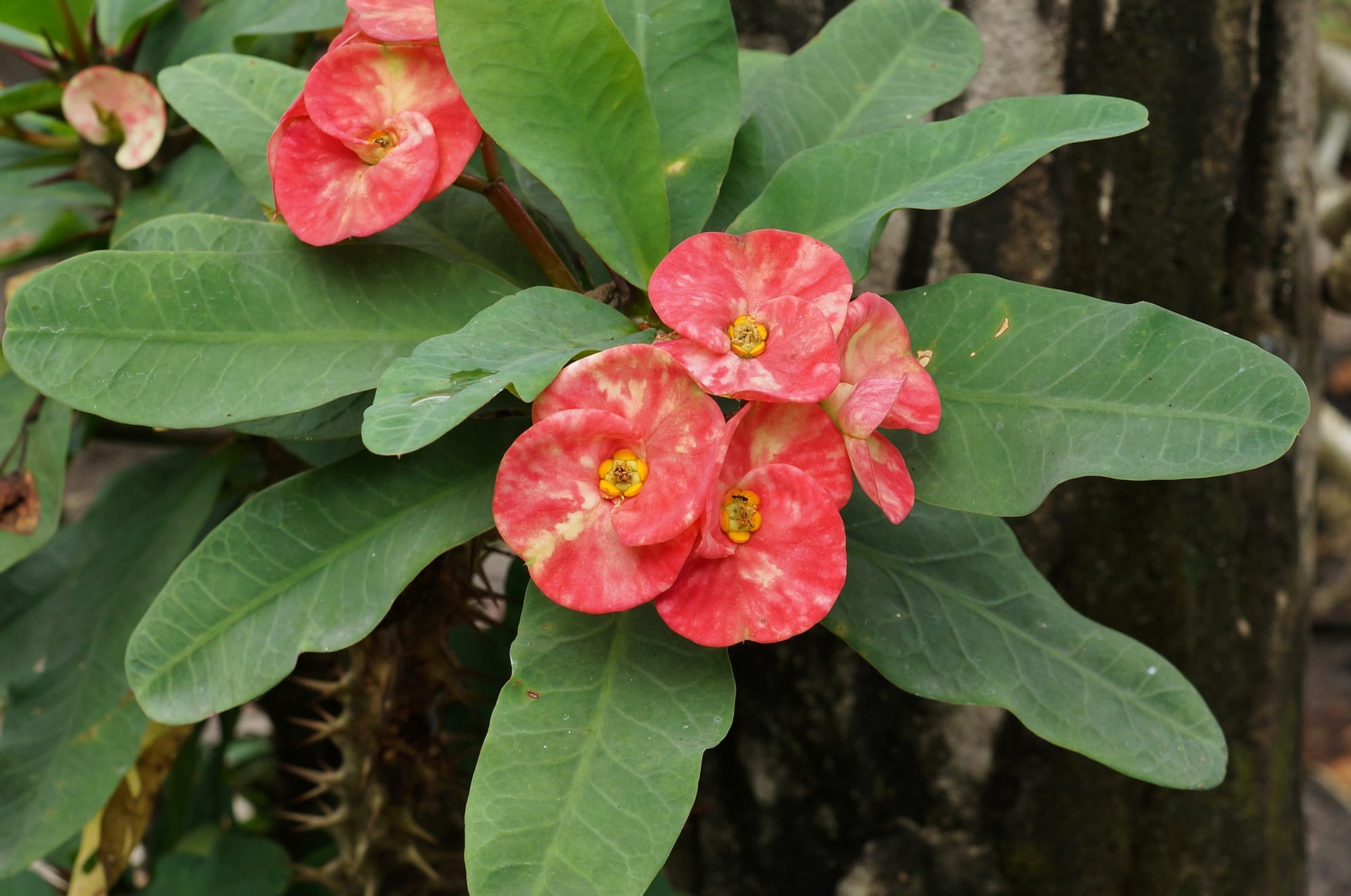
Source: Wikimedia Commons
Crown of thorns
BeginnerEuphorbia milii
A Madagascan Euphorbia with densely spiny stems topped by showy, petal-like bracts in red, pink, yellow or white. It blooms year-round given warmth and is a popular flowering pot plant.
About
Euphorbia milii, crown of thorns, is a shrubby spurge from Madagascar with fleshy stems densely armed with spines. It honours Baron Milius, governor of Réunion, who introduced it to France in 1821. It may have reached the Middle East in ancient times, and the legend linking it to Christ's crown of thorns gave its English name. Stems grow upright but later scramble and lean on other plants, with spines up to 3 cm. Oval leaves up to 3.5 cm long cluster near the tips of new growth and drop naturally before the rest period. What look like flowers are pairs of bracts around the tiny flowers, coloured red, pink, orange, yellow or white, and they appear all year given warmth. The flower stalks are sticky and may trap small insects, but the plant is not carnivorous. There are many varieties and cultivars, notably large-bracted, thick-stemmed Thai hybrids. Plants reach about 1–1.8 m depending on type. It likes sun and dislikes cold, wet soil. In Japan it is sold more as a flowering pot plant than a succulent, in florists and garden centres, and is also used in mixed plantings and beds.
Source: Wikipedia (CC BY-SA 4.0)
Size of the Crown of thorns
The Crown of thorns grows to 1–1.8 m tall (often under 60 cm in pots).
Basic Info
Origin
Madagascar
Lifespan
Perennial shrub
Size
1–1.8 m tall (often under 60 cm in pots)
Temperature
5〜35℃
Humidity
30〜50%
Watering & Fertilizer
Moderate feeding in the growing and flowering season
Growing Tips
Light & Placement
Loves sun; indoors give it a sunny spot. Outdoors in hot climates a little midday shade improves flowering.
Watering
A summer grower. It likes dry to moderately moist soil; water after the mix dries. Leaf drop before the rest period is normal, so water less then.
Temperature & Overwintering
Dislikes cold, wet soil and temperatures below about 2°C; keep it in a sunny room in winter.
Soil & Repotting
Use a free-draining, soil-based potting mix, and wear thick gloves when repotting because of the spines.
Propagation
Propagate from cuttings in warm weather, letting the latex dry on the cut before inserting.
Pests & Cautions
The white latex from cuts is toxic: it irritates skin and can cause severe eye inflammation. Wear gloves and eye protection when pruning or repotting, and keep the plant away from children and pets. It is toxic to dogs and cats. Watch for scale, mealybugs, thrips and mites.
Crown of thorns FAQ
QWhat is the growing difficulty level for Crown of thorns?
Beginner. A variety suitable for beginners. No special equipment or experience is required—you can grow it without problems by setting up a basic cultivation environment.
QHow large does Crown of thorns get?
The mature size of Crown of thorns is 1–1.8 m tall (often under 60 cm in pots). This may vary slightly depending on cultivation environment and individual differences.
QHow should I water and fertilize Crown of thorns?
Crown of thorns: watering & fertilizer — Moderate feeding in the growing and flowering season. Aim for appropriate frequency and amount.
QWhat is the typical price for Crown of thorns?
The price of Crown of thorns varies significantly by variety, characteristics, size, and lineage. Please check GrowerDirect's price guide for the latest market information.
Last updated: September 23, 2026
References & Sources
Edited & verified by: GrowerDirect Editorial Team
The classifications, regulations, and growing data on this page are created and verified based on the primary information database below.
Taxonomy & Authority
Accepted name: Euphorbia milii Des Moul.
Synonyms: Euphorbia bojeri, Euphorbia bojeri mucronulata, Euphorbia breonii, Euphorbia milii breonii, Euphorbia milii imperatae, Euphorbia milii lutea, Euphorbia milii milii, Euphorbia milii tananarivae
Authority databases: GBIF · GBIF
Nomenclature follows global taxonomic authority databases.
Regulations & Conservation Status
Listed in CITES Appendix II (under the listing of succulent Euphorbia spp.). International trade requires export permits, but no registration is needed to transfer plants within Japan. It is not regulated under Japan's Invasive Alien Species Act. An annotation exempts artificially propagated cultivars shipped in consignments of 100 or more plants.
Sources: Species+ (CITES): Euphorbia milii / Ministry of the Environment: list of Invasive Alien Species
Regulations may change. Always verify the latest information with the relevant authorities.
Related Species

Find listings for this species
Related Articles
Top 15 Popular Euphorbia Ranking 2026: Valida, Obesa, White Ghost & More Compared
A ranking guide to popular Euphorbia species. Compare 15 species favored by collectors—including Valida, Obesa, White Ghost, Lactea, Neriifolia, and Suzannae—by characteristics, ease of care, and price range.
Autumn Preparation Management for Summer-Type Succulents
A guide to autumn care for summer-type succulents, covering plant changes from September to November, timing for gradual watering reduction, placement and temperature management for transitioning plants indoors, autumn fertilizing and pest control, variety-specific care checkpoints, and preparation for winter dormancy.
Mealybug Control on Succulents | Complete Guide to Early Detection, Removal, and Prevention
Mealybugs hide easily at the base of succulent leaves and on new growth. This guide covers their characteristics, the environments where they thrive, tips for early detection, removal methods using cotton swabs and alcohol, and daily care practices to prevent recurrence.
Summer and Winter Type Succulents: Growth Cycles and Watering Management Strategy
This article explains the differences in growth types of succulent plants, their annual growth cycles, seasonal watering management strategies, common failures, and countermeasures.
🩺 Common diseases
Can't find the plant you're looking for?
Post your wishes for free and growers with matching plants will contact you with introductions.