Source: Wikimedia Commons
African milk tree
BeginnerEuphorbia trigona
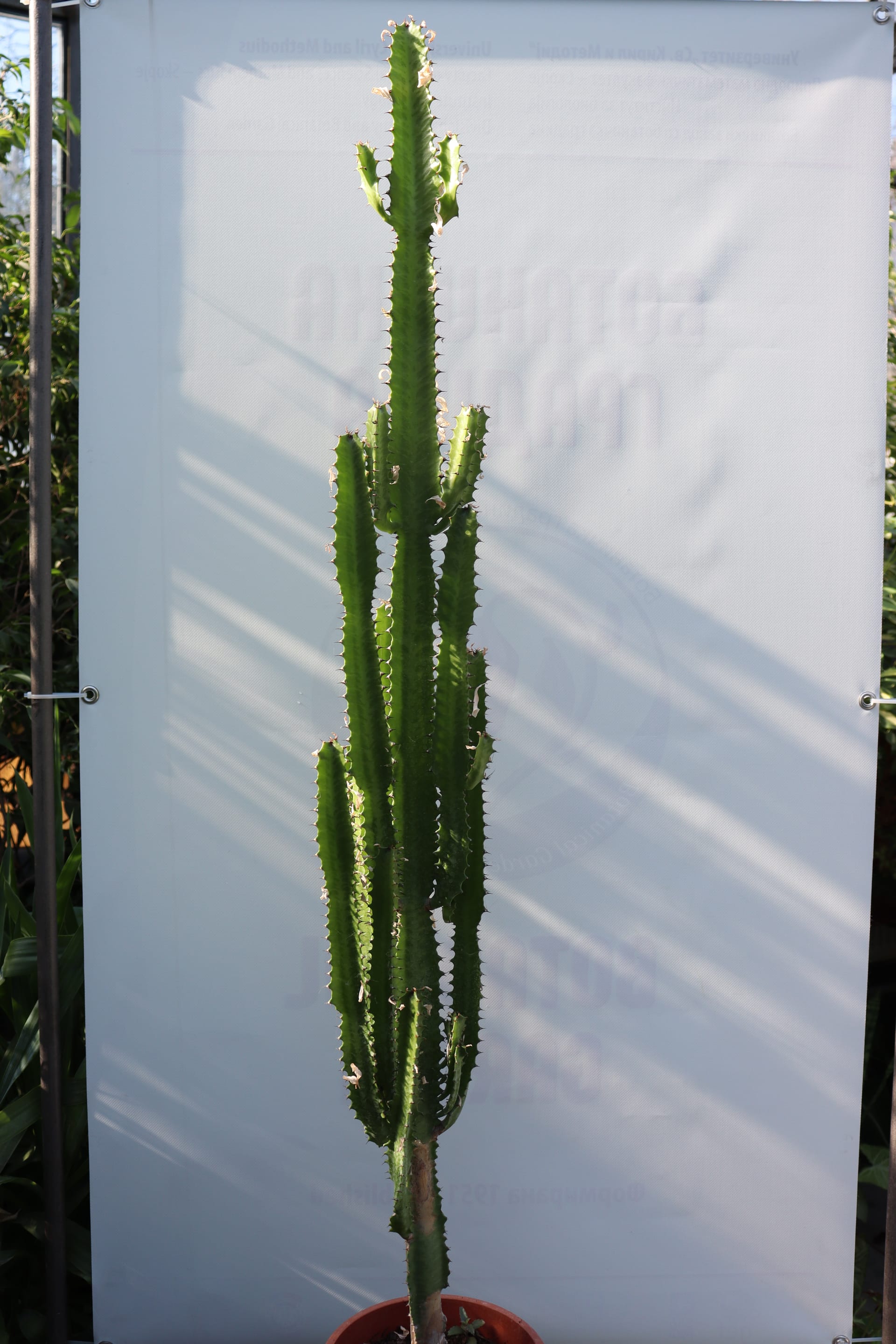
A columnar Euphorbia with upright, three-angled stems branching like a candelabrum, dark green with pale V-shaped markings, paired spines and teardrop leaves along the ridges. It is not known to flower.
About
Euphorbia trigona, the African milk tree, is a columnar succulent attributed to central Africa (Angola, Congo, Gabon, Malawi and neighbouring areas), known in Japan as 'saiunkaku'. Many branches grow upward from an upright stem in a candelabrum shape. The stems have two or three angles (trigona means 'three-angled'), dark green with pale V-shaped markings, and paired spines about 5 mm long along the ridges, with teardrop-shaped leaves between them. It has never been recorded flowering and may be of hybrid origin; it is known only in cultivation, and in Gabon it is used as a ritual plant and hedge. Plants reach 1.5–3 m, but the small, shallow root system means large specimens can topple. Red-tinged forms are also sold. Care is easy: indoors give bright light and water when the mix dries. In Japan it is a staple columnar euphorbia widely sold in houseplant and succulent sections.
Source: Wikipedia (CC BY-SA 4.0)
Size of the African milk tree
The African milk tree grows to 1.5–3 m tall.
Temperature & humidity for the African milk tree
The ideal temperature for the African milk tree is 18〜29℃.
It is cold-sensitive; a Japanese reference gives 10°C as its limit, so bring it indoors for winter.
Basic Info
Origin
Attributed to central Africa (Angola, Congo, Gabon, Malawi and nearby)
Lifespan
Perennial
Size
1.5–3 m tall
Temperature
18〜29℃
Humidity
30〜50%
Watering & Fertilizer
Light feeder
Growing Tips
Light & Placement
Indoors give bright indirect light; outdoors part sun. In poor light the stems grow thin.
Watering
A summer grower. Avoid overwatering; water when the top 2–3 cm of the mix is dry, and less in winter.
Temperature & Overwintering
It prefers about 18–29°C. It is cold-sensitive: bring it indoors before temperatures fall below 7°C. A Japanese reference gives 10°C as its limit.
Soil & Repotting
Use a sandy, free-draining or cactus mix. The roots are shallow and big plants topple easily, so choose a heavy, stable pot.
Propagation
Roots easily from cuttings; dry the cut piece for 3–7 days to callus before inserting.
Pests & Cautions
The white latex from cuts is toxic: it irritates skin and can cause severe eye inflammation. Wear gloves and eye protection when pruning or repotting, and keep the plant away from children and pets. Watch for mealybugs and spider mites.
African milk tree FAQ
QWhat is the growing difficulty level for African milk tree?
Beginner. A variety suitable for beginners. No special equipment or experience is required—you can grow it without problems by setting up a basic cultivation environment.
QWhat is the ideal temperature for African milk tree?
The ideal temperature for African milk tree is 18〜29℃. Avoid sudden temperature changes and maintain a stable environment.
QHow large does African milk tree get?
The mature size of African milk tree is 1.5–3 m tall. This may vary slightly depending on cultivation environment and individual differences.
QHow should I water and fertilize African milk tree?
African milk tree: watering & fertilizer — Light feeder. Aim for appropriate frequency and amount.
QWhat is the typical price for African milk tree?
The price of African milk tree varies significantly by variety, characteristics, size, and lineage. Please check GrowerDirect's price guide for the latest market information.
Last updated: September 23, 2026
References & Sources
Edited & verified by: GrowerDirect Editorial Team
The classifications, regulations, and growing data on this page are created and verified based on the primary information database below.
Taxonomy & Authority
Regulations & Conservation Status
Listed in CITES Appendix II (under the listing of succulent Euphorbia spp.). International trade requires export permits, but no registration is needed to transfer plants within Japan. It is not regulated under Japan's Invasive Alien Species Act. An annotation exempts artificially propagated cultivars of E. trigona.
Sources: Species+ (CITES): Euphorbia trigona / Ministry of the Environment: list of Invasive Alien Species
Regulations may change. Always verify the latest information with the relevant authorities.
Related Species
Find listings for this species
Related Articles
Top 15 Popular Euphorbia Ranking 2026: Valida, Obesa, White Ghost & More Compared
A ranking guide to popular Euphorbia species. Compare 15 species favored by collectors—including Valida, Obesa, White Ghost, Lactea, Neriifolia, and Suzannae—by characteristics, ease of care, and price range.
Autumn Preparation Management for Summer-Type Succulents
A guide to autumn care for summer-type succulents, covering plant changes from September to November, timing for gradual watering reduction, placement and temperature management for transitioning plants indoors, autumn fertilizing and pest control, variety-specific care checkpoints, and preparation for winter dormancy.
Mealybug Control on Succulents | Complete Guide to Early Detection, Removal, and Prevention
Mealybugs hide easily at the base of succulent leaves and on new growth. This guide covers their characteristics, the environments where they thrive, tips for early detection, removal methods using cotton swabs and alcohol, and daily care practices to prevent recurrence.
Summer and Winter Type Succulents: Growth Cycles and Watering Management Strategy
This article explains the differences in growth types of succulent plants, their annual growth cycles, seasonal watering management strategies, common failures, and countermeasures.
🩺 Common diseases
Can't find the plant you're looking for?
Post your wishes for free and growers with matching plants will contact you with introductions.