Source: Wikimedia Commons
Tiger jaws
BeginnerFaucaria tigrina
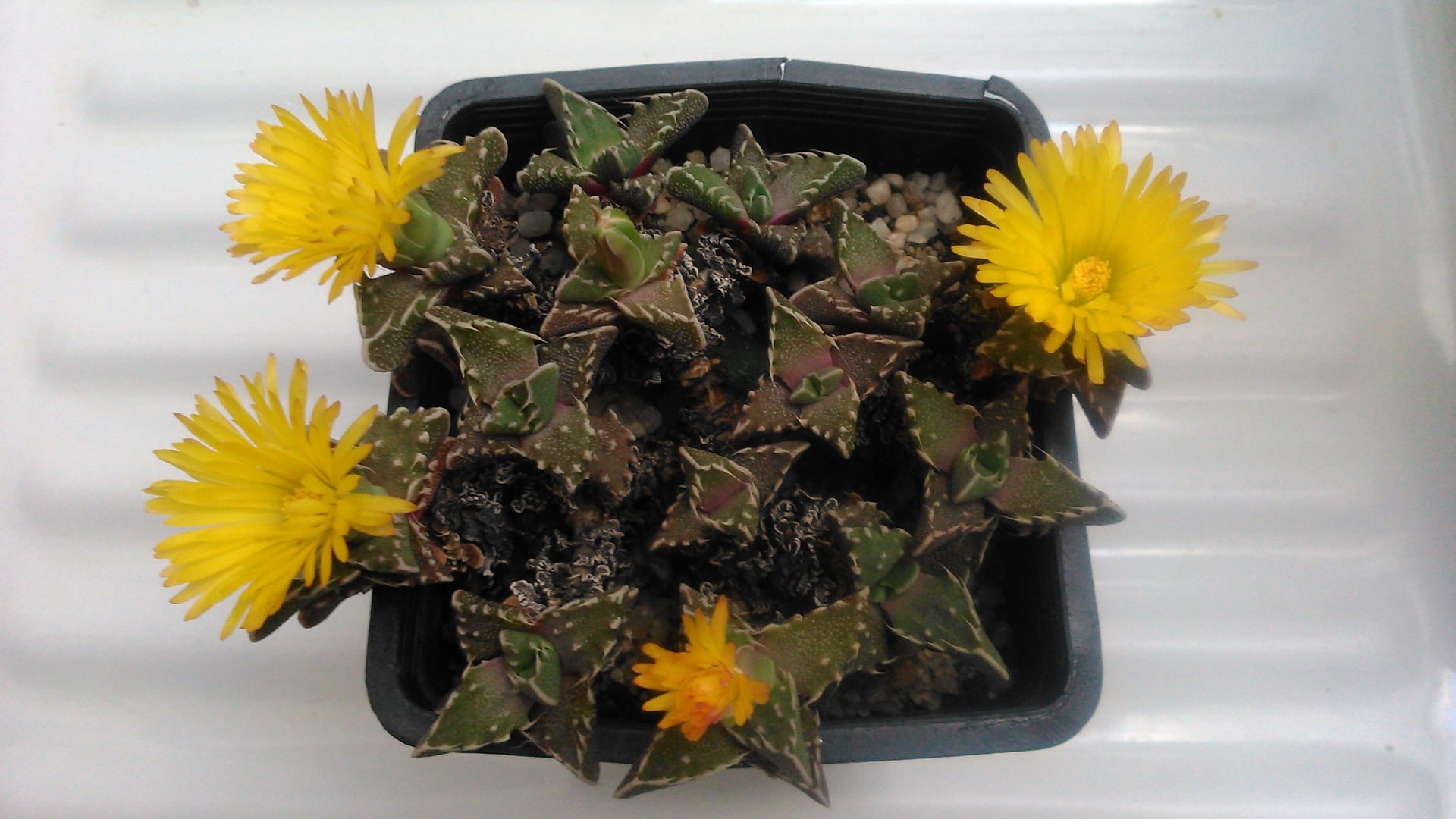
A mesemb whose paired, thick triangular leaves bear soft, thread-like teeth like open jaws. Large yellow flowers appear between the white-dotted leaves in autumn and winter.
About
Faucaria tigrina is a mesemb (Aizoaceae) found only in the Albany Thicket of the Eastern Cape, South Africa, where it grows among rocks in small openings, shaded by the surrounding thorny scrub. It is a small, stemless plant about 8 cm across. Thick triangular leaves emerge in pairs from the centre, their edges lined with long, soft, thread-like teeth, like an animal's open jaws; Faucaria means 'throat' or 'jaws' and tigrina 'of the tiger'. The Japanese name shikainami comes from an old phrase in Noh chant. Leaf colour ranges from light to dark green or pinkish-red to purple depending on sun, and small white spots roughen the surface. Large yellow flowers open in autumn and winter. The teeth are thought not to be defensive but to collect water vapour from coastal fog and channel it towards the roots. Only about four wild subpopulations remain, threatened by urban development and overgrazing, and the South African Red List rates it Endangered. It was first recorded in 1789 by a collector sent to gather plants for Kew. It is the easiest and most popular Faucaria; Japanese references class it as a winter grower, and it has long been sold in Japan.
Source: Wikipedia (CC BY-SA 4.0)
Size of the Tiger jaws
The Tiger jaws grows to About 8 cm across (clumping).
Basic Info
Origin
South Africa (Eastern Cape)
Lifespan
Perennial; old plants form a short stem of dead leaves
Size
About 8 cm across (clumping)
Temperature
5〜35℃
Humidity
30〜50%
Watering & Fertilizer
Light feeder
Growing Tips
Light & Placement
Likes full sun, which tints the leaves reddish-purple. Keep it in a dry, airy position.
Watering
Classed as a winter grower in Japan. It dislikes staying wet, so in the growing season water lightly once the mix has dried a little; give very little while dormant.
Temperature & Overwintering
It does not tolerate freezing, so keep it frost-free in winter; a Japanese reference gives 0°C as its limit. In hot, humid summers rest it in a well-ventilated place.
Soil & Repotting
South African growers recommend a peat-free mix of two parts loam, one part coarse sand and one part pumice.
Propagation
Propagate by division or from seed sown in autumn and barely covered. Seedlings form a taproot, so keep it straight when transplanting.
Pests & Cautions
Red spider mites appear in dry conditions; keep the air moving and cut away any rotting parts before rot spreads.
Tiger jaws FAQ
QWhat is the growing difficulty level for Tiger jaws?
Beginner. A variety suitable for beginners. No special equipment or experience is required—you can grow it without problems by setting up a basic cultivation environment.
QHow large does Tiger jaws get?
The mature size of Tiger jaws is About 8 cm across (clumping). This may vary slightly depending on cultivation environment and individual differences.
QHow should I water and fertilize Tiger jaws?
Tiger jaws: watering & fertilizer — Light feeder. Aim for appropriate frequency and amount.
QWhat is the typical price for Tiger jaws?
The price of Tiger jaws varies significantly by variety, characteristics, size, and lineage. Please check GrowerDirect's price guide for the latest market information.
Last updated: September 23, 2026
References & Sources
Edited & verified by: GrowerDirect Editorial Team
The classifications, regulations, and growing data on this page are created and verified based on the primary information database below.
Taxonomy & Authority
Regulations & Conservation Status
Not listed in the CITES Appendices and not regulated under Japan's Invasive Alien Species Act.
Sources: Species+ (CITES) query for Faucaria tigrina: not listed / Ministry of the Environment: list of Invasive Alien Species
Regulations may change. Always verify the latest information with the relevant authorities.
Related Species
Find listings for this species
Related Articles
Autumn Preparation Management for Summer-Type Succulents
A guide to autumn care for summer-type succulents, covering plant changes from September to November, timing for gradual watering reduction, placement and temperature management for transitioning plants indoors, autumn fertilizing and pest control, variety-specific care checkpoints, and preparation for winter dormancy.
Mealybug Control on Succulents | Complete Guide to Early Detection, Removal, and Prevention
Mealybugs hide easily at the base of succulent leaves and on new growth. This guide covers their characteristics, the environments where they thrive, tips for early detection, removal methods using cotton swabs and alcohol, and daily care practices to prevent recurrence.
Summer and Winter Type Succulents: Growth Cycles and Watering Management Strategy
This article explains the differences in growth types of succulent plants, their annual growth cycles, seasonal watering management strategies, common failures, and countermeasures.
Selecting Pots for Succulents: The Relationship Between Root Development and Pot Choice | A Complete Guide to Pot Size, Material, and Drainage
Essential guide to pot selection for succulent growth. From choosing the right size to comparing terracotta vs. plastic, and optimizing drainage—practical tips for developing healthy root systems.
🩺 Common diseases
Can't find the plant you're looking for?
Post your wishes for free and growers with matching plants will contact you with introductions.