Source: Wikimedia Commons
Gasteria armstrongii
BeginnerGasteria nitida var. armstrongii
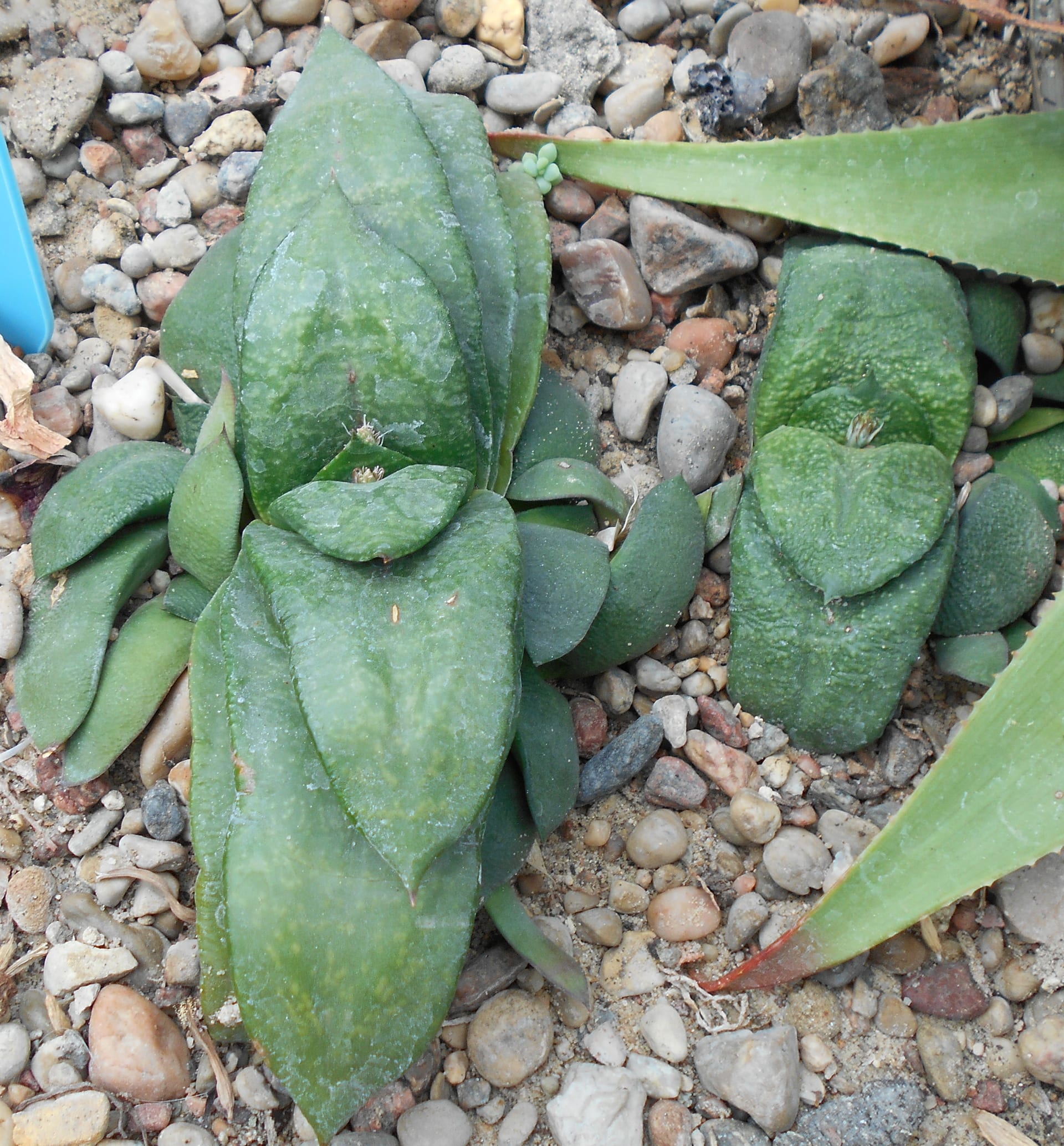
A dwarf Gasteria whose thick, rough, dark green tongue-shaped leaves stack in two opposite rows close to the ground, with bands of white tubercles. The Japanese name likens it to a reclining ox.
About
Gasteria armstrongii grows only on pebbly flats and hills of renosterveld between Jeffreys Bay and the Gamtoos River in the Eastern Cape of South Africa. It is stemless, with up to about three pairs of leaves lying flat in two opposite rows, solitary or offsetting into small clusters. The firm leaves are triangular to tongue-shaped, 3–6 cm long and 2.3–3.5 cm wide at the base, dark green on both sides with rough white tubercles in irregular cross-bands and a short sharp tip. It blends into the pebbles, and in drought the leaves turn reddish-brown and pull down into the soil. Reddish-pink flowers appear in summer on unbranched stalks 40–50 cm long. It differs from the larger G. nitida, which has smooth leaves in a rosette and branched flower stalks. Described in 1912, it was reduced to a variety of G. nitida in 1992, though DNA work has since led some to treat it again as a species. Development and collecting have reduced wild numbers. It grows slowly, adding only two or three leaves a year. In Japan it is a classic, much-exhibited plant, with many selected broad-leaved clones, the variegated 'Gagyu-nishiki' and numerous hybrids.
Source: Wikipedia (CC BY-SA 4.0)
Size of the Gasteria armstrongii
The Gasteria armstrongii grows to About 5 cm tall (leaves 3–6 cm long).
Basic Info
Origin
South Africa (Eastern Cape, Jeffreys Bay to the Gamtoos River)
Lifespan
Perennial; slow-growing, adding two or three leaves a year
Size
About 5 cm tall (leaves 3–6 cm long)
Temperature
5〜35℃
Humidity
30〜50%
Watering & Fertilizer
A little organic or liquid feed in the growing season
Growing Tips
Light & Placement
It tolerates sun but prefers bright, lightly shaded conditions; avoid strong direct sun in hot weather. In winter keep it on a sunny windowsill or in a cold frame.
Watering
In the growing season, spring to autumn, water generously in an airy spot to keep the leaves plump. Water year-round, but keep it on the dry side in winter. Japanese references class it as a summer grower.
Temperature & Overwintering
Fairly cold-hardy, but freezing or frost leaves black spots on the thick leaves. A Japanese reference gives 2–5°C as the minimum survival temperature.
Soil & Repotting
It has long, carrot-like roots, so use a tall pot (such as an orchid pot) and a free-draining mix.
Propagation
Propagate from seed, division or leaf cuttings. For leaf cuttings in spring, dry the detached leaf on a windowsill for one to three weeks, then root it in clean sand.
Pests & Cautions
Growth is slow; seedlings take about three years to flower. Larger, older plants are the most prized, so grow it patiently.
Gasteria armstrongii FAQ
QWhat is the growing difficulty level for Gasteria armstrongii?
Beginner. A variety suitable for beginners. No special equipment or experience is required—you can grow it without problems by setting up a basic cultivation environment.
QHow large does Gasteria armstrongii get?
The mature size of Gasteria armstrongii is About 5 cm tall (leaves 3–6 cm long). This may vary slightly depending on cultivation environment and individual differences.
QHow should I water and fertilize Gasteria armstrongii?
Gasteria armstrongii: watering & fertilizer — A little organic or liquid feed in the growing season. Aim for appropriate frequency and amount.
QWhat is the typical price for Gasteria armstrongii?
The price of Gasteria armstrongii varies significantly by variety, characteristics, size, and lineage. Please check GrowerDirect's price guide for the latest market information.
Last updated: September 23, 2026
References & Sources
Edited & verified by: GrowerDirect Editorial Team
The classifications, regulations, and growing data on this page are created and verified based on the primary information database below.
Taxonomy & Authority
Regulations & Conservation Status
Not listed in the CITES Appendices and not regulated under Japan's Invasive Alien Species Act.
Sources: Species+ (CITES) query for Gasteria nitida: not listed / Ministry of the Environment: list of Invasive Alien Species
Regulations may change. Always verify the latest information with the relevant authorities.
Related Species
Find listings for this species
Related Articles
Complete Guide to Growing Gasteria | Species, Watering, and Propagation Explained
Complete guide to basic Gasteria care. This guide introduces popular varieties and their characteristics, location selection that makes use of strong shade tolerance, watering and fertilizer application, and propagation through leaf propagation and division.
Autumn Preparation Management for Summer-Type Succulents
A guide to autumn care for summer-type succulents, covering plant changes from September to November, timing for gradual watering reduction, placement and temperature management for transitioning plants indoors, autumn fertilizing and pest control, variety-specific care checkpoints, and preparation for winter dormancy.
Mealybug Control on Succulents | Complete Guide to Early Detection, Removal, and Prevention
Mealybugs hide easily at the base of succulent leaves and on new growth. This guide covers their characteristics, the environments where they thrive, tips for early detection, removal methods using cotton swabs and alcohol, and daily care practices to prevent recurrence.
Summer and Winter Type Succulents: Growth Cycles and Watering Management Strategy
This article explains the differences in growth types of succulent plants, their annual growth cycles, seasonal watering management strategies, common failures, and countermeasures.
🩺 Common diseases
Can't find the plant you're looking for?
Post your wishes for free and growers with matching plants will contact you with introductions.