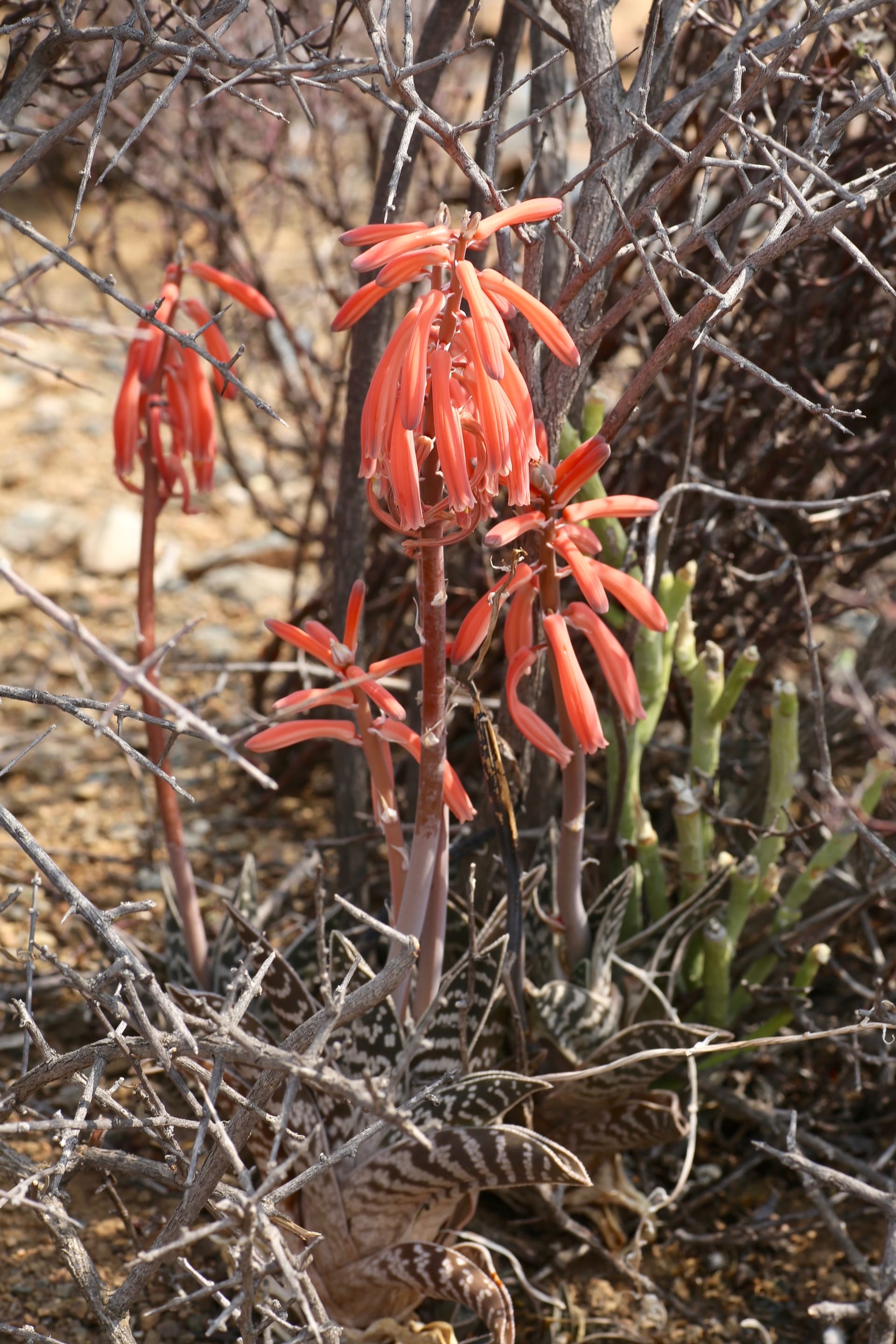
Source: Wikimedia Commons
Tiger aloe
BeginnerGonialoe variegata
A small aloe relative whose V-shaped leaves stack in three ranks, dark green with white spots in transverse bands and a white horny edge. It is now placed in the genus Gonialoe.
About
Gonialoe variegata was long known as Aloe variegata. Phylogenetic work moved it, with two Namibian relatives, into Gonialoe, a name thought to refer to the angled, V-shaped cross-section of the leaves. It grows across the arid Karoo of South Africa and into southern Namibia, usually in small groups in the partial shade of shrubs or rock crevices. Plants stay under about 25 cm tall, with triangular leaves 15–20 cm long arranged in three ranks of 6–8, sometimes twisting into a spiral with age. White spots form irregular cross-bands on both leaf surfaces, and the margins have a white horny edge with fine teeth; drought turns the leaves chocolate brown. The pink to dull-red flowers appear from July to September in habitat on a surprisingly large inflorescence. It is more robust, with denser racemes, than its two Namibian relatives. First recorded by an expedition in 1685, it has long been a windowsill plant in Europe, and in Japan it has been sold for many years under the name Chiyoda-nishiki.
Source: Wikipedia (CC BY-SA 4.0)
Lifespan of the Tiger aloe
The Tiger aloe lives Perennial; reaches flowering size in about 3–7 years.
Size of the Tiger aloe
The Tiger aloe grows to 20–30 cm tall (leaves 10–20 cm long).
Basic Info
Origin
South Africa (Karoo and other arid areas) and southern Namibia
Lifespan
Perennial; reaches flowering size in about 3–7 years
Size
20–30 cm tall (leaves 10–20 cm long)
Temperature
5〜35℃
Humidity
30〜50%
Watering & Fertilizer
Modest; a little dilute fertiliser in the growing season
Growing Tips
Light & Placement
In the wild it grows in the shade of shrubs or rocks. Give bright sun to light shade and soften harsh midsummer sun.
Watering
Very drought tolerant but prone to rotting at the base if overwatered or poorly drained. Water only after the mix has dried well.
Temperature & Overwintering
Dislikes temperatures below 5°C and winter wet. In winter keep it bright, frost-free and on the dry side. Japanese references classify it as a spring–autumn grower.
Soil & Repotting
Use a sandy, free-draining mix. Repot when offsets crowd the pot, dividing the clump at the same time.
Propagation
Dividing offsets is easiest. Fresh seed is best; South African growers sow it in summer and keep it moist.
Pests & Cautions
Scale insects and aphids may appear; remove them early and keep plants healthy with good air movement.
Tiger aloe FAQ
QWhat is the growing difficulty level for Tiger aloe?
Beginner. A variety suitable for beginners. No special equipment or experience is required—you can grow it without problems by setting up a basic cultivation environment.
QWhat is the lifespan of Tiger aloe?
The average lifespan of Tiger aloe is Perennial; reaches flowering size in about 3–7 years. With proper cultivation environment and nutrient management, you can keep it healthy for a long time.
QHow large does Tiger aloe get?
The mature size of Tiger aloe is 20–30 cm tall (leaves 10–20 cm long). This may vary slightly depending on cultivation environment and individual differences.
QHow should I water and fertilize Tiger aloe?
Tiger aloe: watering & fertilizer — Modest; a little dilute fertiliser in the growing season. Aim for appropriate frequency and amount.
QWhat is the typical price for Tiger aloe?
The price of Tiger aloe varies significantly by variety, characteristics, size, and lineage. Please check GrowerDirect's price guide for the latest market information.
Last updated: September 23, 2026
References & Sources
Edited & verified by: GrowerDirect Editorial Team
The classifications, regulations, and growing data on this page are created and verified based on the primary information database below.
Taxonomy & Authority
Regulations & Conservation Status
Listed in CITES Appendix II (listed with the former Aloe species). International trade requires export permits, but no registration is needed to transfer plants within Japan. It is not regulated under Japan's Invasive Alien Species Act.
Sources: Species+ (CITES): Gonialoe variegata / Ministry of the Environment: list of Invasive Alien Species
Regulations may change. Always verify the latest information with the relevant authorities.
Related Species
Find listings for this species
Related Articles
Complete Guide to Growing Aloe | Sunlight, Watering, and Propagation from Offsets
From the basic characteristics of drought-tolerant succulent aloe to detailed guidance on sunlight, watering, repotting, propagation by offsetting, and root rot prevention.
Autumn Preparation Management for Summer-Type Succulents
A guide to autumn care for summer-type succulents, covering plant changes from September to November, timing for gradual watering reduction, placement and temperature management for transitioning plants indoors, autumn fertilizing and pest control, variety-specific care checkpoints, and preparation for winter dormancy.
Mealybug Control on Succulents | Complete Guide to Early Detection, Removal, and Prevention
Mealybugs hide easily at the base of succulent leaves and on new growth. This guide covers their characteristics, the environments where they thrive, tips for early detection, removal methods using cotton swabs and alcohol, and daily care practices to prevent recurrence.
Summer and Winter Type Succulents: Growth Cycles and Watering Management Strategy
This article explains the differences in growth types of succulent plants, their annual growth cycles, seasonal watering management strategies, common failures, and countermeasures.
🩺 Common diseases
Can't find the plant you're looking for?
Post your wishes for free and growers with matching plants will contact you with introductions.