Source: Wikimedia Commons
Aloe erinacea
IntermediateAloe erinacea
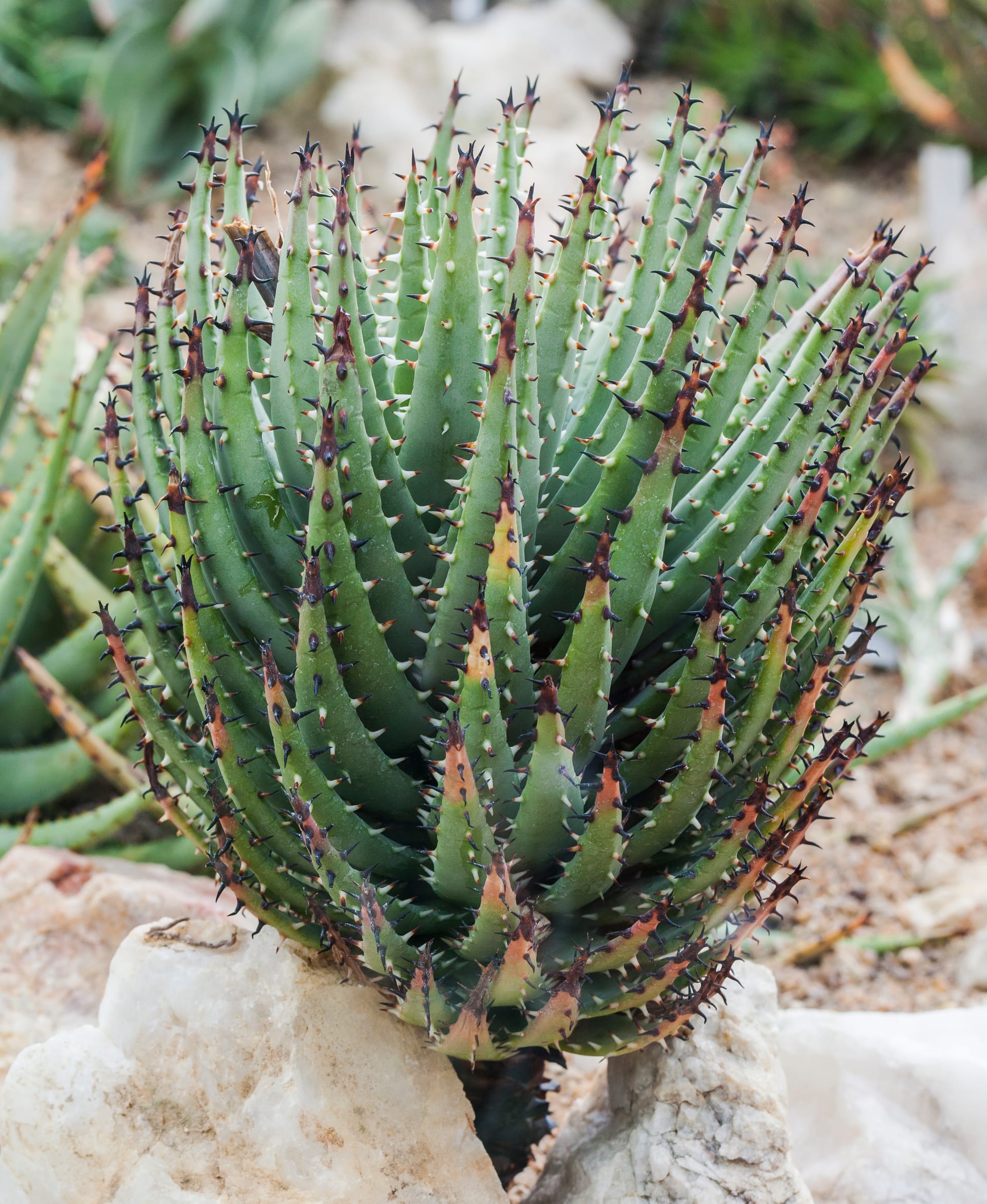
A small aloe with short, incurved blue-green leaves densely armed with long milky-white spines. Endemic to arid Namibian mountains; the name means 'hedgehog-like'.
About
Aloe erinacea is a small aloe endemic to Namibia, growing on arid mountain slopes and rocky shrubland; a Japanese reference places it on very dry rocky or sandy hills at about 900–1,350 m. It closely resembles Aloe melanacantha from Namaqualand in South Africa and is sometimes treated as a subspecies or variety of it, but GBIF accepts it as a species. It is slightly smaller, with shorter leaves in green to celadon blue-green, and may form dense clumps by offsetting. Long milky-white spines cover the plant. Its range is fragmented and illegal collecting is a serious threat. In cultivation it grows in spring and autumn, and because it comes from high altitudes it keeps growing slowly in winter, behaving almost like a winter grower. It rests from late July to August and strongly dislikes humid heat, so summer care is the key. It is slow-growing and needs little fertiliser. In Japan it is a popular species offered mainly by specialist nurseries.
Source: Wikipedia (CC BY-SA 4.0)
Basic Info
Origin
Namibia
Lifespan
Perennial; slow-growing
Size
Small rosettes, sometimes clumping
Temperature
5〜35℃
Humidity
30〜50%
Watering & Fertilizer
Very little; a small amount of base fertiliser at repotting
Growing Tips
Light & Placement
Keep it in a well-ventilated place all year. Grow it outdoors in full sun during the growing season and give 20–40% shade in summer.
Watering
In spring and autumn water thoroughly when the pot dries. During the summer rest water only once or twice a month, avoiding muggy days.
Temperature & Overwintering
It keeps growing slowly in winter, almost like a winter grower. When lows fall below 10°C, protect it from frost and cold wind and bring it indoors at night. A Japanese reference gives 2°C as the minimum survival temperature.
Soil & Repotting
Use a free-draining mix. Repot in March–May or mid-September.
Fertiliser
It grows slowly, so a little slow-release fertiliser mixed in at repotting is enough; avoid heavy feeding.
Propagation
Mainly raised from seed; offsets, when produced, can be removed and rooted.
Pests & Cautions
Summer humidity is the main danger; prioritise air movement in hot weather and handle the sharp spines with care.
Aloe erinacea FAQ
QWhat is the growing difficulty level for Aloe erinacea?
Intermediate. A variety suitable for intermediate growers. Requires some cultivation experience and knowledge of environment management. Pay careful attention to temperature and humidity control.
QHow should I water and fertilize Aloe erinacea?
Aloe erinacea: watering & fertilizer — Very little; a small amount of base fertiliser at repotting. Aim for appropriate frequency and amount.
QWhat is the typical price for Aloe erinacea?
The price of Aloe erinacea varies significantly by variety, characteristics, size, and lineage. Please check GrowerDirect's price guide for the latest market information.
Last updated: September 23, 2026
References & Sources
Edited & verified by: GrowerDirect Editorial Team
The classifications, regulations, and growing data on this page are created and verified based on the primary information database below.
Taxonomy & Authority
Regulations & Conservation Status
Listed in CITES Appendix II (under the genus-level listing of Aloe spp.). International trade requires export permits, but no registration is needed to transfer plants within Japan. It is not regulated under Japan's Invasive Alien Species Act.
Sources: Species+ (CITES): Aloe erinacea / Ministry of the Environment: list of Invasive Alien Species
Regulations may change. Always verify the latest information with the relevant authorities.
Related Species
Find listings for this species
Related Articles
Complete Guide to Growing Aloe | Sunlight, Watering, and Propagation from Offsets
From the basic characteristics of drought-tolerant succulent aloe to detailed guidance on sunlight, watering, repotting, propagation by offsetting, and root rot prevention.
Autumn Preparation Management for Summer-Type Succulents
A guide to autumn care for summer-type succulents, covering plant changes from September to November, timing for gradual watering reduction, placement and temperature management for transitioning plants indoors, autumn fertilizing and pest control, variety-specific care checkpoints, and preparation for winter dormancy.
Mealybug Control on Succulents | Complete Guide to Early Detection, Removal, and Prevention
Mealybugs hide easily at the base of succulent leaves and on new growth. This guide covers their characteristics, the environments where they thrive, tips for early detection, removal methods using cotton swabs and alcohol, and daily care practices to prevent recurrence.
Summer and Winter Type Succulents: Growth Cycles and Watering Management Strategy
This article explains the differences in growth types of succulent plants, their annual growth cycles, seasonal watering management strategies, common failures, and countermeasures.
🩺 Common diseases
Can't find the plant you're looking for?
Post your wishes for free and growers with matching plants will contact you with introductions.