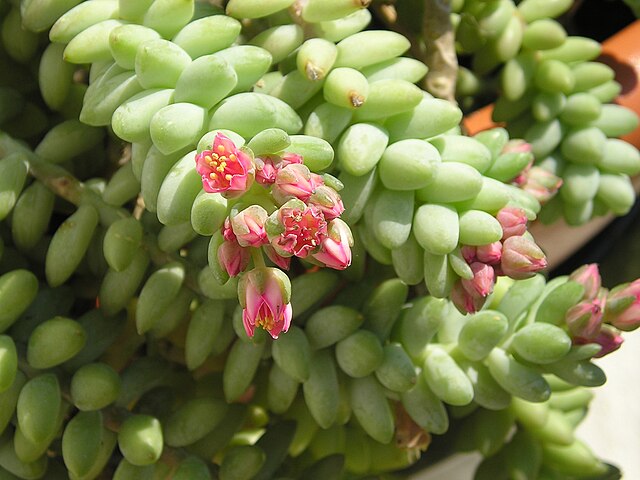
Source: Wikimedia Commons
Burro's Tail
IntermediateSedum morganianum
A succulent with plump leaves trailing downward in chains. Beautiful when displayed in hanging baskets.
About
Sedum morganianum (Donkey's Tail or Burro's Tail) is a trailing succulent native to Mexico and Honduras. Its long, rope-like stems are densely covered with plump, glaucous blue-green leaves, creating a beautifully textured cascading effect ideal for hanging baskets and elevated shelves. Stems can trail 30–60 cm or more over several years of growth. The leaves are exceptionally fragile and detach with the slightest contact, making handling and moving the plant a delicate operation. However, fallen leaves root readily into new plants, making propagation straightforward. Plants require bright light with some direct sun, but should be protected from the most intense midsummer exposure. Watering should be infrequent, with the soil allowed to dry completely between sessions.
Size of the Burro's Tail
The Burro's Tail grows to Trailing (30-60cm).
Temperature & humidity for the Burro's Tail
Overwintering requires temperatures above 5°C.
Basic Info
Origin
Mexico and Honduras
Lifespan
Perennial
Size
Trailing (30-60cm)
Temperature
5〜35℃
Humidity
30〜50%
Watering & Fertilizer
Moderate watering
Growing Tips
Light & Placement
Prefers a sunny spot, but watch for leaf scorch in harsh midsummer sun. Hang it or place it on a high shelf and move it as little as possible.
Watering
Water only after the soil has dried completely; excess moisture is a no-go. Hanging pots dry quickly, but pour gently at the base without touching the leaves.
Temperature & Overwintering
Overwinters at minimum temperatures of 5°C or above. In winter hang it by a bright indoor window and lengthen the interval between waterings.
Propagation
Dropped leaves root simply when laid on soil. Rather than discarding leaves knocked off during handling, use them to make new plants.
Notes
Leaves detach easily, so handle with care
Soil & Repotting
Use a well-draining succulent mix. Since the leaves drop easily, keep repotting to a minimum; growth is slow, so once every few years is enough.
Burro's Tail FAQ
QWhat is the growing difficulty level for Burro's Tail?
Intermediate. A variety suitable for intermediate growers. Requires some cultivation experience and knowledge of environment management. Pay careful attention to temperature and humidity control.
QHow large does Burro's Tail get?
The mature size of Burro's Tail is Trailing (30-60cm). This may vary slightly depending on cultivation environment and individual differences.
QHow should I water and fertilize Burro's Tail?
Burro's Tail: watering & fertilizer — Moderate watering. Aim for appropriate frequency and amount.
QWhat is the typical price for Burro's Tail?
The price of Burro's Tail varies significantly by variety, characteristics, size, and lineage. Please check GrowerDirect's price guide for the latest market information.
Last updated: August 31, 2026
Growing Specifications
- Hardiness (RHS)
- H1c
Sources: RHS Find a Plant
References & Sources
Edited & verified by: GrowerDirect Editorial Team
The classifications, regulations, and growing data on this page are created and verified based on the primary information database below.
Primary sources
Taxonomy & Authority
Regulations & Conservation Status
Sources: CITES Appendices — taxon not listed
Regulations may change. Always verify the latest information with the relevant authorities.
Related Species
Find listings for this species
Related Articles
Autumn Preparation Management for Summer-Type Succulents
A guide to autumn care for summer-type succulents, covering plant changes from September to November, timing for gradual watering reduction, placement and temperature management for transitioning plants indoors, autumn fertilizing and pest control, variety-specific care checkpoints, and preparation for winter dormancy.
Mealybug Control on Succulents | Complete Guide to Early Detection, Removal, and Prevention
Mealybugs hide easily at the base of succulent leaves and on new growth. This guide covers their characteristics, the environments where they thrive, tips for early detection, removal methods using cotton swabs and alcohol, and daily care practices to prevent recurrence.
Summer and Winter Type Succulents: Growth Cycles and Watering Management Strategy
This article explains the differences in growth types of succulent plants, their annual growth cycles, seasonal watering management strategies, common failures, and countermeasures.
Selecting Pots for Succulents: The Relationship Between Root Development and Pot Choice | A Complete Guide to Pot Size, Material, and Drainage
Essential guide to pot selection for succulent growth. From choosing the right size to comparing terracotta vs. plastic, and optimizing drainage—practical tips for developing healthy root systems.
🩺 Common diseases
Can't find the plant you're looking for?
Post your wishes for free and growers with matching plants will contact you with introductions.