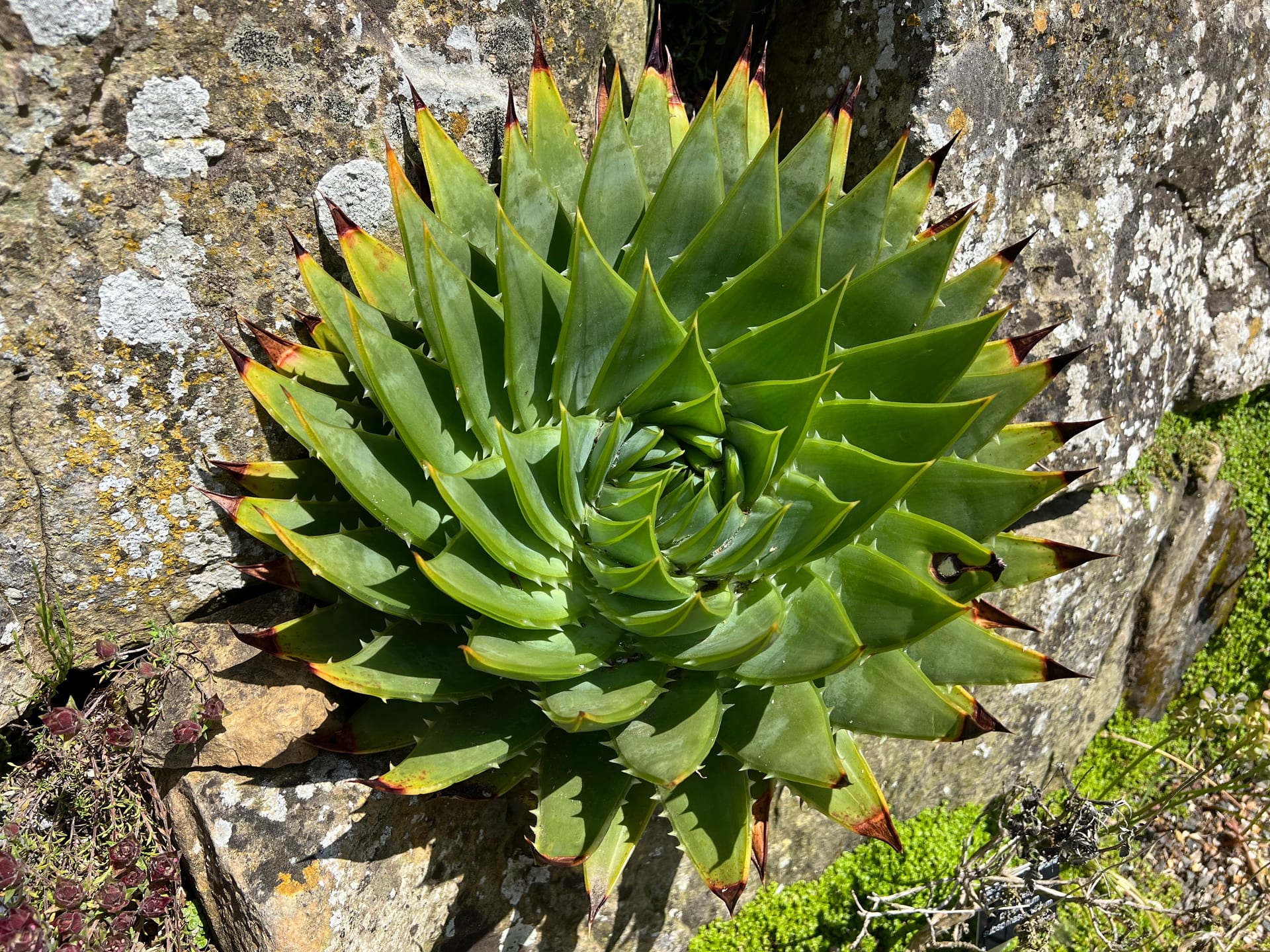
 © LavaLampBamboo / CC BY-SA 4.0
螺紋蘆薈
Aloe polyphylla is a striking, stemless aloe whose broad grey-green leaves form five neat rows that spiral outward in a clockwise or counterclockwise pattern, no two plants look quite the same. It grows naturally only in the cool, high-altitude mountains of Lesotho, above 2,000 meters. As a perennial, it rarely produces offsets and develops slowly as a single rosette that can carry around 150 leaves. Keeping that perfect spiral shape takes careful, experienced care, which is why this species is considered suitable for advanced growers rather than beginners. For those willing to take the time, it rewards patience with a one-of-a-kind sculptural form. It is listed in CITES Appendix I and designated an Internationally Endangered Species under Japan's Act on Conservation of Endangered Species (種の保存法), so transferring a plant by sale or gift, or displaying or advertising it for sale, requires an individual registration certificate, and this applies to plants propagated in Japan too. Plants without a certificate cannot be bought or sold, so always confirm the certificate when buying.
View 螺紋蘆薈 encyclopedia →成交手續費 0%!2026年9月30日前註冊,前 2 株免佣金!
生產者 招募中!
在 GrowerDirect 上架,直接銷售給全國的客戶吧!
GrowerDirect承諾的 6 項透明性重點
生產者在多肉植物與仙人掌出品時明示以下資訊。保證品種、產地、所需光量、栽培難度的透明度。
- 品種明示
- 實物照片
- 色澤
- 產地明示
- 所需光量
- 難度明示
查看全部131個品種
多肉植物與仙人掌分類正在招募認證生產者
生產者正在陸續註冊,即將上架。設定上架通知,不錯過新商品。
「接收上架通知」需免費註冊會員即可設定。當有符合您儲存條件的新商品上架時,我們會以郵件和站內通知提醒您。
已註冊的生產者(搶先看)
螺紋蘆薈的基本資料
- 栽培難度
- 適合高級者
- 壽命
- 多年生。幾乎不生子株,以單頭生長
- 體型
- 高度約30公分,株幅30~60公分
- 澆水
- 生育期應控制供水量給予
- 日照和擺放位置
- 光線充足的向陽至明亮的半日陰環境。因自生地為涼爽高山,夏季炎熱時應放在通風良好的涼爽處所,減弱強烈日照。
- 澆水
- 據說比其他蘆薈更喜水。生育期應在土壤乾燥後充分澆水,但前提是使用排水性良好的土壤以免積水。
- 溫度和越冬
- 耐寒性強,美國生產者指出可耐受-12℃左右的低溫。但高溫多濕的夏季是最大挑戰,易因悶熱高溫而受損。
- 栽培土壤和換盆
- 自生地生於岩石裂隙和碎石斜坡。應使用含粗碎石較多、排水和透氣性都極佳的土壤種植。
- 繁殖方法
- 由於幾乎不生子株,繁殖只能通過實生(種子)進行。國內流通株也是以實生苗或組織培養繁殖。
- 病蟲害和注意事項
- 作為附錄I物種和國際瀕危野生動植物,轉讓需要登記票(國內繁殖株也包括在內)。購買時必須確認是否附有登記票。
關於螺紋蘆薈
A stemless aloe with broad grey-green leaves arranged in five spiraling rows, native only to Lesotho's high mountains. It grows slowly as a single rosette, rarely producing offsets, making it a plant for experienced growers.
開始照料螺紋蘆薈前需要了解的7件事
1Placement and Sunlight
This aloe prefers bright light and good airflow, but intense midsummer sun can scorch the leaves. In summer, a spot with bright, filtered light or light afternoon shade is safer.
2Watering
This aloe is said to like more water than other aloes. Provided it is planted in a fast-draining mix where water never lingers, water thoroughly during the growing season whenever the soil has dried, and never let water pool at the base of the pot.
3Well-Draining Soil
A well-draining succulent or cactus mix suits this plant best. Water pooling in the center of the rosette can cause rot, so water the soil directly rather than the crown of the plant.
4Repotting
Because it grows slowly as a single rosette, frequent repotting isn't necessary. Move it into a slightly larger pot only once the roots have filled the current one.
5Seasonal Care
During hot, humid weather, keep airflow good and adjust watering to avoid rot. Coming from cool mountain habitats, it tolerates cold reasonably well, but some winter protection is still a good idea.
6Choosing a Plant and the Registration Certificate
Look for a plant with a neat, well-formed spiral and a firm, healthy center. As a CITES Appendix I species designated under Japan's Act on Conservation of Endangered Species (種の保存法), any transfer requires a registration certificate, including for plants propagated in Japan. Always confirm the certificate comes with the plant when buying.
7Rarely Offsets
This aloe rarely produces offsets and grows as a single head, which makes propagation by division difficult. It's a plant best enjoyed for the long-term growth of a single specimen rather than for multiplying easily.
螺紋蘆薈的常見問題
- Q.Is this suitable for beginners?
- A.This species is generally considered suitable for advanced growers. Because watering and placement require some care, it's best attempted after you've gained experience with succulents.
- Q.How large does it grow?
- A.Its leaves form five rows of 15 to 30 each, for around 150 leaves on a single plant. Since it grows slowly as a single rosette, it takes many years to develop its full spiral form.
- Q.Can I choose the direction of the spiral?
- A.The spiral can turn either clockwise or counterclockwise, and this is fixed for each individual plant. Checking the direction at the time of purchase lets you pick the one you prefer.
- Q.Can it be propagated from offsets?
- A.Because it rarely produces offsets and grows as a single head, propagation by division is difficult. Growing new plants from seed is the main method used instead.
- Q.What kind of environment does it grow in naturally?
- A.It grows naturally in the cool, high mountains of Lesotho, at elevations above 2,000 meters. In the wild, it's found on rocky, high-altitude slopes.
螺紋蘆薈栽培的實用工具
在圖鑑中詳細了解螺紋蘆薈
查看螺紋蘆薈的圖鑑條目 →
收錄栽培難度、尺寸、原產地、日照等基礎資料。