Appreciating Agave as "Living Art" — The Joy of Admiring Form, Spines, and Color Like Sculpture
Introduces a perspective on appreciating agave like sculpture, not just cultivating it. Explains the three elements of form, spines, and color, and the value concept of "finish" discussed in collector culture.
Key Takeaways
Introduces a perspective on appreciating agave like sculpture, not just cultivating it. Explains the three elements of form, spines, and color, and the value concept of "finish" discussed in collector culture.
From "Ornamental Plant" to "Living Art" — How We're Seeing Agave Differently
In 2026, there's a distinct shift in how agave is perceived. Agave has traditionally been described as an "easy-to-grow succulent" or "star of the dry garden," but in recent years a new perspective has emerged rapidly — appreciating agave like sculpture or contemporary art. Particularly among male collectors, a culture is taking root on social media where the unique term "finish" is used to describe the completeness of individual plants.
This article reframes agave not as merely a "plant to grow," but as "an object to appreciate" through three sculptural elements: form, spines, and color. Rather than horticultural cultivation techniques, this content is designed to develop aesthetic judgment for those already growing agave — specifically, how to see and evaluate your own plants.
Reading Form as Sculpture
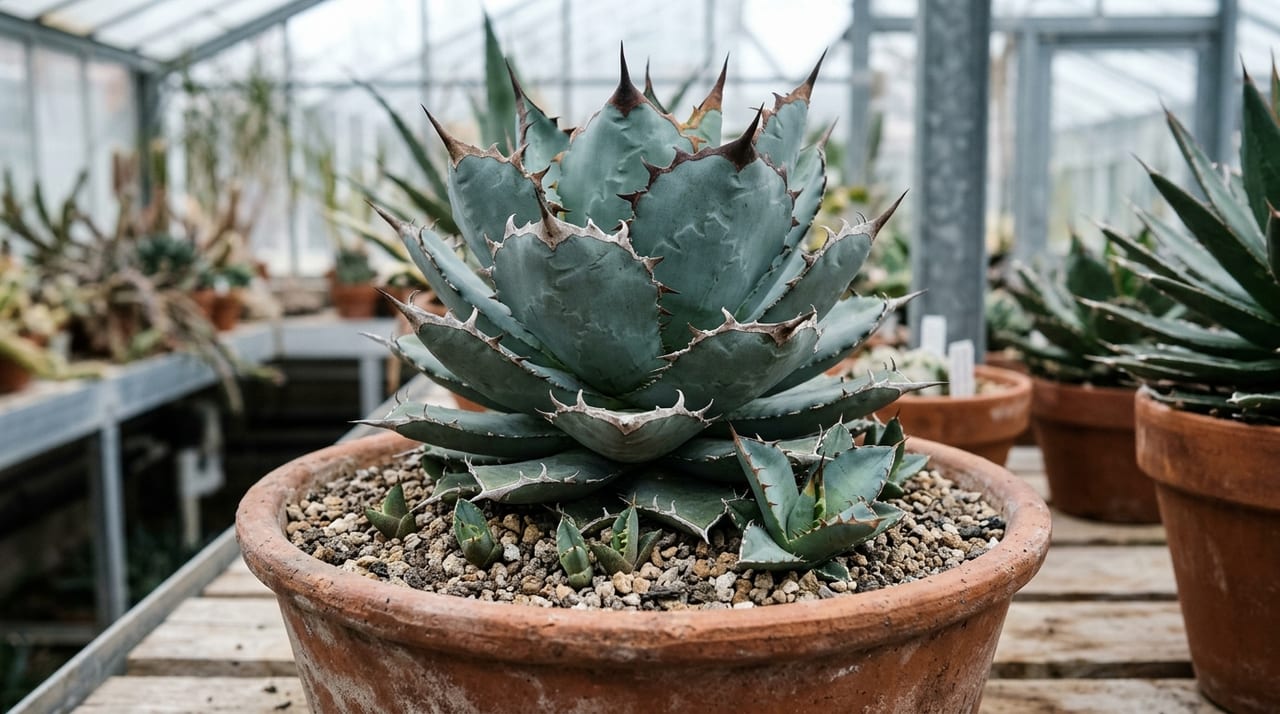
The heart of agave's appeal lies in its three-dimensional form. The silhouette created by leaves spreading in a rosette pattern varies greatly by variety, and even within the same variety, individual specimens differ. When viewing form from an appreciation perspective, consider these key points:
- Leaf compactness: The more tightly packed the internodes and the shorter the spacing between leaves, the more "compact" the impression. This compactness, created through light and water management, becomes an evaluation criterion similar to "density" in sculpture.
- Symmetry and rosette center: Perfect radial symmetry creates a "balanced" impression, but some collectors find unique presence in plants that have developed with intentional asymmetry. Both the beauty of perfect proportion and the beauty of individuality from aging are valid evaluation criteria.
- Leaf curve and twist: Straight leaves, leaves that curl inward, and leaves that curve outward create entirely different impressions. Beyond variety characteristics, growing conditions—particularly light direction—influence these curves.
Just as viewing sculpture involves observing both the overall silhouette and details, observing agave's overall plant contour and the individual character of each leaf greatly changes your perception. Those interested in comparing form differences across representative varieties like Titanota, Horrida, and Parry may find Agave 100 Popular Varieties Identification Guide helpful.
Decoding Spines as "Design"
Agave's greatest individuality lies in its spines. While many succulents discuss spines simply as "defensive mechanisms," agave spines possess remarkably diverse design across varieties.
- Marginal teeth (edge spines): The shape, spacing, and color of spines along leaf margins are among the greatest distinguishing features of varieties. Some varieties have evenly spaced, regular teeth, while others mix large and small spines irregularly.
- Terminal spine (apical spine): The large spine at the leaf tip is, in a sense, agave's "face." Color, thickness, and curve angle define the plant's overall impression.
- Spine imprints on leaves (bud prints): Patterns created when young leaves are still curled and pressed by neighboring leaf spines before unfurling. These cannot be intentionally made but are naturally impressed during growth as a "record of time," and are among the details particularly valued by collectors.
When viewed not simply as sharp and painful from a functional perspective, but as a subject of appreciation including a temporal dimension—how they're arranged and how they change through growth stages—their depth becomes vastly greater.
Color as Another Evaluation Dimension
Agave color is determined by the interplay of variety-specific genetic traits and stress-induced coloration from growing conditions. The color range is remarkably broad—from glaucous blue varieties with waxy coatings to reddish varieties to variegated types.
When viewing color from an appreciation perspective, focus not only on monochromatic tones, but on color gradation within the plant. Often, inner young leaves differ in color from outer mature leaves, and this transition itself creates the plant's "expression." Additionally, plants whose coloration changes with seasons and sunlight—unlike static sculpture—possess the appeal of a living sculptural form that transforms over time.
The Meaning of "Finish" as Discussed on Social Media
In recent social media posts from agave enthusiasts, the phrase "a finished plant" appears frequently. This doesn't simply mean "grown large," but rather refers to a state where the three elements—form, spines, and color—harmonize at a high level, maximizing the potential that the variety possesses.
Cultivation aimed at achieving "finish" differs from mere fertilization (growing large) and closely resembles the process of sculpting the plant's form through intentional tight cultivation, adjusted light levels, and reduced watering. The enjoyment of this process itself is a major reason for shifting agave's position from "a plant to grow" to "a work to create."
This awareness of "finish" extends beyond personal satisfaction, nurturing a culture where collectors share plant photographs and discuss form and spine design with each other. This parallels the "appreciation" culture found in bonsai and ornamental fish hobbies, representing a new form of aesthetic communication through plants.
How Cultivation Changes When You Adopt an Appreciation Perspective
Adopting an appreciation perspective of agave as "living art" naturally transforms your awareness of daily care. Rather than simply watering to prevent death, you begin considering light placement and positioning with questions like "how can I bring out this leaf's spread?" and "how can I emphasize this spine arrangement?"
As a result, appreciation and cultivation are not opposed but mutually deepen each other. Observing your plants anew through three perspectives—form, spines, and color—should be your first step to noticing previously unseen beauty. How to discern plant grade when aiming for "finish" is detailed in Agave Individual Grade & Quality Evaluation Guide. Finding your desired variety or specimen by carefully comparing photos on GrowerDirect, where growers list plants directly, is one effective approach.