Comprehensive Identification Guide to 100 Popular Agave Species | In-Depth Explanation of Titanota, Horrida, Parryi, and Geminiflora
Comprehensive explanation of characteristics and identification methods for 100 popular agave species. Detailed introduction to identification points and selection criteria from Titanota, Horrida, Parryi, and Geminiflora to rare species.
Key Takeaways
Comprehensive explanation of characteristics and identification methods for 100 popular agave species. Detailed introduction to identification points and selection criteria from Titanota, Horrida, Parryi, and Geminiflora to rare species.
Related Species
Why Agave Identification Is Challenging
The genus Agave (Agave) belongs to the family Asparagaceae (formerly Agavaceae) and encompasses more than 200 species, primarily found across North and Central America. Due to this diversity, many species share similar characteristics, and the mixing of scientific names, trade names, and clone names makes accurate identification challenging in many cases.
Particularly problematic are:
- Appearance changes due to cultivation environment: Even the same variety can change in leaf color and spine shape depending on light exposure, fertilizer, and temperature
- Diversity of trade names: Cases where the same species has multiple commercial names (e.g., Titanota = titanota = Raijin)
- Increase in hybrids: Intentional and unintentional crossbreeding by growers has led to an increase in intermediate specimens
This article organizes representative species available in the market by family and explains identification points. For general agave cultivation information, please also refer to Agave Growing Basics Guide.
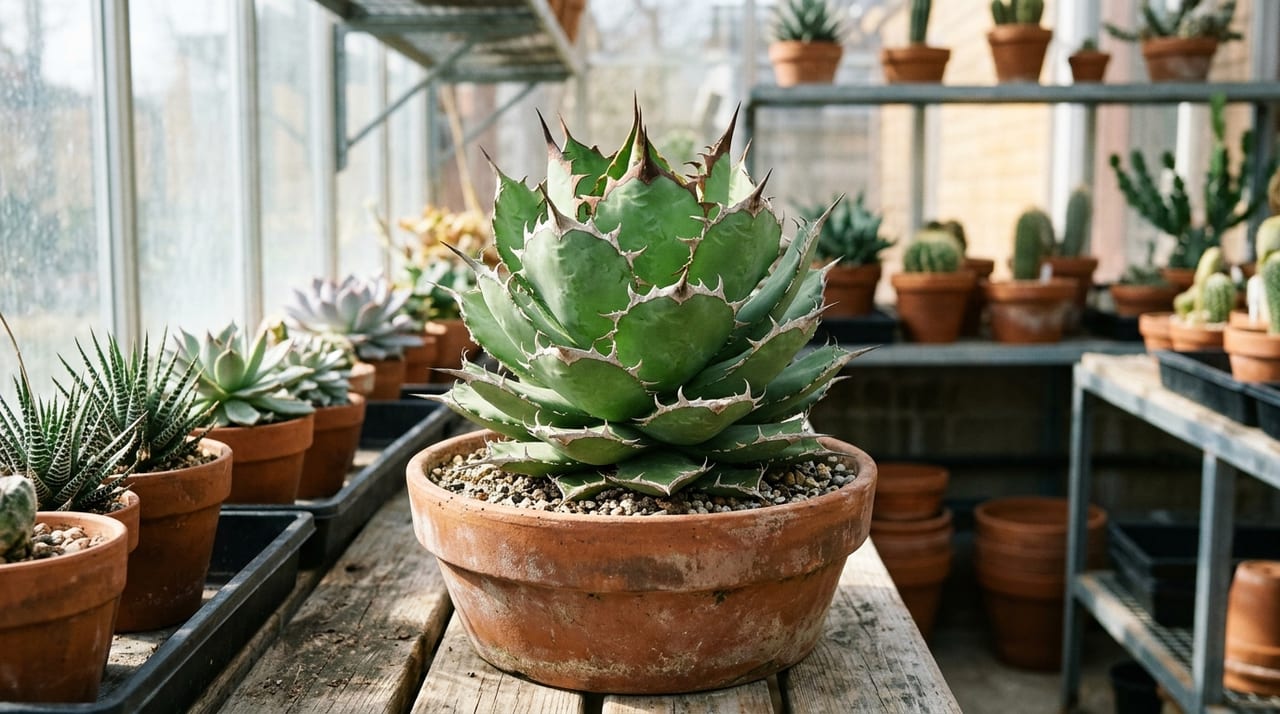
Titanota Group (Agave titanota / A. oteroi)
The most popular agave group. Characterized by compact growth and thick white serrations.
Agave Titanota (Agave titanota)
Identification Points:
- White to cream-colored serrations run continuously toward the leaf tips
- Leaves are relatively broad with gradual tapering at the tips
- Mature size: 30–60 cm in diameter
Agave Oteroi (Agave oteroi)
Often confused with Titanota, but is technically a distinct species.
Key Differences from Titanota:
- Serrations are finer and more pointed, with less interlocking of teeth
- Leaf color is somewhat lighter green with a tendency toward slender foliage
- Mature plants tend to be slightly larger than Titanota
Popular Titanota Group Clones (Reference)
| Clone Name | Characteristics | Price Range (Approximate) |
|---|---|---|
| FO-076 | Broad white serrations, compact growth | ¥10,000–80,000 |
| White Whale (Hakugei) | Dense pure white serrations, high ornamental value | ¥20,000–150,000 |
| Caesar | Serrations curve upward | ¥8,000–50,000 |
| Hades | Deep green leaves with sharp white serration contrast | ¥15,000–100,000 |
Horrida Group (Agave horrida)
Native to central Mexico. Smaller and more compact than Titanota. Features gray-green leaves with fine serrations.
Identification Points:
- Leaf color is gray-green with a bluish tint
- Serrations are fine and sharp, not as thick as Titanota
- Plant diameter: Compact at 20–40 cm
Horrida Soul Food (A. horrida 'Soul Food')
A widely available clone. Popular for its beautiful fine serration lines along leaf edges and compact size. For more information on small agave varieties for collectors, see also Agave Growth Rate and Mature Size by Variety.
Parryi Group (Agave parryi)
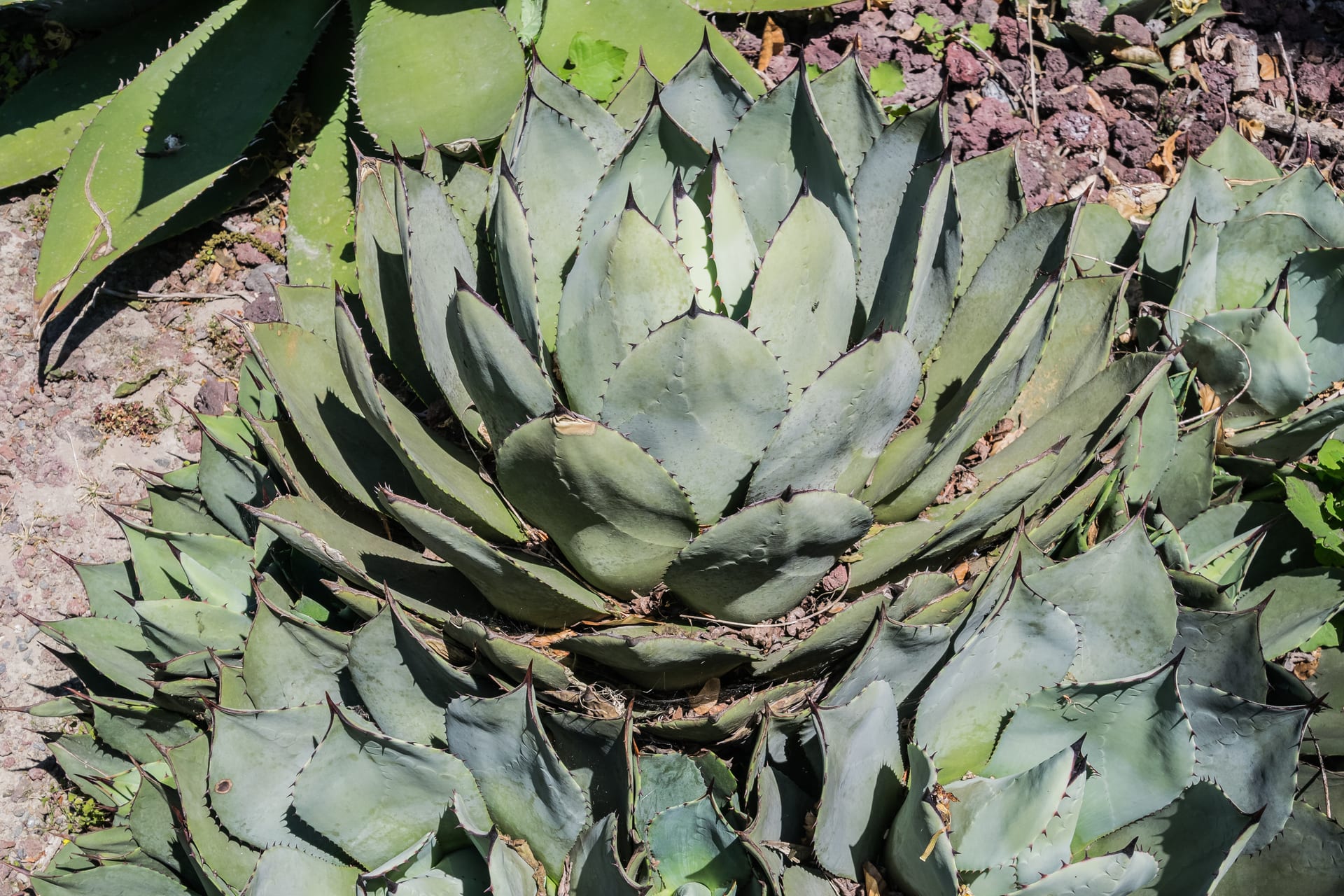
A cold-hardy group widely distributed in the southwestern United States. Characterized by bluish-gray leaf color and large terminal spines.
Identification Points:
- Leaf color: Blue-gray to silver-gray
- Terminal spine (tip spine) is long and dark brown
- Plant diameter: Relatively large at 50–90 cm
Main Parryi Group Varieties
- Agave parryi var. truncata: Distinctive leaf shape with rounded tips as if cut off
- Agave parryi var. huachucensis: Fine serrations with overall slender appearance
Cold-hardy agaves are popular with collectors aiming for outdoor winter survival. Please also refer to Winter Care Tips for Succulents.
Geminiflora (Agave geminiflora)
Distinctive silhouette with many thin leaves radiating outward, setting it apart from other agaves.
Identification Points:
- 300–400+ thin, thread-like leaves densely packed
- White filamentous threads hang from leaf margins (filaments)
- Lacks prominent spines, making it safer to handle
- Plant diameter: 40–80 cm
Utahensis / Desmetiana Group
Agave Utahensis (Agave utahensis)
Native to Utah in North America and among the hardiest agaves. Small with slow growth, highly popular with collectors.
Identification Points:
- Leaf color: Gray-green
- Spines are long, slender, and sharp
- Slow growth rate, mature diameter 30–50 cm
- Cold hardiness: Tolerates temperatures below −20°C (varies by subspecies)
Shawii Group (Agave shawii / schottii)
Agave Shawii (Agave shawii)
A medium-sized species native to Baja California. Features beautifully undulating leaf margins.
Identification Points:
- Leaf margins undulate in a wave-like pattern
- Vibrant green color
- Serrations are relatively small and irregular
Rare Lineages and Hard-to-Obtain Species
Agave Potatorum (Agave potatorum)
Native to Puebla, Mexico. Known as the original species for Raijin (Kissho Kan) and considered one of the most beautiful agaves for its foliage.
Identification Points:
- Uniform, jagged serrations along leaf margins
- Leaf tips are characteristically slender with long terminal spines
- Bluish-green coloration
Price range: Quality specimens are ¥10,000 to several hundred thousand yen
Agave Nickelsiae (Agave nickelsiae)
An extremely rare species with limited availability. Distinctive beauty with slender leaves bearing dense white serrations.
Agave Bracteosa (Agave bracteosa)
A rare octopus-like leaf form with few spines. Soft leaves make it safe for households with children. For more information on sourcing rare agaves, see also Agave Buying Guide.
Identification Checklist
To accurately identify an agave, confirm the following:
| Check Item | Confirmation |
|---|---|
| Leaf color | Green, gray-green, blue-green, or silver |
| Leaf cross-section | Flattened, convex, or V-shaped |
| Terminal spine shape | Length, thickness, and color |
| Serration shape | Size, spacing, color, and continuity |
| Filaments | Present (fibers hang) or absent |
| Plant form | Spreading, upright, or compact |
| Mature size | Small (≤30 cm diam.), medium (30–60 cm), large (≥60 cm) |
Points to Consider When Buying Agave
Beware of Mislabeled Plants
Mislabeled plants and poor-quality specimens with popular variety labels have been documented. When purchasing:
- Verify multiple identification points
- Purchase from growers or specialists
- Check cultivation records and photos of parent plants
GrowerDirect stands out for its high transparency in variety information, as growers list their own offerings with detailed descriptions.
Seedlings vs. Imported Plants
Domestically grown seedlings typically have clear growing conditions and good root health, but take longer to mature. Imported bare-root plants can be cost-effective and allow large specimens to be obtained, but carry rooting risk. For basic rooting management information, also consult Bare-Root Rooting Management Guide.
Summary
Agave identification fundamentally relies on comprehensively evaluating leaf color, serrations, terminal spines, presence or absence of filaments, and mature size. Not only mainstream varieties like Titanota, Horrida, and Parryi but also rare species such as Geminiflora, Utahensis, and Potatorum are available in the market, offering diverse collecting opportunities.
Enhance your agave collection by sourcing plants from trustworthy growers who provide detailed variety information.