Complete Guide to Growing Agave from Seed | From Sowing to First-Year Care
Detailed explanation of how to grow Agave from seed. Learn about sourcing seeds, sowing procedures, germination conditions, seedling-stage care, and growth benchmarks.
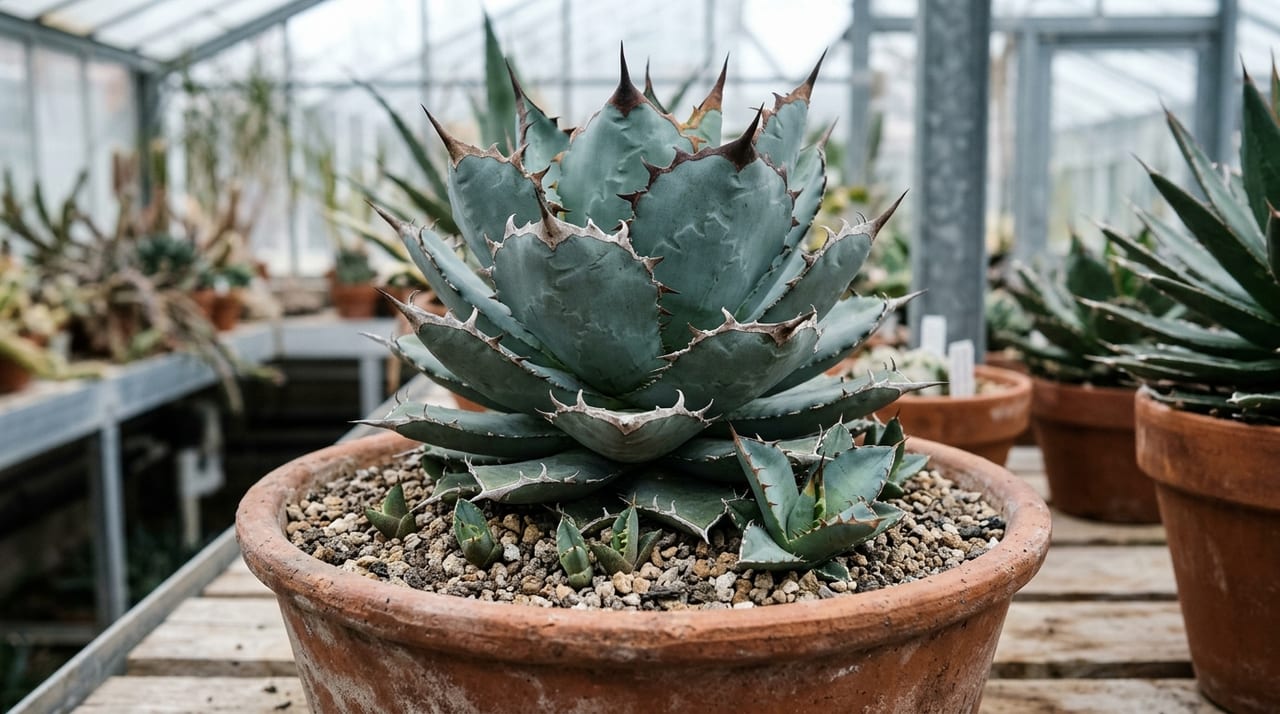
Key Takeaways
Detailed explanation of how to grow Agave from seed. Learn about sourcing seeds, sowing procedures, germination conditions, seedling-stage care, and growth benchmarks.
Growing Agave from seed (seedling cultivation) is a rewarding method that lets you grow your own unique plants from seed. Unlike purchasing mature plants, the process of gradually nurturing small seeds creates a special attachment to each specimen. Additionally, seedlings often show individual variation from the parent plant, offering the possibility of discovering unexpectedly beautiful characteristics. Here we explain the key points for successful Agave seedling cultivation. Those who wish to understand the broader long-term roadmap from seed to market-ready size are encouraged to also refer to Complete Guide to Agave Seedling Development | 3–5 Year Roadmap from Seed to Market Size.
Seedling management by stage
| Stage | Timing | Soil/Water | Light | Key Points |
|---|---|---|---|---|
| Sowing to germination | 0–2 weeks (up to 1 month depending on variety) | Sterilized soil, water-table watering | Indirect light 12–16h (avoid direct sun) | Soil cover 2–3mm, maintain 25–30°C |
| Just after germination to true leaves | After germination | Continue water-table, gradually lower water level | Bright indirect light | Avoid abrupt environmental changes |
| Seedling stage | Up to 6 months | Water when surface soil is dry, thin liquid fertilizer every 2 weeks | Gradually acclimate from 50% shade | Repot individually when 3–4 true leaves appear |
| 1 year onward | 1 year onward | Wet/dry cycles, transition to mature-plant soil | Provide full sunlight | Aim for 3–5cm diameter for Titanota |
※The most common failure is fungal infection. Prevent it through heat sterilization of soil, water-table watering with clean water, and daily aeration of closed containers.
Seed sourcing and quality assessment
Seedling cultivation begins with obtaining quality seeds.
Seed sources
Purchasing directly from domestic Agave specialty growers is the most reliable method. While it is also possible to import seeds individually from overseas, quarantine procedures may be required. Seeds also circulate on resale apps, but variety names are often inaccurate, so caution is needed.
Seed freshness
Freshness is critical for Agave seeds. Seeds harvested within the past six months have the highest germination rates, while those more than a year old show significantly reduced germination. Always check the harvest date when purchasing.
Variety selection
For your first seedling project, varieties with high germination rates and relatively fast growth are recommended. Titanota, Parry, and Montana are species that even beginners can grow easily. Conversely, Utahensis varieties have slightly lower germination rates and extremely slow growth, making them suitable for experienced growers.
Sowing procedure
Here is a detailed procedure to increase sowing success rates.
Soil preparation
Use fine-grain red volcanic soil (akadama) alone or mix it in equal parts with Kanuma soil. Sterilize the soil before sowing by pouring boiling water or heating it in a microwave. Fungi and pathogens are fatal to newly germinated seedlings.
Container selection
Shallow containers with drainage holes, such as Prestera 90 trays or cell trays, are suitable. Prepare a tray for water-table watering to facilitate the hydration method.
Sowing method
Place sterilized soil in the container and moisten thoroughly. Position seeds on the soil surface and cover with a thin layer of soil (approximately 2–3mm). Agave seeds tend to be photophilic, so keep the soil cover very thin or omit it entirely. Deep burial inhibits germination. Begin water-table watering with clean water after sowing (Benlate does not have registration for succulent plants including Agave, and the dilution ratio for water-table application is not specified on the label).
Temperature and light management
Optimal germination temperature is 25–30°C. A heating mat helps maintain stable temperature. Light is necessary, but direct sunlight should be avoided. Ideal results come from 12–16 hours of LED light. Covering with plastic wrap or a transparent lid is also effective for maintaining humidity.
Post-germination initial care
Germination typically begins within 1–2 weeks, though some varieties may take up to a month.
Immediately after germination
The first cotyledons to emerge are long and needle-like in shape. At this stage, seedlings are extremely delicate, so avoid sudden environmental changes. Continue water-table watering and ensure the soil does not dry out.
True leaf emergence
True leaves appear after the cotyledons and have characteristic Agave form. Once 2–3 true leaves have developed, gradually lower the water level in the water-table. This is a transition period from constant moisture to introducing wet/dry cycles.
Thinning and selection
Remove seedlings with obviously poor growth or malformations. Among the remaining seedlings, selecting those with good form and beautiful leaf serration is one of the pleasures of seedling cultivation.
Seedling-stage management (germination to 6 months)
Seedling-stage management significantly influences future growth.
Potting up (repotting)
When 3–4 true leaves are visible, transplant into individual pots. Plant one seedling per 2–2.5-inch pot. Use soil with higher water retention than mature-plant soil; a mix of 4 parts red volcanic soil, 3 parts Kanuma soil, 2 parts pumice, and 1 part leaf mold is recommended.
Watering
Seedlings require more frequent watering than mature plants. Water when the soil surface is dry, watering again before it dries completely. However, constantly wet soil causes root rot, so well-draining soil is essential. Should root rot symptoms appear, detailed treatment methods are explained in Complete Guide to Agave Root and Stem Rot Recovery.
Light
Gradually acclimate seedlings to direct sunlight. Start with 50% shade and reduce shade gradually over 2–3 weeks. Sudden exposure to intense light causes leaf burn.
Fertilizer
Apply dilute liquid fertilizer every 2 weeks. Begin with fertilizer diluted to at least twice the recommended strength, then gradually increase concentration if no problems arise. Appropriate fertilization during the seedling stage significantly speeds growth.
Management and growth benchmarks from year one onward
Here is a guide to expected growth after one year of seedling cultivation.
Growth benchmarks
For Titanota, one-year seedlings typically reach 3–5cm in diameter, with well-managed specimens potentially reaching 7–8cm. Parry and Montana grow more slowly, typically reaching 2–4cm in a year.
Management transition after year one
After the first year, gradually transition to mature-plant care. Lengthen intervals between waterings to build drought tolerance. Switch to mature-plant soil mix with higher drainage. Provide plenty of sunlight to achieve a compact form. As plants grow larger, propagation using offsets (pups) becomes an option. For details, see Agave Propagation Methods | Practical Guide to Offsets, Pup Collection, and Seed Sowing.
Agave seedling cultivation takes time, but the attachment to plants grown from seed is special. GrowerDirect allows you to purchase seeds for seeding and selected seedlings directly from specialty growers. You can also hear information about parent plants directly, making it easier to predict what characteristics may appear—another advantage of GrowerDirect.
Seedling cultivation failures and solutions
Here are common failure patterns that beginners encounter in Agave seedling cultivation.
Fungal infection is the most common failure. The high-humidity environment after sowing readily promotes fungal growth, which can cover seedlings and cause mass die-off. Prevent this by thoroughly sterilizing soil, using clean water for water-table watering, and providing daily aeration for closed containers. If damping-off occurs (seedlings collapse at the soil line), you may apply Orthocide 80 WP diluted 600-fold, which is registered for damping-off and seedling rot on flowers and ornamental foliage plants.
Poor germination from deep sowing also occurs. Agave seeds germinate poorly when buried deeply, so keep the soil cover to just 2–3mm.
Excessive light causing seedling burn is also a concern. Newly germinated seedlings are extremely delicate and burn easily when exposed to direct sunlight. Manage seedlings under 50% or more shade for about two months after germination, then gradually increase light.
Missing the thinning stage also leads to failure. Crowded seedlings grown long-term develop intertwined roots, making individual repotting difficult. Ideally, transplant into individual pots once 2–3 true leaves appear.
Source: MAFF Pesticide Registration Database (Orthocide 80 WP)
Long-term planning and selection in seedling cultivation
Agave seedling cultivation is a hobby enjoyed over a long timeline. From sowing to reaching display size takes several years, but the process itself is the essence of seedling cultivation.
Key selection points to watch in years 1–2 are leaf compactness and serration. Plants with short, tightly-packed leaves early on are likely to develop into compact, beautiful specimens. Conversely, plants with long, spaced-out leaves tend to remain loose even with adequate light.
By keeping especially superior specimens from your seedlings as "selected plants" and sharing or selling the rest online, you can enjoy seedling cultivation while improving your collection's quality.