Agave Species Identification Guide | How to Tell Apart Titanota, Oteroi, and Horrida
A detailed guide to distinguishing agave species. We introduce the differences between titanota and oteroi, identification points for popular varieties, and tips for spotting counterfeits.
Key Takeaways
A detailed guide to distinguishing agave species. We introduce the differences between titanota and oteroi, identification points for popular varieties, and tips for spotting counterfeits.
Related Species
Agave species identification (distinguishing species) is a topic of ongoing debate among enthusiasts. In particular, with the recent spread of social media, the number of plants circulating under incorrect species names has increased. The higher-value the species being traded, the greater the risk of counterfeits or mislabeled plants, and accurate species identification is an essential skill for enthusiasts. Here we explain the identification points for popular species and precautions when purchasing.
The Differences Between Titanota and Oteroi
Agave enthusiasts face one of the hottest classification debates: the relationship between titanota and oteroi.
Classification Background In 2019, Agave oteroi (A. oteroi) was formally described as a new species, and it was clarified that many of the green-leaved, large-toothed types circulating in horticultural commerce under the name "titanota" belong to this species. In the strict sense, "titanota (A. titanota)" refers to the lineage from the type locality (around Rancho Tambor in Oaxaca state) with leaves bearing white to pale blue waxy powder. However, in the horticultural world, the name "titanota" continues to be widely used today.
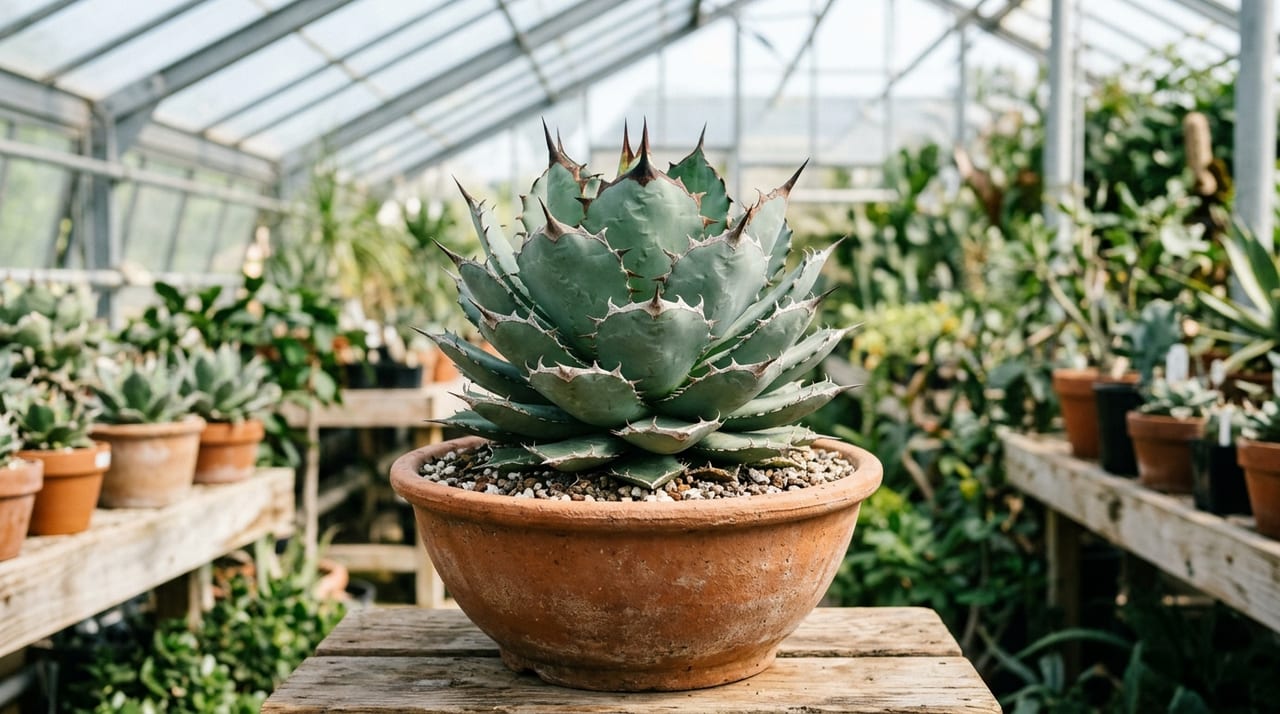
Identification Points Strictly speaking, titanota has leaves with white to pale blue waxy powder (farina), and the teeth (spines along the leaf margin) are relatively small and regular. On the other hand, the so-called "titanota" (= oteroi) popular in horticulture typically has thick, fleshy green leaves with large, jagged teeth. However, individual variation is extremely large, making strict visual distinction difficult.
Practical Approach In the hobby context, it is common to use "titanota" as a horticultural common name. However, when purchasing, confirming information about the plant's origin (where the plant came from) is useful for future variety management.
What Is Agave Oteroi—Characteristics and the Origin of Its Name
Agave oteroi (Agave oteroi) is a medium-sized agave native to the Sierra Mixteca region of Oaxaca state, Mexico, and was formally described as a new species in 2019. The species name is derived from Felipe Otero, a collector who gathered seeds of this lineage in the field. His collection number "FO-076" continues to circulate as a lineage designation that became the foundation for many popular clones.
| Feature | Oteroi Characteristics |
|---|---|
| Leaves | Green to dark green. Short, broad, and fleshy. Minimal white powder |
| Teeth | Large and irregular. Wide range of colors from white to brown to black; strongly curved in mature plants |
| Terminal spine (leaf tip spine) | Thick and long |
| Mature plant size | Rosette diameter approximately 30–50 cm |
| Growth type | Summer-growing type that grows spring through fall. In winter, maintain on the dry side and protect from frost |
In horticulture, green-leaved, large-toothed plants circulating as "titanota" (such as Moby Dick, Black Whale, Caesar, and Hades—many selected clones) belong to this oteroi lineage. On the other hand, types with pale blue leaves like Black & Blue are often treated as strictly defined titanota lineage; distinguishing the two groups helps reduce confusion about variety names.
Reading "Seedling" and "Named" Labels
Labels reading "Moby Dick seedling" or "Caesar × Moby Dick" refer not to the clone itself but to seedlings (plants grown from seed) using that plant as a parent. Only clones propagated as offsets or through tissue culture from named individuals are identical; seedlings do not necessarily exhibit the same characteristics as the parent. The majority of so-called counterfeit problems arise from "seedlings being sold under a named variety's name." Key characteristics and identification methods for major clones are compiled in Popular Titanota Clones and How to Tell Them Apart.
Identification Points for Popular Species
Let me explain how to distinguish representative species.
Horrida (A. horrida) Characterized by narrow leaves and large, sharp marginal spines. Compared to titanota (oteroi), it has narrower leaf width and a slimmer overall appearance. The leaf color is dark green, and it is also characterized by minimal white markings on the surface. Differences in native habitat and care are explained in A Guide to Cultivating Titanota and Horrida Lineages Separately.
Potatorum (A. potatorum) Forms a compact rosette with broad, short leaves. The terminal spine (tip spine) at the leaf apex is prominently large. Many circulate under Japanese common names such as "Kissho-kan" or "Raijin." Typically, the leaf surface is covered with blue-gray powder.
Parryi (A. parryi) A beautiful species with a rounded rosette. Leaves are broad with pointed tips, forming overall symmetry. It has excellent cold hardiness and withstands Japanese winters well, making it suitable for in-ground planting. The basic leaf color is blue-gray.
Utahensis (A. utahensis) A small species with very slow growth. It is characterized by white fibers (filaments) on the narrow leaves; "Evoluspina" is a particularly popular subspecies with long terminal spines.
Comparison of Major Agave Species
This is a quick reference table answering the question "What are the differences between titanota and oteroi?" In horticulture, fleshy plants with jagged teeth are popular as "titanota," but botanically they correspond to oteroi.
| Species | Leaf Characteristics | Teeth (Spines) | Leaf Color & Powder |
|---|---|---|---|
| Titanota (strict definition, botanical) | Broad, slightly flat | Small, regular | Strong white to pale blue powder |
| Oteroi (horticultural "titanota") | Thick and fleshy | Large and jagged | Strong green (minimal powder) |
| Horrida | Narrow and slim, narrow leaf width | Large, sharp, regular | Dark green (minimal powder) |
| Potatorum | Broad, short | Small, densely packed | Blue-gray powder |
| Parryi | Broad, flat and regular | Regular | Blue-gray |
| Utahensis | Fine, white fibers present | Long terminal spine | Green |
Species Identification by Tooth and Leaf Shape
The most important clue for species identification is the characteristics of the teeth (marginal spines).
Tooth Shape Tooth shape varies greatly among species. Titanota lineage typically has large, irregular teeth. Horrida has regularly spaced teeth, while potatorum has small, densely packed teeth.
Leaf Cross-Section The cross-section of the leaf viewed from the side also provides clues for species identification. Titanota lineage typically has thick leaves with surface irregularities. Parryi has flat, regular leaves. Potatorum sometimes has broad leaves that curve in a spoon-like shape.
Leaf Color and Presence of Powder The amount of blue-gray powder (farina) is also a species characteristic. Parryi and potatorum have abundant powder, while horticultural "titanota" (oteroi) has minimal powder with strong green coloring. Conversely, strictly defined titanota has abundant white powder, and this difference also serves as an identification clue.
Tips for Spotting Counterfeits and Mislabeled Plants
Recognize that the higher the price of a variety, the greater the risk of counterfeits.
Choose a Trustworthy Vendor The accuracy of variety names is heavily dependent on seller reliability. Purchasing from established growers or specialty shops is safest. While personal sales on social media are convenient, variety name accuracy is not guaranteed.
Verify Parent Plant Information When purchasing selected titanota plants or named varieties (those with specific names), it is important to confirm information about the parent plant and its origin. Also verify the propagation method (whether from seed or offset).
Potential Changes with Growth Young seedlings often do not yet display species characteristics, which become clearer as they mature. When purchasing young seedlings, understand that their appearance may differ from that of mature plants.
An Appreciation for Enjoying Agave Classification
Species identification is an extremely challenging field when pursued rigorously, but this challenge itself is part of the enjoyment of the hobby.
While managing your collection's variety names as accurately as possible, it is important to avoid becoming too fixated on names and instead to appreciate the beauty of the plants themselves. GrowerDirect allows you to purchase from specialist growers with deep knowledge of varieties, ensuring high accuracy of variety names. The strength of GrowerDirect is that you can directly ask growers questions about how to identify varieties and trace their origins.
Tips for Enjoying Species Identification
Species identification is a challenging topic, but you can develop your skills while enjoying the process by employing several approaches.
Developing a habit of photographing records is the first step. By regularly photographing the same plant and recording changes as it grows, you will come to understand at what stage a variety's characteristics become clear. Additionally, when you arrange multiple varieties side by side and compare them photographically, subtle differences become more apparent.
Using social media and online communities is also effective. On Instagram and agave-focused forums, enthusiasts from around the world share their collections, and by viewing diverse specimens of the same variety, your eye becomes more trained. You can also post photos of plants with unknown variety names and ask for opinions.
Consulting specialist books and field guides also builds foundational knowledge for species identification. "Agaves: Living Sculptures for Landscapes and Containers" by Greg Starr, while in English, is a standard reference rich in photographs with detailed descriptions of variety characteristics.
Ultimately, what is important is an attitude that enjoys the beauty of the plants themselves without becoming overly fixated on the accuracy of variety names. A plant is attractive whether or not you know its name, and the value of your collection lies not in monetary worth but in the joy of cultivation.
How to Keep Observation Records Useful for Species Identification
To improve your species identification skills, regular observation records are extremely valuable.
Items to record include leaf length, width, and thickness; tooth shape, color, and spacing; terminal spine length and angle; leaf color (including lighting conditions); rosette diameter; and new leaf emergence rate. Recording these approximately once a month will reveal growth patterns specific to each variety.
Recording the photography date, weather, and cultivation environment alongside photographic records is extremely helpful for future reference. Because the appearance of the same variety changes with season and cultivation conditions, chronological records improve the accuracy of species identification.