Reading AOS Orchid Awards: Understanding FCC, AM, HCC and the Point-Based System
The American Orchid Society (AOS) judges flowers on a 100-point scale. This article explains the standards for grades like FCC, AM, and HCC, and the differences from domestic orchid shows.
Key Takeaways
The American Orchid Society (AOS) judges flowers on a 100-point scale. This article explains the standards for grades like FCC, AM, and HCC, and the differences from domestic orchid shows.
Related Species
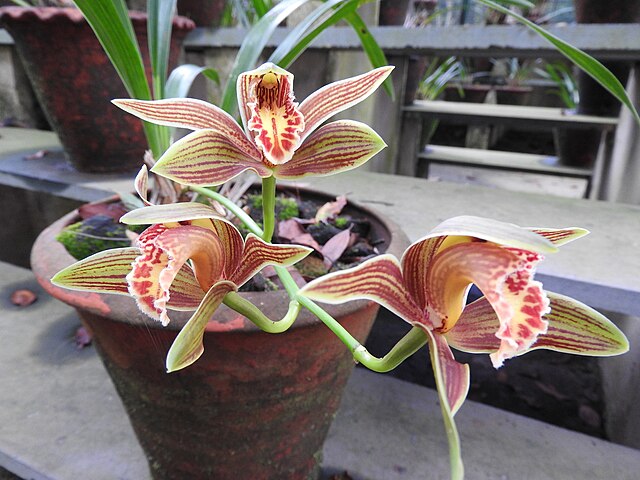
When visiting orchid exhibitions or sales events, you may notice flower tags marked with abbreviations like "AM" and "FCC." These originate from the flower judging and award system operated by the American Orchid Society (AOS). This article will help you understand how to read these point-based international evaluation standards, which differ from domestic Japanese orchid shows.
AOS Judging Uses a 100-Point Scale
A major characteristic of the AOS judging system is that it evaluates flower quality on a 100-point scale. Judges score elements such as flower size, form regularity, color vibrancy and uniformity, and petal texture, with the total points determining how excellent the flower is. In contrast, orchid shows and competitions commonly seen in Japan typically employ qualitative evaluation, focusing on the judges' overall impressions and the overall condition of the plant. The AOS system is distinctive in that evaluation results are recorded using points as a clear standard. Understanding this difference makes it much easier to comprehend the meaning of the evaluations written on overseas tags.
Three Grades: FCC, AM, and HCC
AOS flower grades have several levels depending on points. The point standards, starting from FCC as the highest award, are as follows:
| Grade | Point Standard |
|---|---|
| "FCC (First Class Certificate)" (highest award) | Approximately 90 points or above |
| "AM (Award of Merit)" (second place) | Approximately in the 80s |
| "HCC (Highly Commended Certificate)" | Approximately 75–79 points |
However, these point thresholds are merely rough guidelines, and for accurate thresholds and operational details, it is best to refer to the official AOS judging regulations.
These grades are a kind of "score certificate" showing how highly that particular flower was evaluated at the time of judging, and they are recorded in tags and materials indicating orchid lineage. They are frequently referenced as a quality standard when breeders select parent plants for future crosses, and when buyers choose plants. They have practical significance beyond merely recording show results.
Awards Also Evaluate Beyond the Flower
The AOS award system does not evaluate only the quality of the flower itself. For example, awards like "CCM (Certificate of Cultural Merit)" are said to exist, recognizing the overall cultivation technique and skill in training whole plants that bloom abundantly in pots. These awards are considered to evaluate mastery of long-term plant care and management, rather than the perfection of a single bloom, and they serve as a great source of encouragement for growers. For the latest and most accurate information on the types of awards mentioned here and their operational details, we recommend checking the official AOS regulations.
The Practical Role of Awards
The record of these awards is not merely a matter of past glory—"took a great award long ago." In genera like Dendrobium and Cymbidium, where hybridization is active, there is a pattern where plants with award-winning flowers tend to be selected as parents for future crosses, along with their descendants. For buyers, the award history recorded on the tag is also a clue to understanding what lineage that plant belongs to.
If you keep in mind that domestic Japanese orchid shows judge qualitatively, evaluating flowers' appearance and plant health at the venue holistically, while the AOS point system is an international evaluation based on quantified standards, you can read and understand both without confusing them. Neither is superior; rather, they have different characteristics—in a sense, different measuring sticks. It is helpful to understand them that way.
The Value of Understanding Tag Notation
Overseas orchid nursery catalogs and some imported labels include such AOS award notations. For example, notations like "AM/AOS" are the common way to write both the grade and the acronym of the judging organization. Without knowing the meaning of this notation, it looks like just a string of letters. However, if you understand the underlying 100-point scale and the concept of grades, you can use it as a clue to decode what kind of evaluation history that flower lineage carries. Of course, the presence or absence of awards alone does not determine everything about plant quality, but it is worth knowing as one piece of reference information for cultivation and hybridization.
Summary
Grades like AOS FCC, AM, and HCC, as well as awards honoring cultivation techniques like CCM, are all international evaluation standards that have long been used in the world of orchids. The fact that they are based on the clear standard of points is a distinguishing feature from the qualitative judging of domestic Japanese orchid shows and competitions, and it becomes a clue to reading evaluations recorded in lineage and tags. When you look at orchid tags with this background in mind, the evaluation history that a plant has accumulated may appear in a slightly different light. Through GrowerDirect, you can purchase orchids grown by growers nationwide directly online, and we will continue to introduce the background of these evaluation systems in our columns.