How to Identify and Treat Aquatic Plant Nutrient Deficiencies | Identifying Causes from Leaf Symptoms
Detailed explanation of nutrient deficiency symptoms in aquatic plants. Introduction to deficiency signs of nitrogen, phosphorus, potassium, iron, and trace elements, along with treatment methods.
Key Takeaways
Detailed explanation of nutrient deficiency symptoms in aquatic plants. Introduction to deficiency signs of nitrogen, phosphorus, potassium, iron, and trace elements, along with treatment methods.
Related Species
When managing an aquatic plant tank, you may encounter symptoms such as yellowing leaves or holes appearing. Most of these are caused by nutrient deficiencies. By correctly interpreting symptoms, you can identify which nutrients are lacking and take appropriate action. Here we explain in detail the typical deficiency symptoms that appear in aquatic plants, their causes, and how to address them.
Nitrogen (N) Deficiency Symptoms and Treatment
Nitrogen is the nutrient required in the largest quantities for aquatic plant growth.
Symptom Characteristics
The typical sign of nitrogen deficiency is a progressive yellowing starting from the older leaves (lower leaves). Since nitrogen is a highly mobile element, plants translocate nitrogen from old leaves to new ones. This is why yellowing progresses gradually from the lower leaves. Growth rate also drops significantly, and new growth becomes smaller.
Causes
- In tanks with few aquatic animals (fish or shrimp), nitrogen from their waste tends to be insufficient.
- In high-light and CO2-enriched environments, aquatic plants consume nitrogen rapidly, and if there are few fish, supply cannot keep up.
- Frequent large water changes also remove nitrogen.
Treatment
- Add potassium nitrate (KNO3). The guideline is 0.1–0.2 g per 10 L of water, 2–3 times per week.
- If using liquid nitrogen fertilizer, start with half the product's recommended dose and gradually increase while observing the results.
- Ideally, adjust so that NO3 concentration is maintained at around 5–20 ppm according to water quality tests.
Phosphorus (P) Deficiency Symptoms and Treatment
Phosphorus is an essential nutrient for energy metabolism.
Symptom Characteristics
Older leaves turn dark green or purplish in color. In severe cases, black spots appear on the leaves, eventually becoming holes. Growth points shrink, and new growth is slow to develop. This is easily confused with nitrogen deficiency, but phosphorus deficiency can be distinguished by leaves turning dark rather than yellow.
Causes
- In areas where tap water is treated to remove phosphoric acid, water changes alone do not supply sufficient phosphorus.
- Phosphorus can also become fixed by adsorption in the substrate.
Treatment
- Add potassium dihydrogen phosphate (KH2PO4).
- Since excess phosphorus can cause algae, add it carefully in small amounts.
- According to water quality tests, aim to maintain PO4 at approximately 0.5–1.0 ppm.
- It is also effective to bury solid phosphorus fertilizer at the base as a substrate fertilizer.
Potassium (K) Deficiency Symptoms and Treatment
Potassium is one of the nutrients most commonly deficient in aquatic plant tanks.
Symptom Characteristics
The typical symptom of potassium deficiency is browning and necrosis starting from the edges and tips of older leaves, progressing from yellow to brown. Small holes (pinholes) may also appear on the leaves. Since potassium is also highly mobile, symptoms start with older leaves. In severe cases, entire leaves become tattered and dissolve.
Causes
Since potassium is barely present in tap water, deficiency is inevitable without supplementation. It is the element that must be most consciously replenished in aquatic plant tanks.
Treatment
- The basic approach is to add potassium carbonate solution in small amounts daily.
- Using commercially available potassium liquid fertilizer for aquatic plants is convenient.
- The guideline is to add 1–2 ml per 10 L of water daily.
- Potassium rarely becomes excessive, but extreme overdosing can raise pH, so caution is needed.
Iron (Fe) and Trace Element Deficiencies
Although needed in small quantities, iron and trace elements are essential for healthy aquatic plant growth.
Iron Deficiency Symptoms
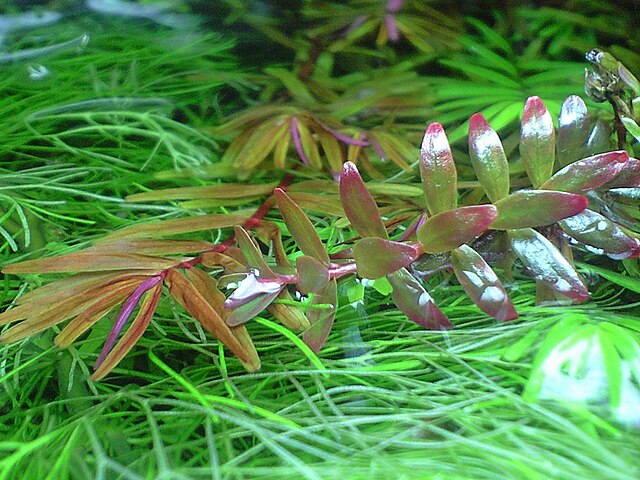
The characteristic of iron deficiency is new leaves (near the growth point) turning white to yellow. Since iron has low mobility, symptoms appear on new growth rather than old leaves. If red-colored aquatic plants fail to turn red, iron deficiency is suspected. If Rotala or Ludwigia remain green without developing their red coloration, try adding iron.
Trace Element Deficiencies
- Manganese deficiency causes "interveinal chlorosis," where the tissue between leaf veins turns yellow.
- Boron deficiency causes new growth to become deformed or the growth point to die.
These can be prevented with comprehensive trace element fertilizers.
Treatment
- Add liquid fertilizer containing ferrous iron (Fe2+) 2–3 times per week.
- Since iron becomes difficult for plants to absorb when oxidized to ferric iron (Fe3+) in water, adding it in chelated form is effective.
- Regular addition of comprehensive trace element liquid fertilizer can prevent deficiencies of trace elements in general.
Comprehensive Method for Diagnosing Deficiency Symptoms
Often multiple nutrients are deficient simultaneously, making symptom diagnosis difficult.
Diagnosis by Location of Symptoms
| Location of Symptoms | Corresponding Nutrient Category |
|---|---|
| Older leaves | Deficiency of mobile elements (N, P, K, Mg) |
| New leaves | Deficiency of immobile elements (Fe, Mn, Ca, B) |
Remembering this rule makes it easier to narrow down the cause.
Don't Change Everything at Once
Even if multiple symptoms are present, avoid adding multiple types of fertilizer in large quantities all at once. Start by adding potassium and iron, then wait 1–2 weeks to observe results before taking further action.
Nutrient management for aquatic plants is complex, but steady improvement is possible by mastering the basics. GrowerDirect's aquatic plant growers often share their fertilization recipes that they practice in their own growing environments. When purchasing, feel free to ask them for fertilization advice as well.
Daily Management to Prevent Deficiency Symptoms
Preventing nutrient deficiency symptoms is more efficient than addressing them after they appear.
- First, make regular observation of aquatic plants a habit. At least once a week, observe the plants closely and check for any changes in leaf color or appearance of holes. Early detection leads to early treatment.
- The basic principle of fertilization is "small amounts at high frequency." Adding small amounts daily is better than adding large amounts once per week, as nutrients reach plants more consistently.
- Conduct water quality tests regularly as well. By particularly monitoring NO3 (nitrate) and PO4 (phosphate) values, you can quantitatively assess nitrogen and phosphorus levels. NO3 should be 10–25 ppm and PO4 should be 0.5–2.0 ppm in an ideal aquatic plant tank.
- The most effective way to prevent nutrient deficiencies is a "two-pillar approach" that uses a commercial comprehensive liquid fertilizer as the base while separately supplementing potassium and iron, which are most likely to be deficient.
Establishing a Water Quality Testing Habit to Support Nutrient Balance Management
Regular water quality testing is essential for accurate nutrient management. The minimum items to measure are NO3 (nitrate) and PO4 (phosphate).
| Item | Target Value |
|---|---|
| NO3 (Nitrate) | Nitrogen is appropriate if NO3 remains in the 10–25 ppm range |
| PO4 (Phosphate) | The target is 0.5–2.0 ppm |
Measuring and recording these values weekly allows fine-tuning of fertilizer dosage. Although iron test kits are available, iron oxidizes quickly in water and is difficult to measure accurately, so it is more practical to judge by the color of new aquatic plant growth. If new growth is whitened, iron is deficient; if normal green, it is sufficient.
Be Aware of Nutrient Excess Symptoms
Nutrient imbalances cause problems not only from deficiency but also from excess.
| Nutrient | Symptoms of Excess |
|---|---|
| Nitrogen | Causes filamentous algae blooms |
| Phosphorus | Becomes a cause of green water algae blooms |
| Potassium | Causes a rapid pH increase, stressing aquatic life |
| Iron | Can cause brownish water turbidity |
It is important to regularly conduct water quality tests and record values to prevent excess.