Aquatic Plant Tank pH Management Guide | Optimal Water Quality for Growing Aquatic Plants
Explains the basics of pH management in aquatic plant tanks. Covers the relationship between pH and aquatic plants, pH fluctuations from CO2 injection, the connection to KH (carbonate hardness), and specific methods for adjusting pH.
Key Takeaways
Explains the basics of pH management in aquatic plant tanks. Covers the relationship between pH and aquatic plants, pH fluctuations from CO2 injection, the connection to KH (carbonate hardness), and specific methods for adjusting pH.
Related Species
In aquatic plant tanks, pH management is a critical factor that determines healthy growth of aquatic plants. Many aquatic plants prefer slightly acidic water conditions, and when pH falls outside the appropriate range, nutrient uptake efficiency decreases and growth stagnates. However, since pH is an invisible numerical value, it can be difficult for beginners to understand. Here, we explain the basics of pH management and practical methods in an easy-to-understand manner.
Basic Knowledge of pH and Its Relationship to Aquatic Plants
pH is a numerical value that indicates the degree of acidity or alkalinity of an aqueous solution and is expressed on a scale from 0 to 14.
- pH below 7: Acidic
- pH 7: Neutral
- pH above 7: Alkaline
In aquatic plant tanks, slightly acidic to neutral pH of 5.5–7.0 is generally appropriate.
The reason many aquatic plants prefer slightly acidic conditions is related to nutrient solubility. Iron and trace elements ionize readily in slightly acidic water and exist in forms that aquatic plants can absorb. When pH rises above 7 into alkaline conditions, iron converts to insoluble ferric oxide, and aquatic plants cannot absorb iron. As a result, iron deficiency symptoms appear, with new growth turning white.
The utilization efficiency of CO2 (carbon dioxide) is also affected by pH. In slightly acidic water, CO2 exists in a form that aquatic plants can use easily, but as alkalinity increases, the proportion of bicarbonate ions rises, and most aquatic plants cannot utilize this efficiently. In other words, even if the same amount of CO2 is added, the effect diminishes when pH is high.
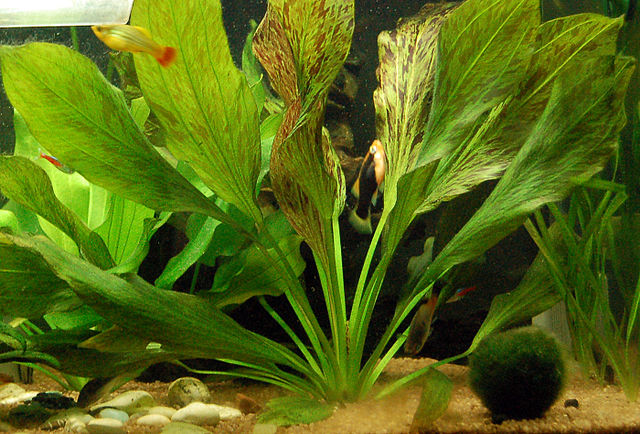
However, some aquatic plant species prefer neutral to slightly alkaline conditions. Certain species of Vallisneria and Echinodorus grow without issues at slightly higher pH values. It is important to set pH target values according to the species of aquatic plants being cultivated.
The Relationship Between CO2 Injection and pH
CO2 injection is the most natural way to lower pH and is closely linked to pH management in aquatic plant tanks.
When CO2 dissolves in water, it becomes carbonic acid (H₂CO₃) and releases hydrogen ions, lowering pH. In typical aquatic plant tanks with CO2 injection, pH during lighting (while CO2 is being added) is approximately 6.0–6.8. After lighting is turned off, CO2 injection stops, so pH typically rises by approximately 0.5–1.0 units during the night.
This daily pH fluctuation itself is not a major problem for aquatic plants or livestock, but fluctuations exceeding 2.0 units can become a source of stress. If too much CO2 is added, pH drops too low and becomes dangerous for livestock; if too little is added, the pH-lowering effect is insufficient and aquatic plant growth efficiency does not improve.
Installing a drop checker (CO2 indicator) in the tank allows you to check CO2 concentration and pH levels in real time. The color guide is as follows.
- Green: Appropriate
- Yellow: Excess CO2
- Blue: Insufficient CO2
Using a pH meter or pH monitor in conjunction provides more precise management. Continuous measurement pH monitors are expensive, but they are extremely convenient for fine-tuning CO2 injection amounts. Because they allow you to understand the rate of pH decline and patterns of daily fluctuation, they help prevent problems in the long term.
The Relationship Between KH (Carbonate Hardness) and pH
KH (carbonate hardness) is an important parameter that directly affects pH stability. Water with high KH has high buffering capacity against pH fluctuations, and pH becomes less likely to drop even when CO2 is added.
Generally, KH 2–5 dKH is the appropriate range for aquatic plant tanks.
| KH Status | Target Range | Risk |
|---|---|---|
| Too low | 1 dKH or less | Even small amounts of CO2 addition can cause pH to drop rapidly, risking entry into dangerously acidic levels for livestock |
| Too high | 8 dKH or higher | Even large amounts of CO2 addition do not lower pH, and risk of oxygen depletion arises from excessive CO2 dissolution |
Aquatic soil works to make water slightly acidic and lowers KH. New aquatic soil has a strong effect, but its ion-exchange capacity decreases 3–6 months after use begins. As the soil's effect weakens, pH tends to rise, so increase the frequency of water testing to track changes.
Most regions in Japan have tap water with KH of approximately 1–4 dKH, but there is considerable regional variation. Check the tap water quality data for your region and adjust as needed. In regions with high KH, diluting by mixing in RO water (reverse-osmosis filtered water) is effective.
Specific Methods for Adjusting pH
To adjust pH to a range suitable for aquatic plants, combine several methods.
Methods for lowering pH include the following.
- CO2 injection: The most recommended method. A two-in-one approach that promotes aquatic plant photosynthesis while optimizing pH
- Use of aquatic soil: Nutrient-rich aquatic soil in particular has strong acidifying properties
- Placing peat moss or alder cone seeds in the water: Preferences vary because the water color becomes stained brown
Cases where pH needs to be raised are rare, but they occur when the soil's acidification is too strong or when CO2 is excessive. Methods for raising pH include the following.
- Add a small amount of coral sand to the filter
- Perform a water change using tap water (pH returns toward neutral)
Commercial pH adjusters are convenient but have short-lasting effects and risk destabilizing water quality. Implementing fundamental measures (adjusting CO2 injection amounts, replacing soil, managing KH) leads to better long-term pH stability.
Creating custom water quality using RO water is for advanced users but enables the most precise pH management. Add mineral supplements to RO water, adjust it to target GH and KH values, and use this water for water changes.
Recommendations for Establishing pH Measurement Habits and Keeping Records
pH management is based on continuous measurement and record-keeping. Since single measurements cannot capture daily or seasonal fluctuations, make regular measurement a habit.
There are three main types of measurement tools.
| Tool | Characteristics |
|---|---|
| Test strips | Inexpensive and convenient but low precision with readings accurate only to about 0.5 units |
| Liquid reagent tests (such as Tetra Test or Sera Test) | High precision and excellent cost-effectiveness |
| Digital pH meter | Most accurate but requires regular calibration |
Measuring at the following three times provides a complete picture of daily fluctuations.
- Before CO2 injection starts
- During CO2 injection (3–4 hours after lighting turns on)
- Just before lighting turns off
At minimum, establish a habit of measuring pH during CO2 injection once per week.
Record measurement results in a notebook or smartphone app. Recording the following items makes it easier to investigate the cause when problems arise.
- Date and time
- pH value
- Water temperature
- CO2 injection amount
- Whether a water change was performed
If you want to deepen your knowledge of water quality management, it's also recommended to ask GrowerDirect's aquatic plant growers about management methods. Professional growers possess water quality management expertise based on years of experience and can provide advice tailored to your environment.