How to Assess Bonsai Tree Age | Key Points for Recognizing Age and Presence
A comprehensive guide to estimating bonsai tree age. Learn to read age from bark, root spread, and branch fineness; species-specific assessment methods for black pine, five-needle pine, shimpaku juniper, maple, and plum; the limitations of increment borers and trunk-circumference estimation formulas; famous old trees from Ōmiya Bonsai Village and their stories; how cultivation records enhance value; and a year-round management schedule by season.
Key Takeaways
A comprehensive guide to estimating bonsai tree age. Learn to read age from bark, root spread, and branch fineness; species-specific assessment methods for black pine, five-needle pine, shimpaku juniper, maple, and plum; the limitations of increment borers and trunk-circumference estimation formulas; famous old trees from Ōmiya Bonsai Village and their stories; how cultivation records enhance value; and a year-round management schedule by season.
Related Species
In the world of bonsai, tree age is one of the important value criteria. Bonsai that have lived for decades or even more than a century take on a distinctive character and presence, with the weight of time manifesting in their form. However, knowing the exact age of a bonsai is surprisingly difficult; it is common practice to estimate age from external characteristics. Here we explain the key points for assessing bonsai tree age and how to recognize maturity.
Basic Approach to Estimating Tree Age
To know a bonsai's true age, records of when the seed was sown or when the material was collected from the wild are necessary. However, most bonsai change hands multiple times or lack such records, so in most cases the precise age remains unknown.
Counting growth rings would give an exact age, but one cannot fell a bonsai to do so. Therefore, the practical reality is that we must estimate based on external characteristics.
An important distinction: in bonsai, "tree age" and "cultivation years" are not the same thing. Tree age is the number of years from seed; cultivation years is the number of years since the bonsai was first trained. Wild-collected material (yamadori) often already has decades of tree age at the time of collection, so a bonsai with few cultivation years may have considerable actual age.
Also, because bonsai growth is restricted within a pot, the trunk remains thinner than a field-grown tree of the same age, and the growth pattern differs. One cannot simply calculate tree age from trunk thickness in bonsai.
External Characteristics That Indicate Age
Several external features suggest the presence of age.
The condition of the trunk bark is the most obvious indicator. In young trees, the trunk surface is smooth; with time, bark becomes rough and textured. In pines, characteristic hexagonal crackling (rough bark) develops, especially pronounced in black pine. Shimpaku juniper develops shari—twisted wood grain with exposed heartwood. In broadleaf species, bark becomes scaly or develops deep vertical furrows.
Root spread (nebarі) is also an age indicator. Trees grown in pots for many years develop thick bases with roots thrusting powerfully in all directions. In particular, the "eight-direction root flare"—thick roots spreading radially at the base—is the ideal form in bonsai and cannot be achieved without time.
The fineness of branching relative to trunk thickness indicates age. Trees with thick trunks from which fine branches branch repeatedly are the result of years of pruning and branch development. Young trees typically have fewer, thicker branches; this delicacy is something only time can achieve.
The natural growth of moss on the trunk or the development of hollow sections (uro) are also hallmarks of ancient trees.
Species-Specific Ways of Assessing Tree Age
Because aging appears differently in different species, knowing species-specific characteristics increases assessment accuracy.
Black pine develops rough bark as a measure of age. In black pines managed as bonsai, the trunk is still relatively smooth at about 10 years; rough bark begins to crack at 20–30 years, and deep hexagonal patterns develop after 50 years or more. However, fertilization management affects the rate of bark development, so this is not an absolute standard.
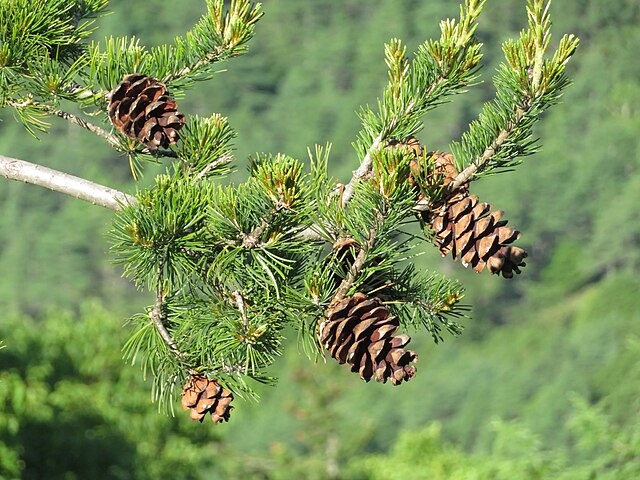
Five-needle pine does not develop rough bark as extensively as black pine; age is estimated from trunk thickness and branch density. Because five-needle pine grows slowly, a trunk 10 cm in diameter indicates at least several decades of age. The petrified variety (sekka goyo-matsu), whose bark becomes thick and cork-like, develops an aged appearance earlier than standard five-needle pine, so cultivar differences must be considered in age estimation.
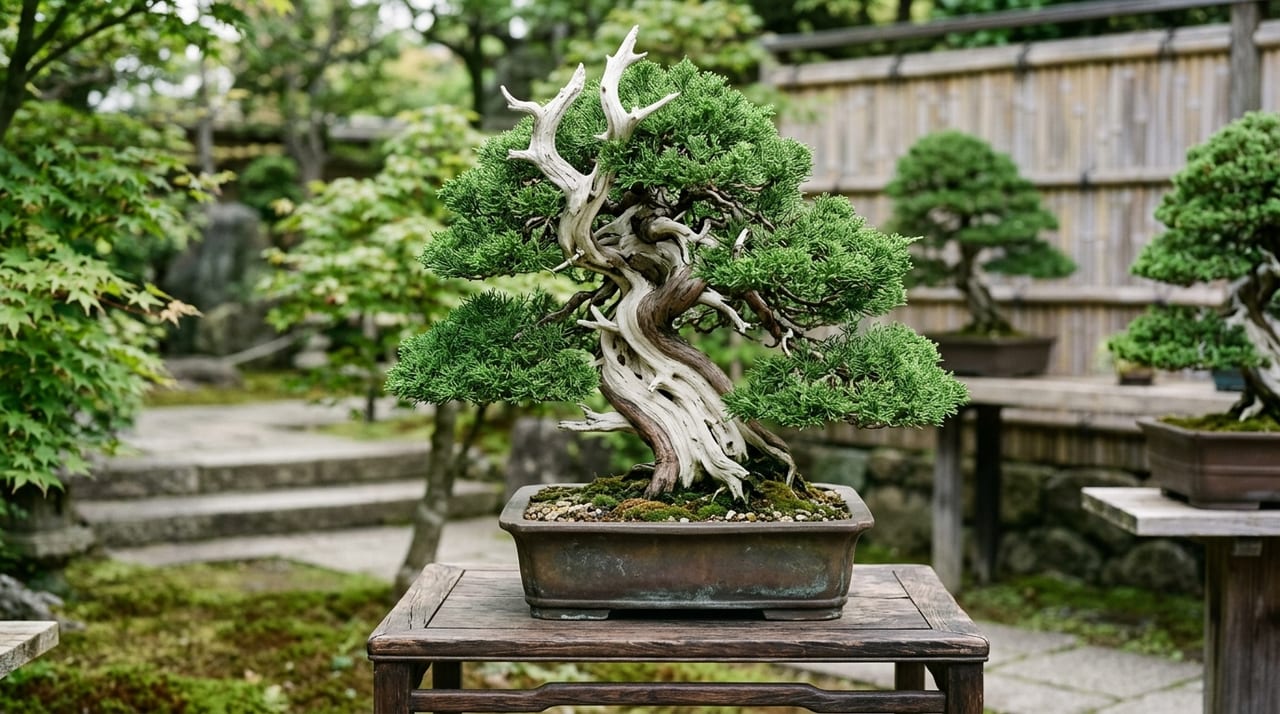
Shimpaku juniper shows age through shari development. The Itoigawa variety (Itoigawa hinoki) is known for beautifully formed natural shari; individuals with shari developed over wide areas can be judged to have appropriate age. Shari formation in Shimpaku juniper proceeds very slowly, with exposed heartwood gradually bleaching where the tree absorbs water. Unlike artificially carved shari, naturally formed and weathered shari have smooth surface texture with grain standing out, taking on an amber color. This patina cannot be recreated in short periods, so the maturity of shari is a reliable indicator of age.
Maple and other deciduous varieties are judged by the balance of trunk thickness and branch fineness. Even small specimens like mini-leaf maples show age through changes in bark texture and root spread. Trees with thick trunks and densely fine branching are evidence of years of cultivation. Root spread thickness is also an important assessment factor. In maple, long cultivation results in slab-like root flares rising at the base, with roots spreading to cover the surface. Old pruning scars that have healed into callused knobs as years pass indicate repeated care over time. Young maple bark appears greenish and smooth, while aged bark takes on a grayish-white tone with fine surface cracks.
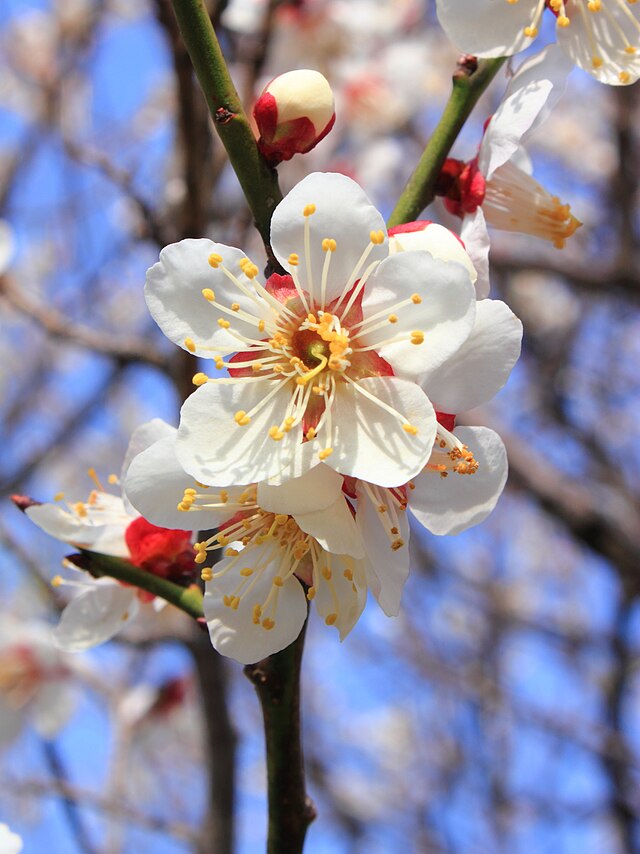
Plum is one of the tree species where age shows most clearly in the bark. Young plum bark is relatively smooth, but with age it develops deep vertical cracks, becoming thick and rugged. As it grows older, parts of the trunk die and hollow, until eventually only thin strips of living wood remain to flower. This "old plum" aesthetic is unique to aged plum specimens and is a major point of appreciation; the extent of bark cracking and trunk hollowing are indicators of age.
Supplementary Methods for Age Estimation
Beyond visual assessment, there are more objective methods to obtain clues.
Sampling with an increment borer In forestry and dendrochronology, a specialized tool called an increment borer is used to extract a pencil-thin wood core from the trunk without felling the tree, allowing ring count and age determination. While this method has the advantage of assessing rings without cutting down the tree, in bonsai, boring a hole damages the trunk itself and risks marring a precious specimen, so it is almost never actually used. It is best to keep this merely as theoretical knowledge; in practice, bonsai assessment relies on non-destructive visual observation.
Simple estimation formulas from trunk circumference and their limitations In field-grown trees, formulas such as "trunk diameter × growth coefficient" are sometimes used to estimate age. However, this method is almost useless in bonsai. Because bonsai grow in the confined environment of a pot with roots and branches deliberately restricted, growth rates differ entirely from field cultivation. Two trees of the same diameter—one accelerated through aggressive fertilization and one developed slowly over time—can have vastly different actual ages. Numerical formulas often provide no reliable basis for estimation; ultimately, one must return to comprehensive observation of bark, root spread, and branch fineness.
Notable Aged Bonsai
Old bonsai can possess value approaching that of cultural property. Ōmiya Bonsai Village in Saitama, known as one of Japan's premier bonsai regions, brings together many celebrated specimens passed down through generations, drawing enthusiasts from across Japan and abroad. The Imperial Gardens and bonsai parks throughout Japan preserve pine specimens reported to be several centuries old.
These ancient trees typically have associated provenance and stories; many bear names like the famous "Treasure-ship Pine." Bonsai accompanied by names and narratives transcend mere plants and are revered as cultural treasures passed down through generations. Beyond the tree's inherent beauty, understanding this background allows one to appreciate more deeply the weight and significance that aged bonsai carry.
Techniques for Making Young Trees Appear Aged
In bonsai, various techniques have been developed to impart the character of antiquity to younger trees.
One approach accelerates bark roughening. With pines, lightly scratching the trunk with a brush or applying lime sulfur mixture to roughen the surface are common techniques. However, excessive treatment places stress on the tree and requires moderation.
To develop a thick trunk quickly, the effective method is ground cultivation for several years allowing free growth, followed by potting. In ground cultivation, roots spread freely so trunk thickening accelerates, reaching suitable potting size in just a few years. Air layering also allows creation of thick-trunked bonsai in relatively short periods.
The jin and shari techniques also express age. Even artificially created jin and shari gradually develop natural appearance through repeated lime sulfur application and weathering.
Affixing moss to the pot surface evokes the atmosphere of long elapsed time. However, moss reduces air circulation, so tree health management must be prioritized.
Tree Age and Bonsai Value
Tree age is an important component of bonsai value, but mere age does not guarantee high worth. Bonsai value is determined by comprehensive assessment: beauty of form, refinement of branch structure, expression in the trunk, and strength of root spread.
Young trees with excellent potential and promising futures are highly valued. Conversely, bonsai with great age but poor maintenance may have diminished value.
Bonsai is "the art of cultivation." Purchase is not the endpoint but a beginning; the essential value lies in personally nurturing the tree over many years. The joy of developing a young sapling into an aged bonsai over decades is the ultimate reward of bonsai appreciation.
How Cultivation Records Enhance Value
Another factor influencing bonsai value is "record-keeping." A bonsai with a documented cultivation history—who trained it, how it was managed—tends to be valued higher than one without such documentation.
The reason is clear. As discussed, tree age must rely on visual estimation, but when records exist of seeding or collection dates, repotting and pruning histories, and successive owners, the tree's development can be supported by fact rather than supposition. When records confirm that a renowned bonsai master created the work, that provenance itself becomes valuable.
Certificates, provenance documents, records of successive owners, and historical photographs provide proof of authenticity and history. In recent years, many enthusiasts digitally preserve photographs and work records, making them valuable assets for the next steward. The older the tree, the more its value depends not just on the tree itself but on "the documented record that validates its story."
Care Principles for Enjoying Bonsai Long-Term
Bonsai, with proper care, can live and thrive as art for decades or even centuries. To maintain health over long periods, incorporate the following principles into daily management.
The fundamental water rule: "Water when dry" The golden rule of bonsai watering is "when the surface soil dries, water thoroughly." Water until it drains from the pot's base; half-hearted watering fails to reach deep roots and causes drought. Since drying speed varies by season and species, daily observation is most important.
Seasonal focus management (annual schedule)
| Season | Primary Tasks | Watering | Key Points |
|---|---|---|---|
| Spring (Mar–May) | Repotting, bud pinching, bud pruning, wiring | Gradually increase | Observe new growth to judge pruning timing. Ideal repotting season |
| Summer (Jun–Aug) | Leaf trimming, shading, pest control | Morning and evening, sometimes twice daily | Water shortage is critical. Leaf misting and shading for heat control |
| Autumn (Sep–Nov) | Supplementary fertilizing, autumn color observation, tidying overgrown shoots | Gradually reduce | Prepare for winter and build vigor for spring ahead |
| Winter (Dec–Feb) | Pruning, wire removal, frost protection | Sparse, avoid freezing | Deciduous trees are dormant. Protect from frost, harsh wind, and freezing |
Regular observation and record-keeping Bonsai changes occur gradually each day. Observe new growth, leaf color shifts, and root condition, and develop a habit of noting concerns. Keeping photograph records allows you to reflect on form changes over years, aiding in refining structure. As mentioned, such records become documentation supporting future bonsai value.
Experience the Weight of Years at GrowerDirect
At GrowerDirect, you can purchase bonsai cultivated with care over many years directly from specialist growers. Being able to confirm tree age and cultivation history directly with the grower is reassuring. For those wishing to start with promising young stock, consultation on material selection with the grower's expertise is also available.