Guide to Caring for Rare Carnivorous Plants | Care of Heliamphora, Genlisea, Byblis, and Roridula
This article provides detailed explanations of the capture mechanisms, required cultivation environments, and management methods for rare carnivorous plants (Heliamphora, Genlisea, Byblis, and Roridula) that attract collectors' attention. A complete cultivation guide for these advanced-level rare genera.
Key Takeaways
This article provides detailed explanations of the capture mechanisms, required cultivation environments, and management methods for rare carnivorous plants (Heliamphora, Genlisea, Byblis, and Roridula) that attract collectors' attention. A complete cultivation guide for these advanced-level rare genera.
Related Species
Welcome to the World of Rare Carnivorous Plants
While many people think of Venus flytraps and sundews when it comes to carnivorous plants, the world of these plants is far deeper, with many rare species that are difficult to cultivate. Heliamphora, Genlisea, Byblis, and Roridula are all rare species with distinctive capture mechanisms and high ornamental value, rarely seen in general garden centers. This article provides detailed explanations of the ecology and key points of cultivation management for these four genera.
Heliamphora | Cultivated in the Mists of South American Tepuis
Heliamphora (Heliamphora) is a pitcher-like carnivorous plant native to tepuis (table-top mountains) in Venezuela, South America. It has trap-like capture leaves similar to Nepenthes, but has weak digestive fluid secretion and relies primarily on a primitive mechanism of drowning prey with rainwater.
The key to cultivation is temperature management. The native habitat ranges in elevation from 1,500 to 3,000 meters, with daytime temperatures of 20–25°C and nighttime temperatures dropping to around 10°C. To survive Japanese summers, cooling equipment capable of maintaining temperatures below 25°C is essential. An air-conditioned room or a cultivation case made from a modified refrigerator is effective.
Cultivation conditions are as follows.
- Soil: Sphagnum moss alone or a 7:3 mixture of sphagnum moss and perlite
- Water level: Keep shallow (1–2 cm) and maintain a constantly moist condition at the pot bottom
- Light: Avoid direct sunlight; provide bright indirect light or approximately 14 hours of plant LED light per day
- Fertilizer: Generally not necessary, but growth becomes more stable when insects such as flies are placed in the trap leaves 1–2 times per month
Genlisea | The Spiral Trap Hidden Underground
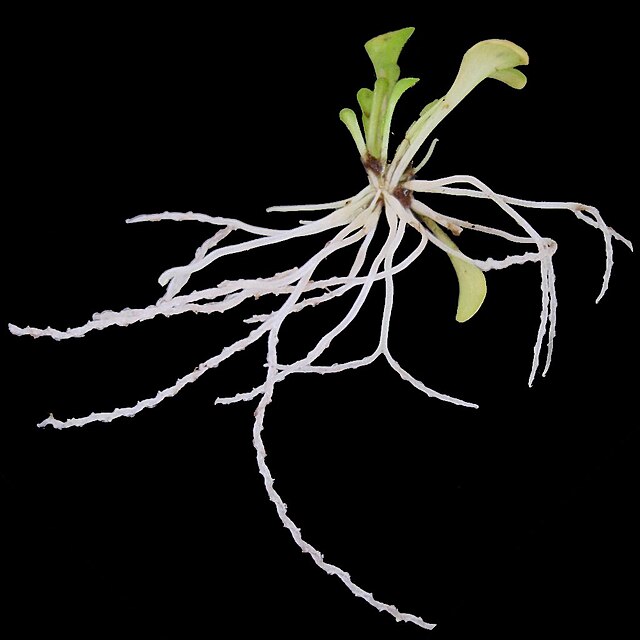
Genlisea (Genlisea), also called the "corkscrew plant," is a unique carnivorous plant with spiral-shaped trap organs underground. The above-ground portion has rosette-forming, elongated leaves and produces small yellow or purple flowers. The underground traps are structured to capture microorganisms and protozoans, and because they cannot be observed from outside, there are enthusiasts around the world fascinated by this mysterious mechanism.
Cultivation can be approached with a sense similar to sundews.
- Soil: Sphagnum moss alone, or a 1:1 mixture of peat moss and perlite
- Water level: Keep constantly moist
- Light: Avoid direct sunlight and manage in bright partial shade
- Temperature: Relatively flexible in the range of 15–30°C
Therefore, it is a rare species that beginners can work with relatively easily.
Tropical species (such as G. violacea) and temperate to subtropical species differ in cold tolerance. Tropical species should be kept above 10°C in winter, while temperate species are better suited for long-term cultivation if allowed to enter dormancy. Propagation is also possible through leaf cuttings; placing healthy leaves on moist sphagnum moss results in small plantlets developing within 2–3 months.
Byblis | Australia's Rainbow-Colored Carnivorous Plant
Byblis (Byblis) is a carnivorous plant distributed in Australia and New Guinea, with glandular hairs that secrete mucus densely covering the entire leaf surface. It is affectionately known as the "rainbow plant" because it shimmers with rainbow colors when exposed to light. It uses a sticky trapping method similar to sundews, but belongs to a completely different lineage.
The annual species B. liniflora is easy to grow from seed and flowers 3–4 months after sowing. The perennial species B. gigantea and B. lamellata are adapted to the Mediterranean climate of Western Australia and have the property of entering semi-dormancy during the dry summer period. In cultivation in Japan, overcoming summer conditions for perennial species is the greatest challenge.
The basics of cultivation are as follows.
- Soil: Use a 1:1 or 2:1 mixture of peat moss and perlite, and cultivate with water level management
- Light: It prefers strong light, and when grown in direct sunlight from a south-facing window or outdoors, the leaves develop abundant mucus and display beautiful coloration
Annual species can be continuously cultivated by collecting seeds in autumn and sowing them the following spring.
Roridula | South Africa's Anomaly Where Symbiotic Insects Handle Digestion
Roridula (Roridula) is a shrub-like plant native to fynbos vegetation in South Africa. It has glandular hairs that secrete mucus to trap insects, but does not secrete digestive enzymes itself. Instead, it has a rare mechanism in nature called "indirect carnivory," where symbiotic bugs (genus Pameridea) living on the leaves feed on trapped insects, and the plant absorbs their excrement.
Cultivation difficulty is quite high, and soil selection is key.
- Soil: A highly draining mixture of coarse perlite, river sand, and small amounts of peat moss (the native habitat has well-draining sandy soil with a nutrient-poor, peat-deficient environment)
- Watering: Avoid water level management. Manage on the dry side and water when the soil surface becomes dry
It prefers temperatures in the range of 5–25°C, and the hot, humid Japanese summer is the greatest barrier. In summer, move it to a cool, well-ventilated environment and minimize watering. Providing sufficient light allows the stems to become sturdy and the glandular hairs to develop. Smoke treatment (soaking in smoke water) is effective for seed germination, and germination rates improve by mimicking the natural ecology of sprouting after wildfires.
Common Cultivation Basics and How to Obtain These Plants
The common basics for cultivating these four genera are "no fertilizer, clean water, appropriate light." Chlorine and minerals in tap water can accumulate and cause root damage, so the use of rainwater or distilled water and RO water is strongly recommended. The secret to long-term cultivation is to avoid fertilizer and rely on natural food sources such as insects.
The main sources for obtaining these plants are domestic specialty shops for carnivorous plants and auctions and sales events organized by enthusiast groups (such as the Japan Carnivorous Plant Lovers Society). In recent years, individual-to-individual transactions through social media have also increased, and trading opportunities for rare species are expanding on grower-direct platforms like botachoku.com. When purchasing, check the condition of the soil and the health of the roots, and for ideal results, purchase in spring or autumn when temperatures are mild to minimize damage during transport.
Cultivating rare carnivorous plants is not straightforward, but stable growth is possible by accurately reproducing the natural habitat environment. I recommend starting with relatively easy-to-handle species such as Genlisea or annual Byblis, and then progressing to challenge Heliamphora and Roridula as you gain experience.