How to Grow Utricularia: Cultivation Methods by Aquatic and Terrestrial Types
We explain how to grow Utricularia by aquatic and terrestrial types. We provide detailed information on the mechanism of traps (bladders), recommended varieties, soil and watering management methods, and tips for getting plants to bloom.
Key Takeaways
We explain how to grow Utricularia by aquatic and terrestrial types. We provide detailed information on the mechanism of traps (bladders), recommended varieties, soil and watering management methods, and tips for getting plants to bloom.
The genus Utricularia (Utricularia) is the largest genus of carnivorous plants, with approximately 230 known species distributed across diverse environments worldwide. It encompasses diverse life forms, including aquatic species that float in water, terrestrial species that creep along the ground, and epiphytic species that attach to tree trunks. What they share is a small pouch-shaped trap called a "bladder" (approximately 0.2–5 mm), which sucks in and consumes tiny organisms such as water fleas. In contrast to these modest traps, many species produce delicate and brightly colored flowers, which is part of their appeal.
The Capture Mechanism of Utricularia
The bladders of Utricularia are among the fastest-moving mechanisms in the plant kingdom. Near the lid at the entrance of the bladder is a trigger hair, and the hunting sequence is as follows.
- A tiny organism touches the trigger hair
- In approximately 0.5 milliseconds (less than 1/1000th of a second), the lid opens and the prey is drawn in along with water
- The lid closes
- Digestive enzymes are secreted, and the prey is digested and absorbed
These bladders are attached in countless numbers to underground stems or submerged stems and are nearly invisible to the naked eye. When observed with a magnifying glass or microscope, the remains of captured microorganisms can sometimes be seen inside the transparent or translucent bladders, making them an irresistible subject for enthusiasts.
The terrestrial species Utricularia bifida, native to Japan, has innumerable small bladders attached to underground stems that spread through the soil. While the traps are difficult to see under normal cultivation, small bladders can be observed if the plant is uprooted and the roots are rinsed.
Cultivation Methods for Terrestrial Species: Utricularia bifida and Livida
Terrestrial species are the easiest group to cultivate and are recommended for beginners. Representative cultivated species include the following.
- Utricularia sandersonii (Rabbit's Foot)
- Utricularia livida
- Utricularia bifida
The conditions for soil, pots, and watering are as follows.
| Item | Details |
|---|---|
| Soil | The basic mix is peat moss and silica sand in a 6:4 ratio (you may add akadama soil to adjust drainage) |
| Pot | A shallow plastic pot is appropriate |
| Watering | The basic method is semi-aquatic watering, maintaining approximately 1 cm of water in a saucer at all times |
| Water quality | Use distilled water or rainwater |
Bright partial shade to full sunlight is suitable for light conditions. Rabbit's Foot can bloom even in relatively weak light, but the number of flowers increases with sufficient light. Strong direct sunlight in mid-summer can cause leaf scorch, so use a shade cloth or avoid afternoon direct sun.
Winter care varies by variety.
- Japanese Utricularia bifida: Can overwinter outdoors
- Tropical Rabbit's Foot and Livida: Maintain a minimum temperature of 10°C or higher, and continue semi-aquatic watering on an indoor windowsill
Cultivation Methods for Aquatic Species: Utricularia and Japanese Bladderwort
Aquatic species are compatible with medaka biotopes and can be enjoyed floating on the water surface. The Japanese Utricularia australis and other aquatic species can be cultivated simply by placing them in goldfish bowls or water lily basins.
The conditions for containers, substrate, and water quality are as follows.
| Item | Details |
|---|---|
| Container | Any container with a water depth of approximately 10–30 cm will do |
| Substrate | A thin layer of field soil or akadama soil encourages microorganisms to thrive, which serve as food for Utricularia |
| Water quality | Slightly acidic to neutral soft water is ideal |
Placing it outdoors in a sunny location is ideal. With sufficient light, it produces bright yellow flowers above the water surface in autumn. Although small, the flowers of aquatic species are charming and add color to the biotope.
In winter, many aquatic species form winter buds (turions) and sink to the bottom of the water. Outdoor overwintering is possible in environments where the water does not freeze completely. As water temperature rises in spring, they resurface and resume growth.
Cultivation Methods for Epiphytic Species and Enjoying Them in Terrariums
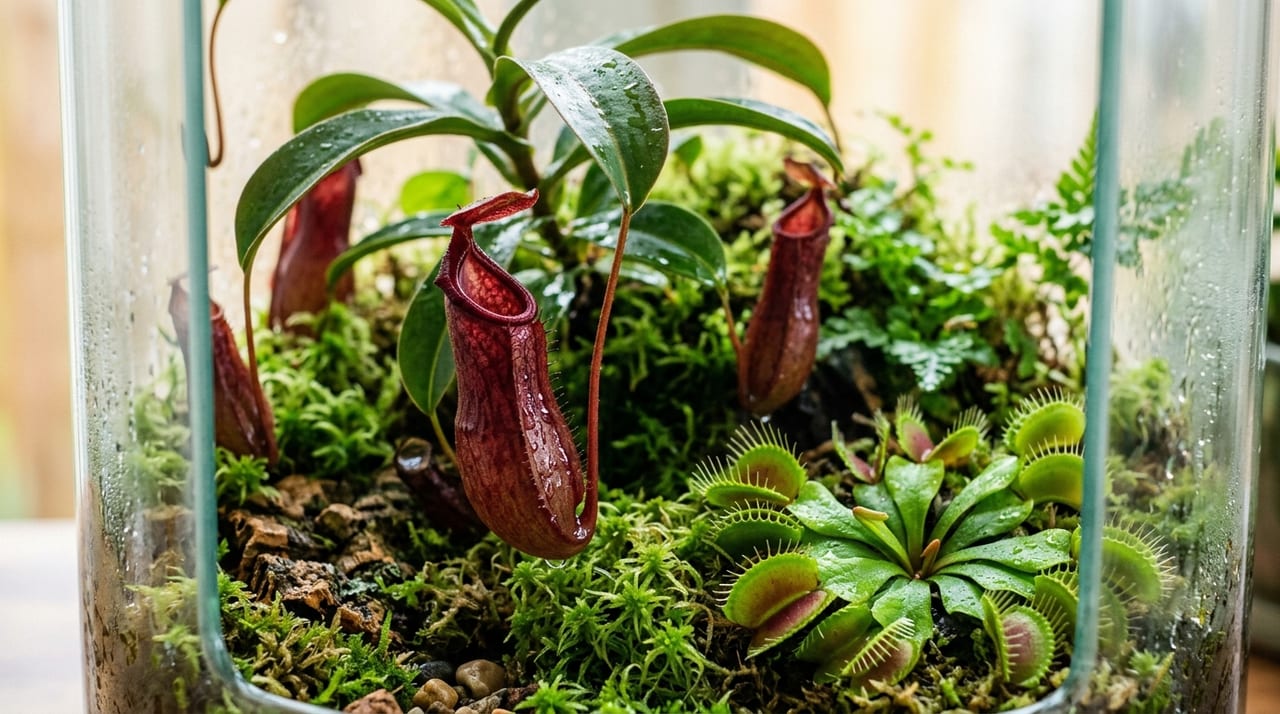
Epiphytic species attach to tree trunks and moss in tropical rainforests, and terrariums are ideal for their cultivation. Representative cultivated species include Utricularia nervifolia and Utricularia reniformis.
The conditions for placement, humidity, temperature, and light are as follows.
| Item | Details |
|---|---|
| Placement | Thinly wrap sphagnum moss around cork or tree fern boards, place the epiphytic species on top, and set it inside the terrarium |
| Humidity | Maintain high humidity (70–90%) |
| Temperature | Maintain cool temperatures (18–25°C) |
| Light | Weak to moderate light is sufficient. Indirect light from LED lights is appropriate |
The flowers of epiphytic species are generally larger and more showy than those of terrestrial species. The white flowers of U. nervifolia and the purple flowers of U. reniformis are especially beautiful when they bloom inside a terrarium.
Enjoying the Flowers: Rabbit's Foot and Its Relatives
The greatest appeal of Utricularia is that it produces flowers so charming that you wouldn't think it's a carnivorous plant. Rabbit's Foot (U. sandersonii) has white flowers that look like a rabbit's face and is a popular variety on social media. Under proper care, it produces flowers almost continuously throughout the year.
Utricularia warburgii produces vibrant purple flowers, and Livida has beautiful flowers with a gradient from cream to light purple. Because flower color, size, and blooming patterns vary by species, collecting multiple varieties is an enjoyable way to appreciate them.
The key to producing abundant flowers is providing sufficient light and maintaining appropriate humidity. Fertilizer is basically unnecessary; rather, keeping the soil clean promotes better flowering.
Tips for Cultivating Utricularia
Utricularia is a particularly unique carnivorous plant that captures tiny organisms using suction-type traps (bladders) spread through water or wet soil. Approximately 230 species are known, making it the carnivorous plant genus with the most species worldwide.
| Care Type | Details |
|---|---|
| Aquatic Utricularia Care | Floating types (U. gibba, U. vulgaris, etc.) can be cultivated in aquariums or buckets. Soft water (rainwater or distilled water) is ideal, as these plants dislike the minerals in tap water. Vigorous growth occurs under direct sunlight, and small yellow flowers bloom on the water surface. |
| Terrestrial Utricularia Care | Types that form bladders in wet soil (U. sandersonii, U. livida, etc.) are managed in constantly moist peat moss. They are very hardy and easy to propagate, making them suitable for beginners. U. sandersonii, which produces small flowers frequently, is affectionately known as "Rabbit's Foot." |
Propagation of Utricularia
Utricularia proliferates explosively when conditions are right. Aquatic species reproduce as stems branch to form new individuals, while terrestrial species spread via underground stems. If they spread excessively, thin them out, divide them into other containers, or share them with friends.
Common Mistakes and Solutions
Mistake 1: I thought it died because I can't see the bladders
The bladders of Utricularia are located in soil or water and are not visible from above ground. Only leaves and flowers are visible above ground. It is not abnormal for the bladders to be invisible.
Mistake 2: Growing terrestrial species submerged
Terrestrial species such as Utricularia bifida rot at the rhizome if kept constantly submerged. Semi-aquatic watering with moistened soil is the correct method, and care differs from aquatic species. Confirm the type for each species.
Mistake 3: Pulling them out as weeds
Terrestrial species have thin leaves that spread like grass, so plants that land in other pots are often mistaken for weeds and discarded. They are difficult to distinguish until they flower, so handle pots around carnivorous plants carefully.
Explore the Diverse World of Utricularia with GrowerDirect
On GrowerDirect, you can purchase various Utricularia species directly from growers. From rare epiphytic species to easy-to-grow terrestrial species, the wide selection is unique to direct sales. Explore the world of Utricularia, with its charming flowers and ingenious bladders, on GrowerDirect.