Dorstenia Cultivation Guide | Caudex Plant with Distinctive Leaves and Organs
Dorstenia is an African plant with distinctive floral organs and a caudex. Water management adjusted to seasonal cycles is the key to cultivation.
Key Takeaways
Dorstenia is an African plant with distinctive floral organs and a caudex. Water management adjusted to seasonal cycles is the key to cultivation.
Related Species
What Kind of Plant is Dorstenia?
Dorstenia (Dorstenia) is a caudex plant belonging to the Moraceae family, with approximately 170 species distributed mainly across the African continent and tropical and subtropical regions of Central and South America and Southeast Asia. Although relatively unknown among caudex plants in circulation in Japan, it has recently gained rapid attention as a collector's plant.
The greatest individuality of this genus lies in the formation of its floral organs. Unlike typical flowers, Dorstenia's "flower" is a flat, fleshy, pedestal-like inflorescence (receptacle) with a structure similar to a "false fruit," upon whose surface countless minute flowers are densely crowded. It has an appearance like a fig cut open flat, and botanically is called a "hypocrateriiform inflorescence," a unique form. After flowering, it produces seeds through self-pollination, and when the fruit dries, it splits open to disperse seeds tens of centimeters away, equipped with an automatic dispersal function.
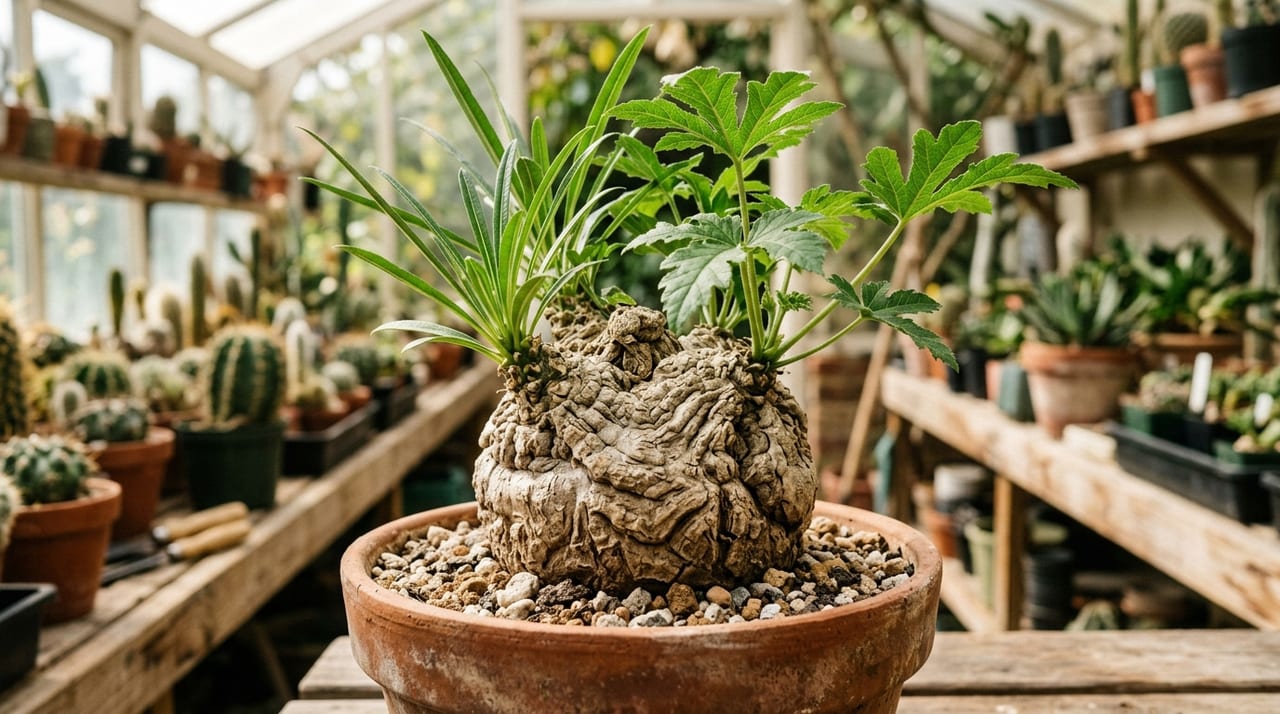
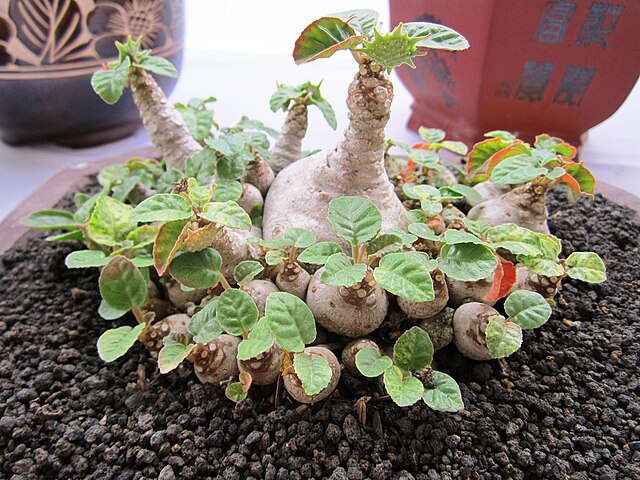
Underground, a succulent caudex develops, and even when the aboveground part dies back during the dry season, it stores moisture and nutrients in preparation for the next rainy season. Leaf morphology also varies greatly by species, with such variation that they don't seem to belong to the same genus.
- Slender, linear leaves
- Deeply lobed leaves
- Textured leaves with prominent veins
Among species relatively easy to obtain domestically are Dorstenia foetida (D. foetida) and Dorstenia elata (D. elata).
Location and Light Management
In its native habitat, it grows in the dappled shade of the edges of tall forests and rocky areas, so intense direct sunlight is unfavorable. Indoors, a bright spot through lace curtains or a distance of about 1–2 meters from a window is appropriate. If light is insufficient, leaves become leggy and inflorescence formation decreases, so be mindful of the delicate balance of "bright but not in direct sunlight."
When managing outdoors, be cautious of intense light after the rainy season. Gradually increase shading rate from early spring, and use 50–70% shade cloth in summer to prevent caudex deterioration. From autumn through winter, bring it indoors and manage it there, placing it by the brightest window possible to suppress etiolation from insufficient light.
The ideal temperature is 18–28°C during the growing season (May–October) and 10–15°C during dormancy. Below 5°C, the caudex becomes susceptible to cold damage, so manage winter dormancy carefully, monitoring the minimum temperature.
Watering by Season
The core of Dorstenia cultivation is water management aligned with seasonal cycles. Because it is adapted to the dry and rainy season rhythms of its native habitat, watering at the same pace year-round causes root rot.
| Period | Characteristics | Watering Guidelines |
|---|---|---|
| Growing season (May–October) | The period when water is most needed. July–September, when inflorescences emerge in succession, is a period of vigorous activity | Water thoroughly when the soil surface dries. Presume rapid drainage with no water pooling at pot bottom. July–September, check drying frequently |
| Dormancy transition (November–December) | A period to gradually extend watering intervals as leaves age | Apply a sense of leaving the soil several days after it dries, reducing to approximately 3–4 times per month |
| Dormancy (January–March) | A period when aboveground parts nearly disappear, leaving only the caudex. Excess moisture is the primary cause of root rot | 1–2 times per month, a very small amount just sufficient to prevent the caudex from completely drying. The guideline is to maintain a state where the caudex, when touched by hand, has slight firmness |
| Awakening period (April) | The period when new shoots begin to emerge from the caudex | Without rushing, confirm the development of new shoots, then gradually increase water and shift to the growing season |
Choosing Substrate and Pots
Drainage and aeration are the top priorities. A standard mix example is a ratio of 4 parts kanuma soil (medium grain) : 2 parts red loam (small grain) : 2 parts perlite : 1 part bark : 1 part charcoal. What matters is not fixation on a particular substrate, but ensuring "water does not stagnate in the pot." The ideal drainage is pressing the surface with a finger and water not seeping out.
Terracotta (unglazed earthenware) or kanuma-based terracotta pots are best. Unglazed terracotta allows water to evaporate from the sides as well, so the pot interior dries faster and reduces root rot risk. Plastic pots retain moisture too well, so it is best to avoid them except when advanced growers use them intentionally. Keep pot size only about one size larger than the caudex to prevent over-moisture from excess substrate.
Repotting is ideally done once every 2–3 years in April during the awakening period. Carefully remove old soil without damaging old roots. If damaged roots are present, remove them with clean scissors, allow the cut to dry, then plant in fresh substrate.
Pests, Diseases, and Daily Observation Points
| Pest/Disease | Cause & Symptoms | Treatment |
|---|---|---|
| Root rot | Primarily caused by over-moisture in winter. The caudex begins to soften and discolor | Remove the affected area cleanly with a sharp blade, allow to dry, then apply a fungicide (such as benomyl) |
| Spider mites | Easily occur in dry indoor environments. Leaves appear whitish and speckled | Check the underside of leaves and prevent by misting with water regularly |
| Mealybugs | Appear as white, cottony clusters in leaf axils and caudex crevices | In early stages, remove with an ethanol-soaked cotton swab. If widespread, consider pesticide application |
Daily, it is important to observe the color, firmness, and inflorescence production of leaves to understand the plant's condition. Healthy Dorstenia produces inflorescences frequently and has leaves with thickness and luster. If leaves become yellow and leaf drop is heavy, suspect either insufficient light or over-moisture.
Enjoying Dorstenia Long-Term
The charm of Dorstenia lies in its appearance continually changing throughout the year. In summer, it spreads leaves vibrantly and produces strange inflorescences in succession; in winter, it becomes just the caudex and sleeps quietly—the essence of this plant is being able to observe such dynamic seasonal changes up close.
Diversity among species is another pleasure. Because there exist a wide range from compact, collectible species to large, impressive caudex species, a path starting with easy-to-grow species, gaining experience, and gradually challenging difficult and rare species is supported by many enthusiasts.
Although Dorstenia may appear difficult at first glance, if you master seasonal water management, it is a relatively hardy caudex plant that you can enjoy for years. Please take time to experience the charm of this genus, which possesses quiet individuality and mysterious sculptural beauty.