How to Grow Lotus | Guide to Growing Flowering Lotus in Pots as Aquatic Plants
This guide explains the tips for growing lotus in containers—planting season, soil, sunlight, water depth, fertilization, and division—along with the differences between lotus and water lilies.
Key Takeaways
This guide explains the tips for growing lotus in containers—planting season, soil, sunlight, water depth, fertilization, and division—along with the differences between lotus and water lilies.
Related Species

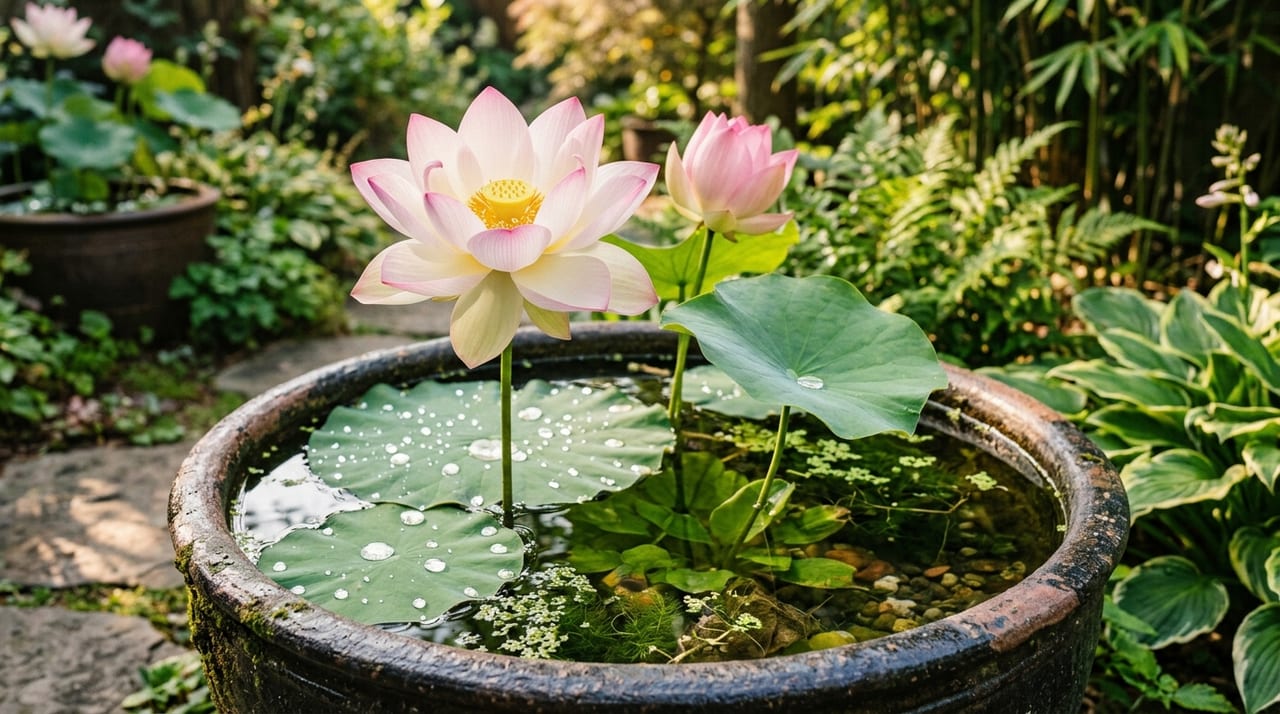
Lotus is a representative aquatic plant that produces large leaves and elegant flowers and has long been enjoyed even as a potted plant. The appeal is that you can enjoy flowering lotus in a single container like a water lily basin or hibachi, even without a pond in your garden. Here, we explain the fundamentals centered on potted cultivation, from planting through daily management to plant renewal through division.
Basic Information About Lotus
Lotus is a perennial aquatic plant in the genus Nelumbo (family Nelumbonaceae), characterized by propagating via rhizomes (lotus roots). It is often confused with water lilies, but botanically they have the following differences:
| Item | Lotus | Water Lily |
|---|---|---|
| Genus | Nelumbo | Nymphaea |
| Leaf and flower position | Raised above the water surface | Floating on the water surface |
The leaves are circular with high water-repellent properties, and the characteristic sight of water droplets beading and rolling off is well known as a representative feature of lotus.
Ornamental "flowering lotus" cultivars are widely available, ranging from compact varieties suited to potted cultivation to large varieties for garden ponds. Since there are numerous dwarf varieties that flower even in small water lily basins or hibachi-sized containers, it has become easier to start growing flowering lotus even in limited spaces such as balconies or garden corners.
Planting Season and Soil Selection
The ideal planting season is from late March to around April, when soil temperatures begin to rise. Lotus rhizomes (seed lotus) have a growth point at the tip, and this part is extremely fragile and prone to breaking, so planting work must be done carefully to avoid damaging the growth point. Loamy clay soil is the most suitable; if it is difficult to obtain, garden soil or aquatic plant cultivation substrate may be used as a substitute. Since clay pellet soil alone has somewhat insufficient nutrient retention and water retention, the basic approach is to use loamy clay soil or paddy soil as the main component.
The planting procedure is as follows.
- Lay soil thickly on the bottom of the pot.
- Place the rhizome horizontally with only the growth point slightly protruding above the soil (avoid burying the growth point completely, as deep planting makes sprouting difficult).
- After planting, gently add water, beginning with a shallow water level and gradually increasing water depth as leaves develop.
Light, Water Depth, and Water Temperature Management
Like water lilies, lotus strongly prefers sunlight and requires at least 5–6 hours of direct sunlight per day to flower. Insufficient light causes excessive leaf growth and poor flowering. Water depth is typically adjusted according to the growth stage as follows.
- Just after sprouting: approximately 5 cm, a shallow water level
- As leaves rise above the water surface: gradually increase to approximately 10–20 cm.
Lotus prefers warm water, with an optimal growth temperature of approximately 25°C. Therefore, choosing a location with good sunlight where water temperature rises easily promotes stable growth. Conversely, in small containers where water temperature may rise excessively in direct summer sun, regular water top-ups to moderate rapid temperature increases are effective.
Fertilizing and Plant Renewal Through Division
During the growing season from May through August, apply slow-release granular fertilizer approximately once every 1–2 months. When fertilizing, note the following:
- Always bury fertilizer in the soil to avoid polluting the water.
- Excessive nitrogen can cause excessive leaf growth and poor flowering; choose a fertilizer that contains phosphorus and potassium in balanced proportions.
Lotus grows vigorously, with rhizomes spreading to fill the pot year after year; in most cases, annual or biennial division and repotting becomes necessary. During the dormant period from winter through early spring, dig up rhizomes from old soil, select vigorous young rhizomes, and replant them in fresh soil to ensure stable flowering in subsequent years.
Troubleshooting and Companion Plants
Lotus leaves may be infested with aphids or leaf beetles; remove them promptly as soon as you notice them. Common causes of failure to flower include the following; reviewing these one by one forms the basis of troubleshooting:
- Insufficient light
- Plant aging (not repotted for an extended period)
- Excessive leaf growth due to overfertilization
When growing lotus in water lily basins or hibachi, you can also enjoy combining floating aquatic plants such as water clover and amazon frogbit as companion plants to add color to the water surface. However, since amazon frogbit is tropical and cold-sensitive, if you plan to keep it floating outdoors year-round, it is advisable to consider winter management (moving it indoors or treating it as an annual).
Cultivar Classification for Potted Growing
Ornamental flowering lotus cultivars are finely classified by plant size, with varieties suited to potted growing. Selecting cultivars that match your planned container size is the first step toward achieving blooms without undue stress.
- "Bowl lotus": A group of dwarf cultivars bred to flower in very small bowl-like containers. Widely used for growing in limited spaces such as balconies.
- Medium cultivars: Grow in pots somewhat larger than bowl lotus.
- Large cultivars: Suited to large garden pots or small ponds.
Even with the same cultivar, flowering can vary depending on soil volume and pot size; therefore, ensure adequate soil volume even for dwarf varieties.
Summary
By mastering careful planting that protects the growth point, managing light, water depth, and water temperature, and performing regular division, lotus is an aquatic plant that can display elegant flowers even when grown in containers. Though seemingly similar to water lilies, lotus belongs to a different genus botanically and has different cultivation rhythms; it is advisable to understand each plant's characteristics and plan your cultivation accordingly. For details on available cultivars, please refer to our online catalog.