Haworthia Window Optical Grading | Discerning Quality Through Light Transmittance Measurement
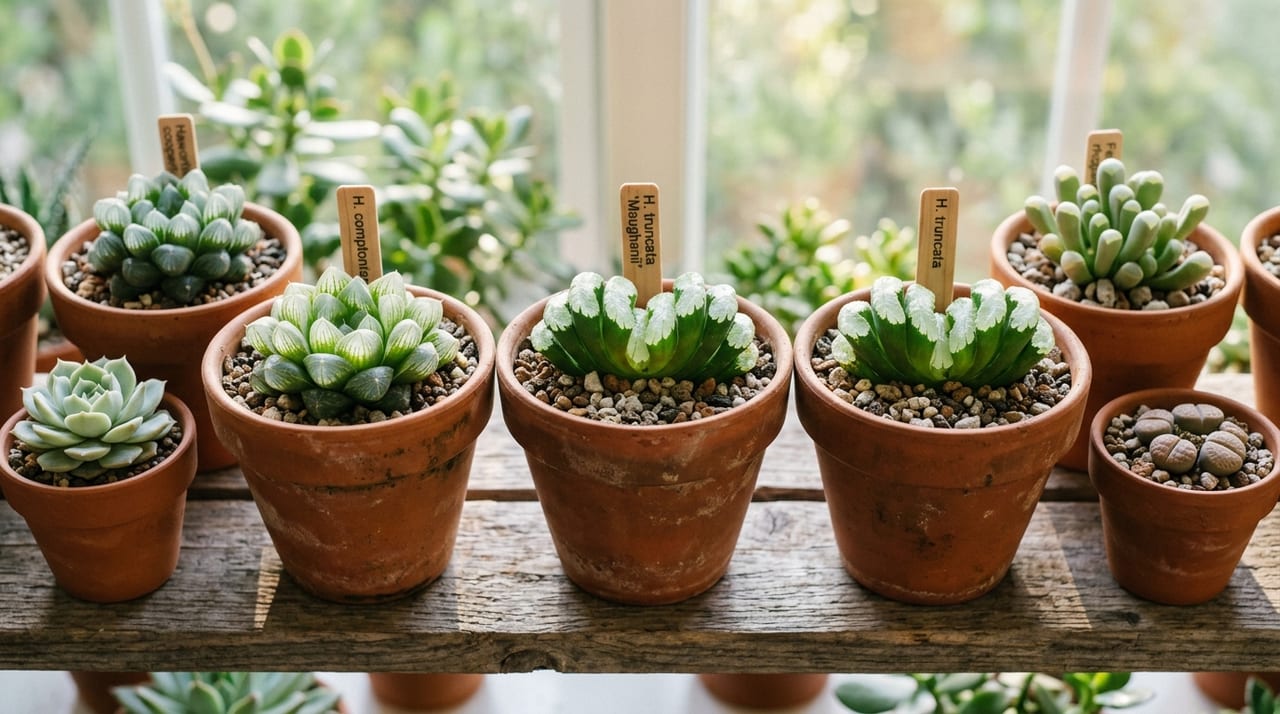
The greatest allure of 'window-form' Haworthias such as Haworthia comptonia and Haworthia truncata lies in the phenomenon of being able to see the internal g…
Key Takeaways
The greatest allure of 'window-form' Haworthias such as Haworthia comptonia and Haworthia truncata lies in the phenomenon of being able to see the internal g…
Related Species
The greatest allure of 'window-form' Haworthias such as Haworthia comptonia and Haworthia truncata lies in the phenomenon of being able to see the internal green tissue (photosynthetic tissue) through the transparent window portion of the leaves. The geometric leaf vein pattern visible through the translucent window is stunningly beautiful, like a precious gem. However, there is variation in the light transmittance of the windows in purchased specimens, and it is not uncommon to find that the transparency is not as expected. In fact, there exists a technique called 'optical grading' for scientifically evaluating the quality of individual specimens. This article explains a method for quality assessment using light transmittance measurement that even non-specialists can implement.
Optical Structure and Quality Factors of Haworthia Windows
The Haworthia window is a specialized tissue in which epidermal cells have become transparent. Normally, the epidermis of plants does not allow light to pass through, but in window-form Haworthias, the epidermal cells become thick and composed of crystalline cellulose with a high refractive index, dramatically improving light transmittance. This transparency is largely dependent on the crystal structure of cellulose and its regularity. In healthy window tissue, cellulose microfibrils are arranged in parallel, minimizing light scattering. Conversely, if this arrangement is disrupted due to poor cultivation or genetic factors, light diffusion increases and transmittance decreases.
High-quality Haworthia windows achieve light transmittance of 90% or higher while maintaining a thickness of 3mm or more. Premium specimens may achieve transmittance of up to 95%, and such specimens hold extremely high value among international collectors. In contrast, poorly cultivated specimens not only have thinner windows but may see their transmittance drop to 50-70%. A 50% transmittance rate means that more than half of the light is scattered or absorbed as it passes through the window, significantly reducing the visibility of internal tissue.
Multiple factors influence the clarity of the window. First is the light intensity during cultivation. Window-form Haworthias develop clear windows under sufficient sunlight (more than 6 hours of direct sunlight per day), but in low-light environments they tend to develop thin, cloudy-looking windows. In low-light environments, plants tend to develop cell tissue with lower refractive indices in an attempt to maximize light utilization. Second is root rot during summer. When roots are damaged, water and nutrient uptake becomes poor, window tissue development is inhibited, and transmittance temporarily decreases. Complete recovery may not occur. Third is genetic background. Even within the same species, there are innate differences in window transmittance depending on the collection locality and breeding lineage.
Simple Optical Grading Implementation Method
The light transmittance of Haworthias can be quantitatively measured using a commercially available light meter (lux meter). The measurement method is as follows.
First, in a dark room, place the light meter 30cm directly above the window portion of the Haworthia and compare the illumination with the surrounding leaf area (non-window portion) under the same light source. Calculate the relative transmittance based on the ratio of illumination at the window portion to that of the surrounding area. For example, if the surrounding leaf area measures 1000 lux while the window portion measures 900 lux or more, the transmittance can be determined to be 90% or higher. By taking measurements at multiple window areas and calculating the average, more accurate assessment is possible.
The grading standards are as follows.
- S grade (90% or higher): Display quality. Specimens with the highest transparency. The pinnacle for collectors.
- A grade (75–90%): High-quality specimens. Balance of practicality and aesthetics. Sufficient satisfaction can be expected.
- B grade (60–75%): Standard specimens. Typical cultivated specimens. Not bad as an entry-level option.
- C grade (50–60% or lower): Caution advised. Poor cultivation is likely. Purchase should be avoided.
Practical Selection Method for Purchase Specimens
In the case of online purchases, optical quality cannot be accurately determined from photographs. However, some inference is possible from the seller's description and explanation of cultivation conditions. By referring to the checklist below, purchase mistakes can be greatly reduced.
Specimens explicitly described as 'grown under high light intensity' or 'maintained outdoors in a south-facing window' are likely to have high transmittance. Conversely, descriptions such as 'grown in partial shade' or 'maintained indoors' should be seen as signals of reduced transmittance. Additionally, if the photograph shows windows that appear white and cloudy, it may indicate excessive development of the silica layer in the epidermis, and such specimens tend to have low transmittance. While the silica layer serves to protect against ultraviolet radiation, excessive thickness significantly reduces light transmittance.
Price is also a useful indicator. Even among the same variety, S-grade specimens often command 2–3 times the price of B-grade specimens, reflecting market recognition of the difference in optical quality. If budget permits, it is worthwhile to select an S-grade specimen for a small price difference.
Some recovery of transmittance is possible through improved cultivation conditions after acquisition. In particular, transition to a high-light environment improves the transmittance of newly formed windows. However, existing cloudy windows will not return to transparency. For specimens with genetically low transmittance, complete improvement cannot be expected. Therefore, accurate quality assessment at the time of purchase greatly influences long-term satisfaction.