Complete Guide to Succulent Leaf Propagation | Maximize Success Rate Through Parent Selection, Environment, and Timing
Learn methods to significantly improve success rates in succulent leaf propagation. From parent selection to timing and environmental setup, discover practical techniques.
Key Takeaways
Learn methods to significantly improve success rates in succulent leaf propagation. From parent selection to timing and environmental setup, discover practical techniques.
Related Species
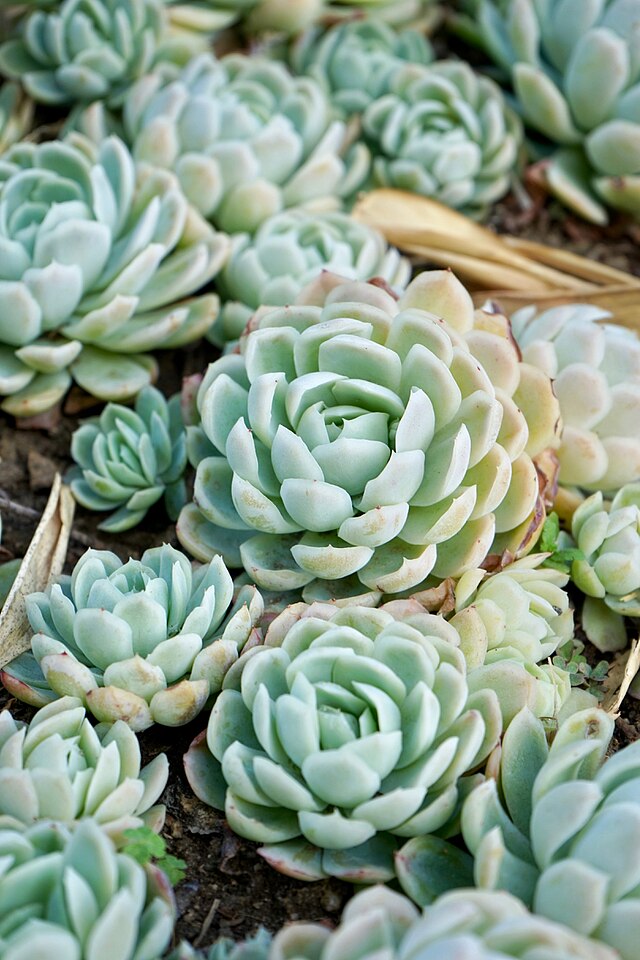
Among succulent propagation methods, leaf propagation is the simplest and most enjoyable. Watching a single leaf grow into a new plant is truly experiencing the miracle of life. However, when you actually try it, you'll notice the success rate is lower than expected. The success rate of leaf propagation is greatly affected by multiple factors: parent selection, timing, potting soil, watering, light, and more. By establishing proper conditions, you can increase the success rate from 50% or less to over 80%. This guide explains, step-by-step, the specific and practical techniques for maximizing the success rate of leaf propagation.
Proper Parent Selection for Leaf Propagation: Health First
The first and most crucial step in determining propagation success is parent selection. Your success depends heavily on which plant you choose and which leaf you harvest. First, check the condition of the parent plant. It's important to harvest leaves from plants that are growing vigorously with good color and luster. Leaves harvested from diseased or nutrient-deficient plants will have significantly lower success rates. In particular, avoid harvesting from plants affected by downy mildew or gray mold. The spores of these diseases cling to leaves and may cause infection when new shoots emerge. Next is the location of the leaf to harvest. Among succulents, the highest success rates come from relatively thick, healthy leaves from the middle to lower portions of the plant. Soft, actively growing leaves from the top of the plant tend to dry out easily and have lower success rates. Conversely, old, thin leaves from the bottom of the plant also struggle because they store less energy.
How you harvest the leaf is equally important. If you forcefully pull a leaf, it may break partway, damaging the root primordium (the cell layer where roots develop). The correct method is to use a knife to cleanly separate the entire leaf at the junction between stem and leaf. During this process, completely preserving the small cell cluster at the leaf base—the heel—greatly influences your success rate.
Post-Harvest Treatment: Drying and Sterilization
First, dry the harvested leaves. This drying process significantly affects your success rate. If you place leaves in soil immediately after harvest, they tend to rot. The correct procedure is to place harvested leaves in a well-ventilated, shaded area for 2–3 days to completely dry the cut surface. You can also gently wipe freshly harvested leaves with tissue and, to prevent bacterial infection, lightly treat them with a diluted benomyl solution (or water mixed with a small amount of wood vinegar) before drying.
Soil for Leaf Propagation: Balancing Drainage and Moisture Retention
The next major factor influencing propagation success is the soil. Standard succulent potting soil drains too well, causing leaves to dry out excessively. Conversely, foliage plant soil retains too much water, making leaves prone to rot. The optimal composition for leaf propagation soil is: 40% akadama (small grain), 20% leaf mold, 20% peat moss, and 20% perlite. This mixture allows leaves to gradually absorb moisture and begin producing new roots. Compared to standard succulent soil, it has higher water retention, keeping leaves from wilting until new roots emerge.
Environmental Conditions for Leaf Propagation: Optimizing Light and Temperature
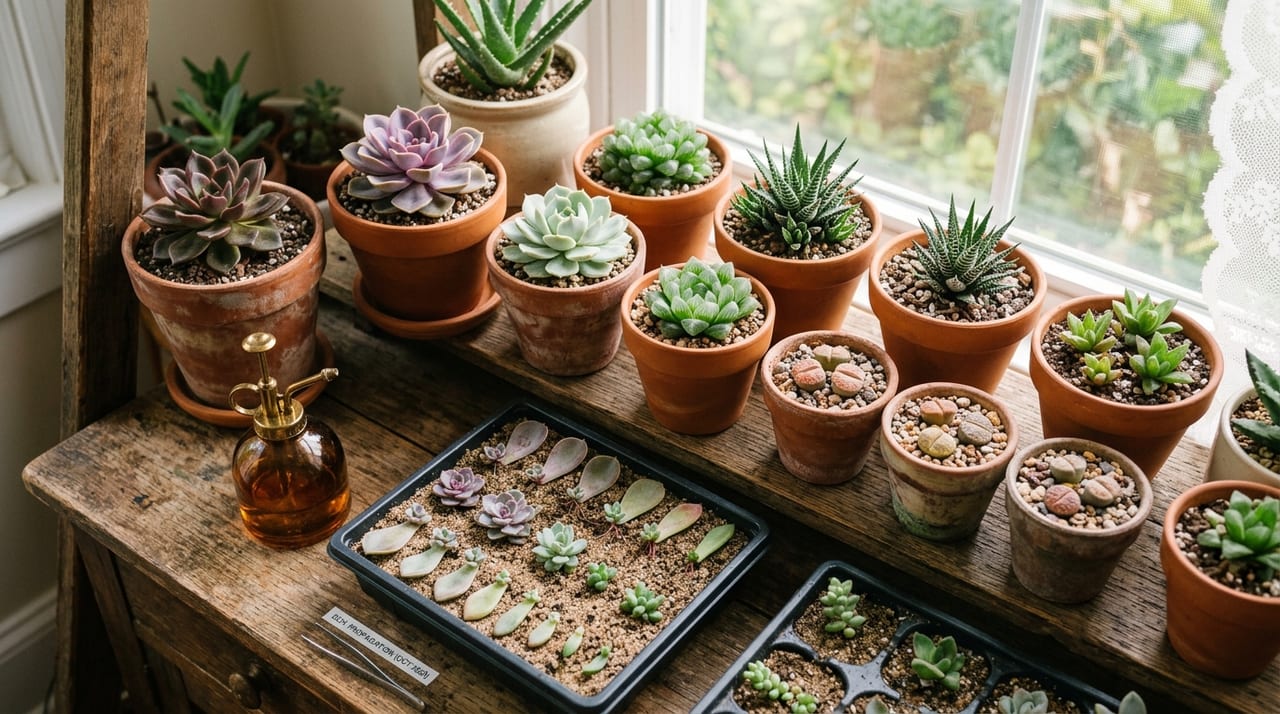
The next major factors affecting success are light and temperature. Many people manage leaf propagation in dark shelving, which is incorrect. Leaf propagation actually thrives in bright conditions. The optimal light environment is bright partial shade, avoiding direct sunlight. Ideal conditions are similar to a south-facing window with a sheer curtain. Under this lighting, root emergence speed doubles and seedlings develop deeper color. When managed on dark shelves, rooting can take 3–4 weeks, but in partial shade, roots begin emerging in 2 weeks. Temperature is equally important. The optimal temperature for leaf propagation is 20–25°C. Within this range, root emergence is fastest.
Watering Timing: 'Less is More' is the Golden Rule
Watering is the most challenging aspect of leaf propagation. Many people frequently water to encourage rooting, which is the primary cause of failure. The correct watering approach is to not water at all for the first week after placing the leaves. During this period, water evaporates from the leaf surface, causing the leaf to gradually shrink and roots to begin emerging from the cut surface. After one week, once the soil surface is slightly dry, begin light misting to lightly dampen the soil.
Optimal Timing for Leaf Propagation: Spring and Fall Have Clear Advantages
Success rates for leaf propagation are heavily influenced by season. Spring (March–May) and fall (September–November) have the highest success rates. Temperatures during these periods are 20–25°C, ideal for rooting. Summer propagation (June–August) suffers because high temperatures cause leaves to dry out through transpiration, lowering success rates. Winter propagation (December–February) nearly halts rooting due to cold, with success rates dropping below 10%.
Echeveria Leaf Propagation: Genus-Specific Tips
Among succulents, Echeveria is the easiest genus for leaf propagation. Under proper conditions, success rates can reach 70–80%. The most critical point for Echeveria leaf propagation is the harvesting technique. For species with larger leaves, such as Echeveria pulvinata and Echeveria laui, completely removing the leaf increases success rates further. Completely preserving the small protuberance at the leaf base—the growth point—is the key to success.
Common Propagation Failures: Causes and Solutions
The main causes of leaf propagation failure are as follows. When leaves rot, it's usually due to overwatering or insufficient air circulation. Manage the soil on the drier side and improve air circulation. When leaves wilt, it may be due to insufficient light or temperatures that are too high. Move them to a partial-shade location with temperatures of 20–25°C.