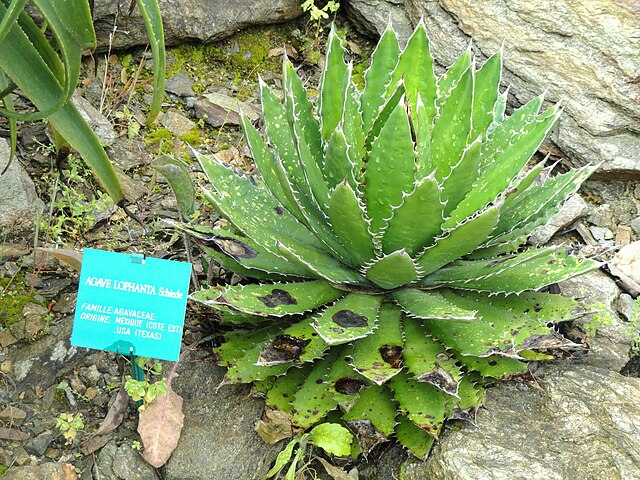
Source: Wikimedia Commons
Agave Lophantha
BeginnerAgave lophantha
An agave with vivid central green and lime green edges. Cold-hardy enough for ground planting.
About
Agave lophantha is a medium-sized species distributed across Tamaulipas, Nuevo León, and Coahuila in Mexico, and extending into southern Texas. Its most eye-catching feature is a bright lime-green to yellow-green central stripe running the length of each dark green leaf, creating a vivid two-tone pattern. This striking variegation gives it strong ornamental appeal, and cultivars such as 'Quadricolor' are widely grown. Pale yellow to white marginal teeth line the leaves, which terminate in a short spine. Mature rosettes reach 40–70 cm in diameter. Growth rate is moderate, and the species is generally easy to cultivate. Full sun produces the most vivid leaf coloration. Water when the soil dries; avoid overwatering. Cold hardiness is relatively good, reportedly surviving down to -5°C to -8°C, allowing outdoor year-round cultivation in warmer parts of Japan. Its attractive patterning, ease of care, and moderate cold tolerance make it a strong recommendation for agave beginners.
Basic Info
Origin
Tamaulipas, Nuevo León, Coahuila (Mexico); Texas (USA)
Lifespan
Perennial (15-25 years)
Size
30-60cm
Temperature
5〜40℃
Watering & Fertilizer
Minimal
Growing Tips
Coloration
二色の葉が非常に鮮やか
Temperature
耐寒性が比較的高い(-5℃程度)
Growth
成長が比較的早い
Breeding
子株で旺盛に増える
Housing
地植えでも鉢植えでもOK
Agave Lophantha FAQ
QWhat is the growing difficulty level for Agave Lophantha?
Beginner. A variety suitable for beginners. No special equipment or experience is required—you can grow it without problems by setting up a basic cultivation environment.
QWhat is the ideal temperature for Agave Lophantha?
The ideal temperature for Agave Lophantha is 5〜40℃. Avoid sudden temperature changes and maintain a stable environment.
QWhat is the lifespan of Agave Lophantha?
The average lifespan of Agave Lophantha is Perennial (15-25 years). With proper cultivation environment and nutrient management, you can keep it healthy for a long time.
QHow large does Agave Lophantha get?
The mature size of Agave Lophantha is 30-60cm. This may vary slightly depending on cultivation environment and individual differences.
QHow should I water and fertilize Agave Lophantha?
Agave Lophantha: watering & fertilizer — Minimal. Aim for appropriate frequency and amount.
QWhat is the typical price for Agave Lophantha?
The price of Agave Lophantha varies significantly by variety, characteristics, size, and lineage. Please check ボタちょく's price guide for the latest market information.
Last updated: June 24, 2026
Growing Specifications
- USDA Zone
- 8–10
References & Sources
Edited & verified by: BoTachoku Editorial Team
The classifications, regulations, and growing data on this page are created and verified based on the primary information database below.
Taxonomy & Authority
Regulations & Conservation Status
Sources: CITES Appendices (List of species protected by CITES Appendix II) / 環境省 特定外来生物一覧 (Agave 非該当を確認)
Regulations may change. Always verify the latest information with the relevant authorities.
Related Species
Agave Lophantha Listings
Find listings for this species
Related Articles
Guide to Agave Individual Grade & Quality Assessment | Quality Evaluation Points That Determine Market Price
An explanation of evaluation criteria for discerning individual differences in agave plants. This guide summarizes key points to know before purchasing, from checkpoints for spines, color, growth point, and root development to estimated market prices.
Agave Propagation Methods | Practical Guide to Offsets, Pup Division, and Seed Sowing
A comprehensive guide to three primary methods for agave propagation. This article explains the procedures for offset propagation, pup division, and seed sowing, covering success factors and variety-specific selection criteria from a professional perspective.
Growth Acceleration Strategy for Large Agave Plants | Fertilization, Light, Temperature, and Repotting Timing
Maximizing the growth of large agave plants requires strategically optimizing four key elements: fertilization, light, temperature, and repotting. A growth rate 3 to 5 times faster than normal is achievable within one year.
Outdoor Environment Setup for Large Agave Species and In-Ground Installation Strategies for Oversized Varieties
Challenges in Large Agave Cultivation and the Importance of Outdoor Environments Among Agave species, large varieties that exceed one meter at maturity (such as Agave titanota and Agave parry) captivate many plant enthusiasts with their imposing presence and visual impact. However, as size increases, indoor management becomes increasingly difficult, making the transition to outdoor cultivation essential. Outdoor environments require more than simply "securing land"—they demand a complex system encompassing wind-resistant anchoring methods, efficient drainage, and seasonal adaptation strategies. This article explains practical, concrete methods for setting up outdoor environments to safely and healthily cultivate large Agaves.