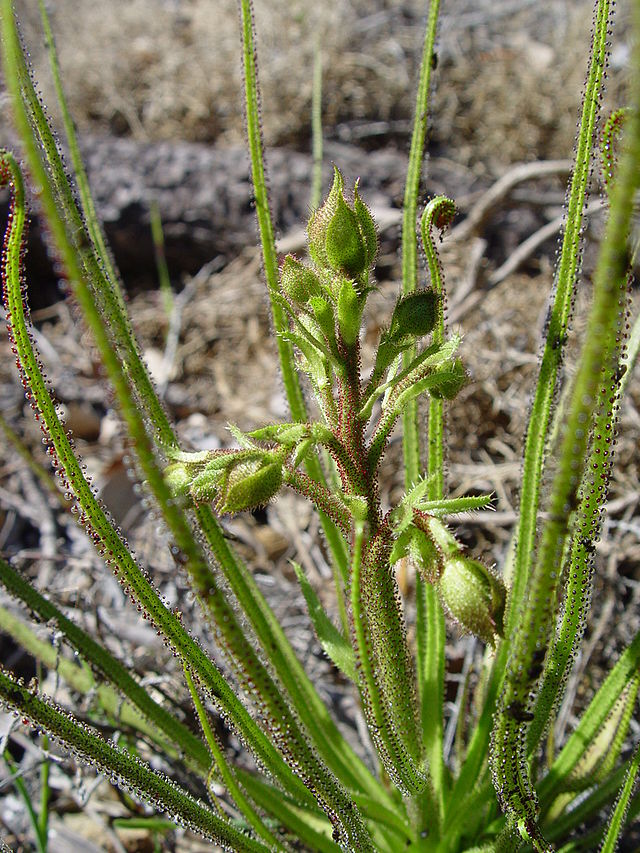
Source: Wikimedia Commons
Drosophyllum Lusitanicum
AdvancedDrosophyllum lusitanicum
A rare carnivorous plant from dry areas, attracting insects with honey-like sweet scent. Dislikes transplanting.
About
Drosophyllum lusitanicum, the dewy pine or Portuguese sundew, is a remarkable carnivorous plant that defies the typical carnivore association with wetlands: it grows naturally in dry, calcareous scrub and rocky garrigue of southern Portugal, southwestern Spain, and northern Morocco, in well-drained, alkaline soils with a Mediterranean climate. It attracts insects with a powerful honey-like fragrance and traps them on the glandular, mucilaginous tentacles covering its long, pine-needle-like leaves—the 'dewy' shimmer of these giving rise to its common name. Cultivation is contrary to most carnivorous plants: it requires sharply drained, alkaline mineral media (coarse sand, perlite, limestone chips), watering only when the substrate approaches dryness, no tray watering, excellent air circulation, and full direct sun. It is extremely sensitive to root disturbance and should ideally be grown from seed sown directly in its final container.
Lifespan of the Drosophyllum Lusitanicum
The Drosophyllum Lusitanicum lives 3-5 years.
Size of the Drosophyllum Lusitanicum
The Drosophyllum Lusitanicum grows to 20-40cm.
Basic Info
Origin
Southern Portugal, southwestern Spain, and northern Morocco, dry calcareous scrubland and rocky garrigue
Lifespan
3-5 years
Size
20-40cm
Temperature
10〜30℃
Humidity
60〜90%
Watering & Fertilizer
Insects (auto-capture)
Growing Tips
Light & Placement
Strong direct sun and good airflow are essential. Grow it on the dry side in a breezy, sunny spot.
Watering
Unlike most carnivorous plants, water only after the medium has dried. Tray watering is strictly forbidden.
Soil & Repotting
Use a well-drained, slightly alkaline sandy mix of sand, perlite and limestone powder. It strongly resents transplanting, so do not repot.
Propagation
It is normally raised from seed. Because it dislikes transplanting, sow seed directly into its final pot.
Pests & Cautions
Overwatering and poor airflow are the main causes of failure. Treating it like a bog-type carnivorous plant will kill it.
Drosophyllum Lusitanicum FAQ
QWhat is the growing difficulty level for Drosophyllum Lusitanicum?
Advanced. A variety suitable for advanced growers. Requires advanced cultivation techniques and specialized equipment, with careful environmental adjustments needed.
QWhat is the lifespan of Drosophyllum Lusitanicum?
The average lifespan of Drosophyllum Lusitanicum is 3-5 years. With proper cultivation environment and nutrient management, you can keep it healthy for a long time.
QHow large does Drosophyllum Lusitanicum get?
The mature size of Drosophyllum Lusitanicum is 20-40cm. This may vary slightly depending on cultivation environment and individual differences.
QHow should I water and fertilize Drosophyllum Lusitanicum?
Drosophyllum Lusitanicum: watering & fertilizer — Insects (auto-capture). Aim for appropriate frequency and amount.
QWhat is the typical price for Drosophyllum Lusitanicum?
The price of Drosophyllum Lusitanicum varies significantly by variety, characteristics, size, and lineage. Please check GrowerDirect's price guide for the latest market information.
Last updated: September 17, 2026
References & Sources
Edited & verified by: GrowerDirect Editorial Team
The classifications, regulations, and growing data on this page are created and verified based on the primary information database below.
Taxonomy & Authority
Accepted name: Drosophyllum lusitanicum (L.) Link
Synonyms: Spergula droseroides Brot., Rorella lusitanica (L.) Raf., Spergulus droseroides Brot. ex Steud., Drosera lusitanica L.
Authority databases: GBIF · POWO · ICPS cultivar registration (International Carnivorous Plant Society)
Nomenclature follows global taxonomic authority databases.
Regulations & Conservation Status
This genus is not listed in CITES Appendices (among carnivorous plants, only Nepenthes/Sarracenia/Dionaea are subject to CITES).
Sources: CITES Appendices (carnivorous plants) - ICPS/Barry Rice / CITES & Carnivorous Plant Checklist (RBG Kew)
Regulations may change. Always verify the latest information with the relevant authorities.
Related Species
Find listings for this species
Related Articles
Guide to Growing Drosophyllum lusitanicum: A Rare Carnivorous Plant Thriving in Mediterranean Dry Regions
Characteristics and care guide for Drosophyllum lusitanicum, a xerophytic carnivorous plant. Explains soil composition, watering, and repotting considerations.
Carnivorous Plant Dormancy Awakening Guide | Correct Timing for Resuming Feeding, Fertilizing, and Watering
A step-by-step guide to the correct timing for resuming watering, restoring humidity, feeding, and fertilizing as your carnivorous plants emerge from dormancy and enter spring growth.
Why Carnivorous Plant Traps Fail and How to Fix Them | Optimizing Humidity, Nutrition, and Prey-Capture Systems
Investigate why carnivorous plant traps fail to capture insects. From humidity management to nutrient balance, gland secretion function, and dormancy, a detailed scientific approach to restoring trap function.
A Guide to Giving Carnivorous Plants as Gifts | How to Choose Unique Presents and Tips for Long-Term Enjoyment
A guide to selecting carnivorous plants as gifts. Covers how to choose varieties based on the recipient's type, and important care tips to communicate before gifting, such as water quality and dormancy periods.
Can't find the plant you're looking for?
Post your wishes for free and growers with matching plants will contact you with introductions.