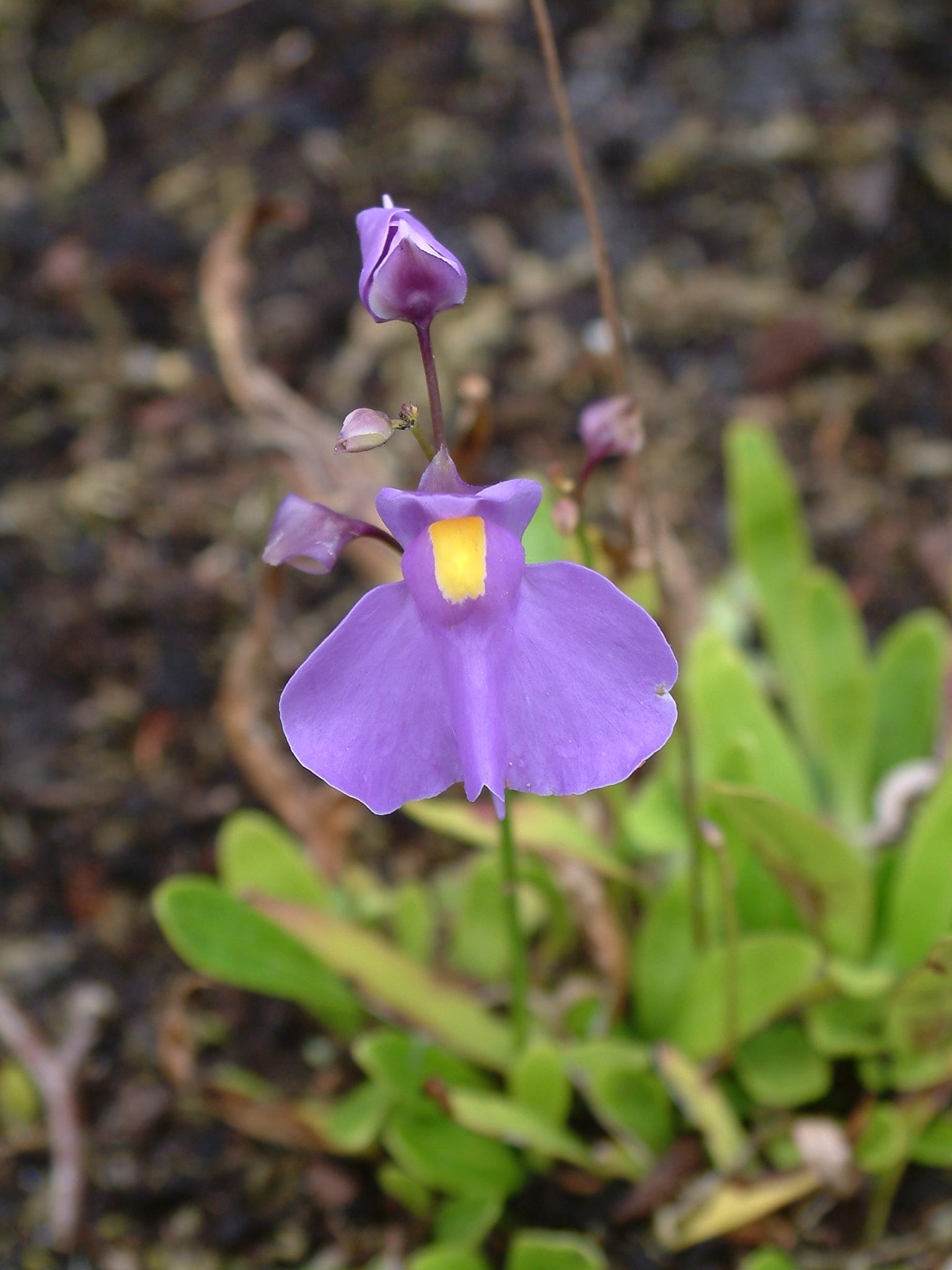
Source: Wikimedia Commons
Utricularia longifolia
BeginnerUtricularia longifolia
A large bladderwort from rocks in Brazil's Atlantic Forest. It grows the longest leaves in the genus and bears flowers large enough to be mistaken for orchids. One of the easier tropical species to grow.
About
Utricularia longifolia is a perennial bladderwort endemic to Brazil, described by George Gardner in 1842 from Pedra Bonita, about 50 km north of Rio de Janeiro. Its range lies in the Atlantic Forest (Mata Atlântica), over 90% of which has been lost to development, with the rest fragmented. It grows on rocks among Sphagnum and rarely among grasses, a terrestrial to lithophytic species. Small bladder traps below ground catch minute soil organisms, while what shows above ground are leaves. It makes the longest leaves in the genus: Peter Taylor's monograph describes them as sometimes over 1 m long and 4.5 cm wide, although in cultivation they are usually about 10-20 cm. The flowers are large and, in bloom, impressive enough to be mistaken for orchids. Clones in cultivation include a short-leaved plant, a white-flowered form and plants called var. forgetiana. Formerly placed in section Psyllosperma, it is now included in section Foliosa. In Japan it is sold by general online retailers as a member of the bladderwort group. It is not fussy about the growing medium and is among the easier tropical bladderworts to grow.
Source: Wikipedia (CC BY-SA 4.0)
Size of the Utricularia longifolia
The Utricularia longifolia grows to Leaves about 10-20 cm in cultivation (over 1 m in the wild at times).
Basic Info
Origin
Brazil (Atlantic Forest)
Lifespan
Perennial
Size
Leaves about 10-20 cm in cultivation (over 1 m in the wild at times)
Temperature
10〜30℃
Humidity
60〜90%
Watering & Fertilizer
No fertilizer (catches tiny organisms with underground bladders)
Growing Tips
Light & Placement
Grow in a bright room, greenhouse or terrarium. It is usually grown as a terrestrial plant, but can also be grown epiphytically or semi-aquatic.
Watering
Keep the mix constantly moist; the pot can stand in a little water. Use rain water or other water low in dissolved minerals.
Soil & Repotting
Grows in pure sphagnum or a 1:1 peat and sand mix; it likes free drainage and is not fussy about the medium.
Temperature & Overwintering
A tropical species; keep it in a warm room in winter, away from the cold.
Fertilizer
Do not add fertilizer to the soil; too much fertilizer can kill it.
Propagation
Remove half the soil and plants from the pot and replant them in fresh mix to get two pots. Left alone for too long it declines, so renew it now and then.
Utricularia longifolia FAQ
QWhat is the growing difficulty level for Utricularia longifolia?
Beginner. A variety suitable for beginners. No special equipment or experience is required—you can grow it without problems by setting up a basic cultivation environment.
QHow large does Utricularia longifolia get?
The mature size of Utricularia longifolia is Leaves about 10-20 cm in cultivation (over 1 m in the wild at times). This may vary slightly depending on cultivation environment and individual differences.
QHow should I water and fertilize Utricularia longifolia?
Utricularia longifolia: watering & fertilizer — No fertilizer (catches tiny organisms with underground bladders). Aim for appropriate frequency and amount.
QWhat is the typical price for Utricularia longifolia?
The price of Utricularia longifolia varies significantly by variety, characteristics, size, and lineage. Please check GrowerDirect's price guide for the latest market information.
Last updated: September 23, 2026
References & Sources
Edited & verified by: GrowerDirect Editorial Team
The classifications, regulations, and growing data on this page are created and verified based on the primary information database below.
Primary sources
- Wikipedia
- Ministry of the Environment, Japan: list of Invasive Alien Species (Utricularia requires a species-name certificate on import)
- ICPS Growing Guide: Genlisea and terrestrial Utricularia
- University of Reading Tropical Biodiversity: Utricularia longifolia
- The Carnivorous Plant FAQ (B. Rice): Utricularia section Foliosa
- GBIF
Taxonomy & Authority
Accepted name: Utricularia longifolia Gardner
Authority databases: GBIF · GBIF Utricularia longifolia Gardner
Nomenclature follows global taxonomic authority databases.
Regulations & Conservation Status
Not listed under CITES. Because the genus Utricularia includes designated Invasive Alien Species in Japan, any Utricularia imported into Japan must be accompanied by a species-name certificate. No paperwork is needed to buy or grow plants already in domestic trade.
Regulations may change. Always verify the latest information with the relevant authorities.
Related Species
Find listings for this species
Related Articles
How to Grow Utricularia: Cultivation Methods by Aquatic and Terrestrial Types
We explain how to grow Utricularia by aquatic and terrestrial types. We provide detailed information on the mechanism of traps (bladders), recommended varieties, soil and watering management methods, and tips for getting plants to bloom.
Why Carnivorous Plant Traps Fail and How to Fix Them | Optimizing Humidity, Nutrition, and Prey-Capture Systems
Investigate why carnivorous plant traps fail to capture insects. From humidity management to nutrient balance, gland secretion function, and dormancy, a detailed scientific approach to restoring trap function.
A Guide to Giving Carnivorous Plants as Gifts | How to Choose Unique Presents and Tips for Long-Term Enjoyment
A guide to selecting carnivorous plants as gifts. Covers how to choose varieties based on the recipient's type, and important care tips to communicate before gifting, such as water quality and dormancy periods.
Developing Nepenthes Pitcher Traps Completely: Cultivation Secrets Through Environmental Management and Physiological Approaches
The carnivorous leaves of Nepenthes represent the masterpiece of an insect-trapping mechanism evolved over 200 million years. This article explains how to mature the carnivorous leaves completely and develop healthy plants with actual predatory function through humidity, light, and nutrient management.
Can't find the plant you're looking for?
Post your wishes for free and growers with matching plants will contact you with introductions.